

Commentary
Maria Lipman
{
  "authors": [
    "Maria Lipman"
  ],
  "type": "commentary",
  "centerAffiliationAll": "",
  "centers": [
    "Carnegie Endowment for International Peace",
    "Carnegie Russia Eurasia Center"
  ],
  "collections": [],
  "englishNewsletterAll": "",
  "nonEnglishNewsletterAll": "",
  "primaryCenter": "Carnegie Russia Eurasia Center",
  "programAffiliation": "",
  "programs": [],
  "projects": [],
  "regions": [
    "Russia",
    "Eastern Europe",
    "Ukraine"
  ],
  "topics": [
    "Political Reform",
    "Democracy",
    "Foreign Policy",
    "Civil Society"
  ]
}
Source: Getty
Nation-building in Ukraine is a formidable task, its divided nation also a hurdle to a democratic development. Still, Ukraine seems to have a better chance of evolving as a democracy than Russia.
“Our spiritual unity is so strong that it is not subject to any action by any authority: neither government authorities, nor, I would even go so far as to say, church authorities,” this was how President Vladimir Putin referred to the ties between Russia and Ukraine, speaking in Kiev this summer at the celebration of the 1025th anniversary of the Christianization of the Kievan Rus. Well, these days this certainly sounds like an underestimation of what government authorities can do. Russia’s hard pressure and unambiguous threats to cripple Ukrainian economy; heavily slanted broadcasting by the Russian television of the developments in Ukraine, in full contempt of those hundreds of thousands Ukrainians (and their numerous sympathizers) who took to the streets in Ukrainian cities; the Russian president’s own rhetoric—as he referred to the Ukrainian protests as a “pogrom” and suggested that they had been incited from abroad—all are bound to take a heavy toll on the “firm foundation for Russian-Ukrainian friendship” emphasized by Putin, and to systematically diminish whatever “spiritual unity” there actually exists.
Shared history, remote as well as recent, geographic proximity, linguistic and ethnic affinity as well as Orthodox Christianity undoubtedly bring the two nations together. Elements of the Soviet legacy are strongly felt both in Russia and Ukraine—in political patterns, power and property entanglement, informal patron-client relations that supersede formal institutions, etc.
But obvious similarities notwithstanding, politics, state-society relations and some of the public perceptions in Ukraine are unlike those of its eastern neighbor.
After the collapse of the Soviet Union, Russia evolved as its successor state albeit a smaller and weaker one. Ukraine, on the other hand, gained status since it declared independence in August 1991 (just before the Soviet Union collapsed). Ukraine has celebrated this gain in status (just like other ex-Soviet states celebrate theirs) as its Day of Independence, a major national holiday, ever since.
As a successor to the Cold War superpower, Russia bears an imperial legacy and feels the urge to assert itself as a special nation, with its own sphere of influence and a status of a major international player. Ukraine does not have any such ambition. While it shares some of Russia’s Soviet legacy, Ukraine does not bear the burden of its imperial one. Nor does Ukraine have Russia’s obsession with “sovereignty;” many in Ukraine favor a rapprochement with Europe, even with no conceivable prospect of becoming an EU member.
Ukraine did not have the brutalizing experience of Russia’s Chechen wars; unlike Russia it does not face the tough challenge of ethnic diversity associated with tensions and even violence—both differences arguably contribute to a generally softer social atmosphere in Ukraine.
Russia is no longer an empire but not a nation state either—its statehood remains undefined and is still best described in “post-” terms, such as “post-communist” or “post-imperial.” Ukrainian post-communist nationhood is not without a problem either: it is a nation state with its nation divided. Russia’s uncertain national identity enabled Putin to hold back public participation and draw on habitual paternalism. He reestablished a political monopoly, a heavily centralized governance, and the state dominance over the people. In Ukraine the divisions between, roughly speaking, the “East” and the “West” preclude a political monopoly—Ukrainian politics may be messy but it is certainly competitive.
A Ukrainian president cannot aspire to become a Putin-style “leader-of-no-alternative,” or rid himself of political rivals. Viktor Yanukovych locked up in prison his archrival Yulia Tymoshenko, but even this radical move failed to keep him unchallenged or uncontested.
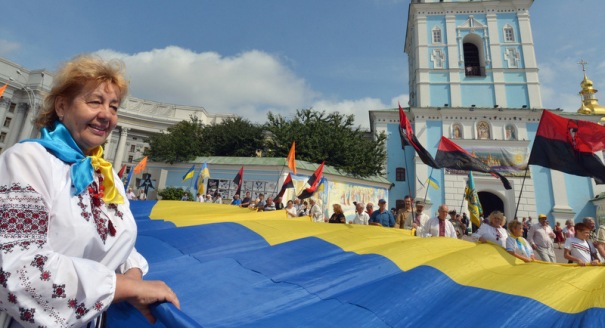
In the Russian monopolized political environment, “patriotism” too is monopolized by the Kremlin. In Putin’s Russia—as in the Soviet Union—patriotism implies the infallibility of the state and the loyalty to the supreme ruler; those who dare challenge either are deemed unpatriotic and “un-Russian” (in the USSR the term was “anti-Soviet”). My tebya nauchim rodinu lyuibit' (we’ll teach you to love your motherland)—was a common threat in the Soviet Gulag. In Ukraine hundreds of thousands rallying against Viktor Yanukovych have national colors painted on their faces and sing the national anthem. (In Russia singing the anthem may be prescribed by the government, but hardly happens spontaneously). Yanukovych has no way or authority to deny his opponents a sense of righteous patriotism. They are just as legitimate as his supporters are. And his Party of Regions faces real, not “systemic” opposition in the Rada.
By the same token, the “East” is as much a legitimate part of Ukraine as the “West” is, the latter having more in common with Ukraine’s western neighbors than with Russia, down to the perception of Russia itself as a former occupant, however unpleasant and unfair this may sound to the citizens of Russia. Whatever Putin may say about “common roots” and “spiritual unity” of the Ukrainians and the Russians who “did a lot together in the previous century,” many in western Ukraine do not share the Russian perception of the WWII—the key element of Russia’s collective memory of the 20th century. May 9 may be celebrated by a majority in Ukraine as the Day of Victory (yet even these Ukrainians still have a distinct Ukrainian national identity), but in the Lvov region May 9 is a Memorial Day, its meaning being anything but national triumph.
Even the Ukrainian Orthodox church cannot play the same role in Ukraine as it does in Russia, where it is the state’s reliable ally readily sharing its own symbolic authority with the government. In Ukraine the government cannot count on the Orthodox Church’s loyalty, in the very least because the Church too is divided between Moscow and Kiev church authorities.
Russia’s uncertainty over its national identity holds back its sociopolitical development and prevents Russia from taking a democratic path. Nation-building in Ukraine is a formidable task, its divided nation also a hurdle to a democratic development. Still, Ukraine seems to have a better chance of evolving as a democracy—if gradually the “East” and the “West” can be brought closer together, the country’s politics, instead of being a succession of crises, might take a more constructive pattern. Ukraine may return to a more democratic, parliamentary system. As European experience shows, a nation state is a prerequisite of democracy. But European history has cautionary lessons too: building a nation state is not without a risk and on this path nationalism not infrequently tramples democracy.
Former Scholar in Residence, Society and Regions Program, Editor in Chief, Pro et Contra, Moscow Center
Lipman was the editor in chief of the Pro et Contra journal, published by the Carnegie Moscow Center. She was also the expert of the Carnegie Moscow Center’s Society and Regions Program.
Recent Work
Maria Lipman
Maria Lipman
Carnegie does not take institutional positions on public policy issues; the views represented herein are those of the author(s) and do not necessarily reflect the views of Carnegie, its staff, or its trustees.

The European Commissioner for Trade is headed to China. But after President Xi’s bridge-building visit to Washington, can a more isolated EU overcome Beijing’s stranglehold on critical raw materials? Who will blink first?

Rym Momtaz, ed.

European NATO countries are wrestling with the possibility of U.S. disengagement from the alliance. With the continent’s security increasingly uncertain, governments must restore the credibility of their collective defense.



Hans-Dieter Lucas, Adam Thomson, Pierre Vimont

The domestic impacts of how long it is taking to end the war in Ukraine have pushed the French electorate to the political extremes and compromised the country’s diplomatic capacity.
Rym Momtaz

Before the next wave of EU enlargement takes place, the union needs to grapple with thorny questions of how power is distributed among its members.


Emil Sondaj Hansen, Ditte Brasso Sørensen

The new U.S.–Denmark–Greenland agreement will help Washington exert political, economic, and financial dominance under the guise of security. Yet, it acknowledged Copenhagen’s and Nuuk’s sovereignty on the island.

Marc Pierini