

Commentary
Dmitri Trenin
{
  "authors": [
    "Dmitri Trenin"
  ],
  "type": "commentary",
  "centerAffiliationAll": "",
  "centers": [
    "Carnegie Endowment for International Peace",
    "Carnegie Russia Eurasia Center"
  ],
  "collections": [],
  "englishNewsletterAll": "",
  "nonEnglishNewsletterAll": "",
  "primaryCenter": "Carnegie Russia Eurasia Center",
  "programAffiliation": "",
  "programs": [],
  "projects": [
    "Eurasia in Transition"
  ],
  "regions": [
    "South Asia",
    "Afghanistan",
    "Russia"
  ],
  "topics": [
    "Security",
    "Military",
    "Foreign Policy"
  ]
}
Source: Getty
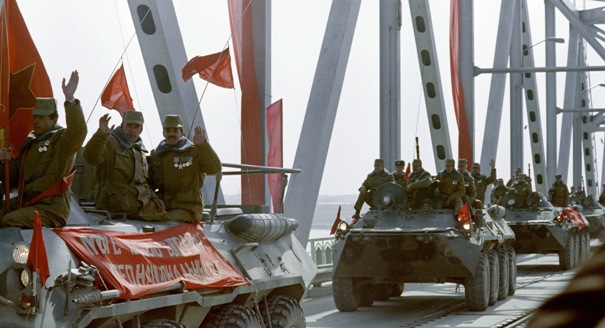
Twenty-five years after the Soviet pullout from Afghanistan, the Russians watch the U.S.-led coalition withdraws from this country and worry about regional stability, security, and drugs production and trade. To deal effectively with these concerns, Russia should focus not so much on Afghanistan as on its Central Asian neighbors.
Twenty-five years after the Soviet pullout from Afghanistan, that ten-year-long war still aches in Russia. Remembered are first of all the 15,000 servicemen who never made it back home alive. Remembered are also the mistakes and miscalculations of the Soviet leadership who sent them there. There is still no authoritative historical account of the war, with much of the archival material still off limits to researchers, but the discussion is candid and frequently controversial.
The Soviet campaign in Afghanistan was modern Russia's first brush with militant Islam. When it began, few Soviet ideologues understood the power of Muslim religion. This cost the Soviet army dearly. As the Soviet Union prepared to withdraw, it was seized by what was dubbed "Afghan syndrome," that is acute awareness of the futility of a fight against foreign populations, and particular unwillingness to engage Muslims as enemies. As the 40th Soviet army crossed the Amu Darya River back into the USSR in February 1989, the motto in Moscow sounded, "Afghanistan—Never Again!"
In reality, in the quarter-century that has elapsed since then, Russian soldiers have had mainly Muslim militants for enemies: in Tajikistan, Chechnya, and Dagestan. This time, it was not as a result of some misguided decisions taken at the Kremlin, but as a consequence of the dissolution of the Soviet Union itself. As a result, Russia had more lessons to learn. These were less about war-fighting than about counter-insurgency, counter-terrorism, and deal-making.
Now, as the Russians watch the U.S.-led international coalition withdraws from Afghanistan without accomplishing the lofty goal of modern nation-building, some of them experience a sort of Schadenfreude. Many more, however, and this includes the country's political, security and military leadership, are worried. Their concerns are about what follows in Afghanistan and what effect it might have on stability in Central Asia and the security situation in the North Caucasus.
There is no question that Russia will have to engage more in Afghanistan. It will not, of course, send in military forces or seek to impose a friendly regime in Kabul: these lessons have been learnt. There is equally little appetite for economic investment. Rather, Moscow will keep contacts with all Afghan parties of any significance; it will maneuver in the difficult diplomatic terrain of South, Central and Western Asia; and it will stay in touch with Washington even as U.S. presence in the region shrinks. Thus, Russia's future engagement in Afghanistan is likely to stay limited.
To deal effectively with its concerns about regional stability, security, and drugs, Russia should focus not so much on Afghanistan as on its Central Asian neighbors. It needs to develop a better understanding of the political transitions in the area's two principal countries, Kazakhstan and Uzbekistan; it needs to enhance its security cooperation with the two smaller states, Kyrgyzstan and Tajikistan; and it should move more resolutely against regional drugs production and trade, which kill twice as many Russians per year as were killed in the entire 10-year period of the Soviet Union's war in Afghanistan.
Former Director, Carnegie Moscow Center
Trenin was director of the Carnegie Moscow Center from 2008 to early 2022.
Recent Work
Dmitri Trenin
Dmitri Trenin
Carnegie does not take institutional positions on public policy issues; the views represented herein are those of the author(s) and do not necessarily reflect the views of Carnegie, its staff, or its trustees.

The EU can impose sanctions but struggles to enforce them without the United States. With Washington increasingly disinterested in backing European interests, the bloc must now fend for itself.


Nicu Popescu, Tiago Antunes

Russia is testing the waters of NATO’s mutual defense clause. What do strikes in Romanian territorial waters mean for the alliance’s posture toward Moscow?

Dimitar Bechev

With its public finances in shambles, the far right polling at 35 percent ahead of the 2027 presidential election, and a growing protest movement, is France’s crisis a threat to the EU’s geopolitical awakening?

Rym Momtaz, ed.

Ahead of a tough winter for Ukraine, Donald Trump’s swing back toward Russia bodes ill. But instead of panicking, Kyiv’s European allies are focusing on action.
Rym Momtaz

Funding Ukraine remains a priority for European leaders. As Russia’s war of aggression heads into another winter, two feasible options to mobilize support for Kyiv should be fast-tracked.


Vladyslav Rashkovan, Gregory P. Wilson