

Commentary
The EU can impose sanctions but struggles to enforce them without the United States. With Washington increasingly disinterested in backing European interests, the bloc must now fend for itself.
Nicu Popescu, Tiago Antunes
{
  "authors": [
    "Akio Kawato"
  ],
  "type": "commentary",
  "centerAffiliationAll": "",
  "centers": [
    "Carnegie Endowment for International Peace",
    "Carnegie Russia Eurasia Center"
  ],
  "collections": [],
  "englishNewsletterAll": "",
  "nonEnglishNewsletterAll": "",
  "primaryCenter": "Carnegie Russia Eurasia Center",
  "programAffiliation": "",
  "programs": [],
  "projects": [],
  "regions": [
    "East Asia",
    "China",
    "Japan",
    "Russia",
    "Eastern Europe",
    "Ukraine"
  ],
  "topics": [
    "Political Reform",
    "Security",
    "Global Governance",
    "Foreign Policy"
  ]
}
Source: Getty
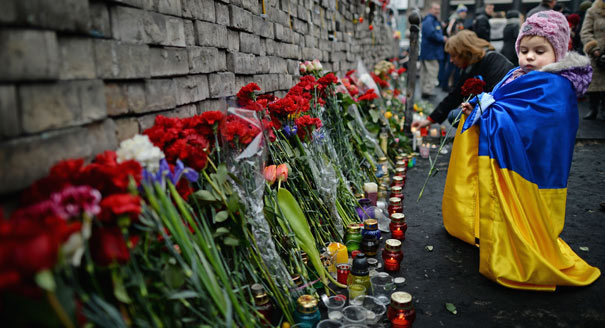
The Ukrainian events develop rapidly with a great sense of alarm; it not only involves danger of terrorism in Moscow, but also entails a big risk for East Asia. The main question now is who would be ready to take charge of the situation.
I am now in Moscow by chance and watch how things rapidly develop around Ukraine with a great sense of alarm; it not only involves danger of terrorism in Moscow, but also entails a big risk for East Asia. Seeing that the hands and the eyes of the big powers are tied to Europe and the Middle East, the big brother in East Asia may well feel tempted to embark upon military adventures vis-à-vis its neighbors. Therefore, before Russia, Ukraine, and the West become totally overwhelmed by their negative emotions and stereotypes to each other; let us make some effort to find out the real picture in Ukraine.
The whole game started with President Viktor Yanukovych’s mal-calculated and ill-performed game to obtain easy money from the EU with signing of the Association Agreement as bait. The EU did not give in, and then Yanukovych flip-flopped toward Russia, thus awaking the opposition movement. Those Ukrainian oligarchs, the sponsors of Yanukovych’s government (Ukraine is like Russia in mid 1990s, where oligarchs monopolized politics), probably did everything to insure their power against the liberals. It may be they who facilitated the recruitment of the “rightists” from all over Ukraine. The rightists are known for their anti-Semitism and strong Russophobia, so if they mingle with the liberals, the opposition movement as a whole would be discredited in the eyes of both Russia and the West.
Now the rightists have gone out of control of their sponsors; they stay in the capital, looking for means for survival and enrichment. To make themselves noticed they play a strongly anti-Russian card. The harsher their tone becomes, the more alarmed the Russians feel; they have been integral and legitimate part of the Ukrainian society. Yanukovych’s reckless act has thus awoken all ethnic emotions and greedy calculations in Ukraine, throwing this country into an abyss of anarchy.
And then a question arises; who’d be ready to take charge of it? Is the EU really ready to take care of the Western half of Ukraine and the Crimean Tatars, if they desire to segregate from the Russian part? Are the Ukrainian oligarchs ready for division of their country into parts? Will the people of Ukraine really want it? I believe that the West and Russia should cooperate to reestablish the old or a new status quo with IMF’s help. Japan may well take part in it (indeed she took a substantial part in the previous undertaking), and China, which is not fond of “separatism” by default, may take part, too.
Emotions and stereotypes should not prevail. The stakes are high. Any politician who plays on the situation will be held accountable at next elections, or even in history.
Akio Kawato
Writer
Akio Kawato is a former Japanese diplomat and blogger.
Carnegie does not take institutional positions on public policy issues; the views represented herein are those of the author(s) and do not necessarily reflect the views of Carnegie, its staff, or its trustees.

The EU can impose sanctions but struggles to enforce them without the United States. With Washington increasingly disinterested in backing European interests, the bloc must now fend for itself.


Nicu Popescu, Tiago Antunes

Russia is testing the waters of NATO’s mutual defense clause. What do strikes in Romanian territorial waters mean for the alliance’s posture toward Moscow?

Dimitar Bechev

With its public finances in shambles, the far right polling at 35 percent ahead of the 2027 presidential election, and a growing protest movement, is France’s crisis a threat to the EU’s geopolitical awakening?

Rym Momtaz, ed.

Ahead of a tough winter for Ukraine, Donald Trump’s swing back toward Russia bodes ill. But instead of panicking, Kyiv’s European allies are focusing on action.
Rym Momtaz

Funding Ukraine remains a priority for European leaders. As Russia’s war of aggression heads into another winter, two feasible options to mobilize support for Kyiv should be fast-tracked.


Vladyslav Rashkovan, Gregory P. Wilson