

Commentary
Judy Dempsey
{
  "authors": [
    "Judy Dempsey"
  ],
  "type": "legacyinthemedia",
  "centerAffiliationAll": "dc",
  "centers": [
    "Carnegie Endowment for International Peace",
    "Carnegie Europe"
  ],
  "collections": [
    "Transatlantic Cooperation"
  ],
  "englishNewsletterAll": "ctw",
  "nonEnglishNewsletterAll": "",
  "primaryCenter": "Carnegie Europe",
  "programAffiliation": "EP",
  "programs": [
    "Europe"
  ],
  "projects": [],
  "regions": [
    "Europe",
    "North America",
    "United States",
    "Western Europe",
    "Iran"
  ],
  "topics": [
    "Foreign Policy",
    "Security"
  ]
}
Source: Getty
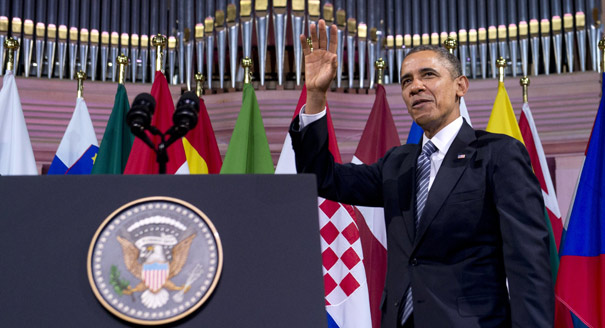
During his trip to Europe, U.S. President Barack Obama has tried to rally his European counterparts to form a united front against Moscow’s annexation of Crimea.
Source: Public Radio International
President Obama's trip to Europe this week has been all about Russia — and rallying European allies to form a united front against Moscow's annexation of Crimea.
During a visit to a US war cemetery in Belgium on Wednesday, Obama felt the need to remind Europeans that "freedom isn't free." He urged them to reverse cuts in their national defense spending. He also warned Russia not to think about further annexation of territory. But it's been heavy going.
Judy Dempsey calls it "very nice rhetoric." She is a senior associate in Europe with the Carnegie Endowment for International Peace. “[He's] trying to rally the troops — literally. Trying to rally NATO to spend more on defense, and trying to rally the Europeans and strengthen their backbone when it comes to Russia.”“But,” she adds, “I’m not sure this rhetoric will get far. Europeans have been united thus far, but they have not been as forceful as the United States has been when it comes to dealing with Putin.”
Despite the renewed emphasis on the importance of Europe, Washington is not pivoting back toward Europe, argues Dempsey. “America’s strategic interests are in the Asia-Pacific. There’s no doubt about this. Europe is too wealthy, too prosperous, too stable to justify a re-pivot,” she says.
Dempsey feels Obama needed to deliver a different message to Europeans . “What he should have said is, ‘Look, if you want the trans-Atlantic relationship to survive and prosper, [then] look after your own security. We will help you when needed, but look after your own defense spending, and where your interests are.’ And he didn’t say this.”
This interview was originally aired on Public Radio International.

Nonresident Senior Fellow, Carnegie Europe
Judy Dempsey is a nonresident senior fellow at Carnegie Europe
Recent Work
Judy Dempsey
Judy Dempsey
Carnegie does not take institutional positions on public policy issues; the views represented herein are those of the author(s) and do not necessarily reflect the views of Carnegie, its staff, or its trustees.

Are Germany’s economic, industrial, and political struggles becoming a liability for the EU’s ability to rise to the geopolitical moment?

Rym Momtaz, ed.

European Commission President Ursula von der Leyen is about to give her annual address on the state of the EU. Here’s what she won’t—but should—say.
Rym Momtaz

Radical-right parties are expected to do well in upcoming elections in four of the EU's biggest member states. If successful, they could prevent the union from addressing key challenges ahead.

Stefan Lehne

The aftermath of the Ceuta crisis shows Europe has drawn the wrong lessons. Rather than doubling down on failed migration policies, the EU needs to address the underlying roots of such episodes.

Richard Youngs

An overwhelming victory by a far-right-wing party in a small state in eastern Germany will have major repercussions for Chancellor Friedrich Merz’s coalition.
Judy Dempsey