

In The Media
Lilia Shevtsova
{
  "authors": [
    "Lilia Shevtsova"
  ],
  "type": "commentary",
  "centerAffiliationAll": "",
  "centers": [
    "Carnegie Endowment for International Peace",
    "Carnegie Russia Eurasia Center"
  ],
  "collections": [],
  "englishNewsletterAll": "",
  "nonEnglishNewsletterAll": "",
  "primaryCenter": "Carnegie Russia Eurasia Center",
  "programAffiliation": "",
  "programs": [],
  "projects": [],
  "regions": [
    "Russia",
    "Eastern Europe",
    "Ukraine",
    "Western Europe"
  ],
  "topics": [
    "Security",
    "Military",
    "Foreign Policy",
    "Global Governance"
  ]
}
Source: Getty
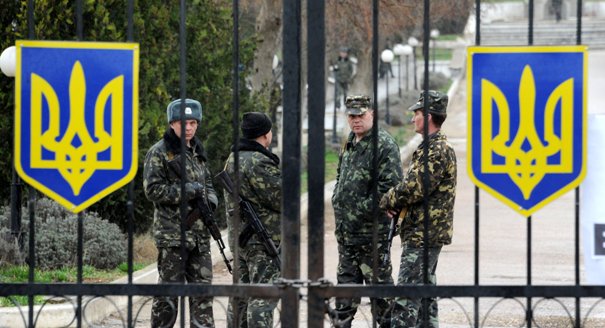
Ukraine became the place where the open crisis of the post-Soviet model occurred. This means that the country may become only the first stage in the chain of future collapses. Also, with Russian invasion in Ukraine the entire international system that came into being after 1991 is starting to crumble.
This is a continuation of Lilia Shevtsova’s post, published on March 4.
So far, the West has not been up to the Ukrainian challenge. I have been writing a lot about it.
But what do Ukrainians themselves have to say on this matter? All of my Ukrainian colleagues, who come from entirely different regions and support Ukraine’s independence and its European vector, have been greatly disappointed with the policy on Ukraine adopted by Western countries—or, rather, with their choice to have no policy at all. Ukrainian journalists at the conference I attended put together a video in which they repeated in unison, “When Ukraine was dying, Europe was silent!”
Ukrainian experts and politicians continue to raise the question that could be uncomfortable for Europeans: why the German and Polish foreign affairs ministers took pains to persuade and even force the Ukrainian opposition to sign an agreement with Viktor Yanukovych that guaranteed his stay in power through 2014 and which was rejected by Maidan? The Kremlin now demands to return to this agreement and uses it as a justification for its actions in Ukraine.Ukrainians are watching with uneasiness the German statements, including the German support for the idea of federalization of Ukraine (supported by the Kremlin and the pro-Russian lobby in Ukraine too!), and the latest of Steinmeier’s calls to preserve G-8 as the ground for dialogue with Russia. Ukrainians remember the German role in 2008, before the Russo-Georgian war, when Chancellor Merkel blocked Ukraine and Georgia from becoming NATO candidate-members and they have certain thoughts about that.
Now the West has to brace itself for the fact that Ukrainian society feels quite strongly that liberal democracies have a tradition of double-standards policy on Ukraine. Let us see if the West can change these feelings in the nearest future.
Ukrainians are quite skeptical about the measures that Western politicians put forward to stop the Kremlin and its military campaign. “What good can sanctions against Putin’s associates do?” they ask doubting that these sanctions will be really tough. Yulia Mostovaya, editor in chief of the popular Ukrainian weekly “Zerkalo Niedeli,” has best formulated the Ukrainian view of the most effective approach to this problem. “To help Ukraine, the West must find a mechanism that would ensure the return of Russian, Ukrainian, and Kazakh assets that were taken out of these countries and laundered in the West.” As Gideon Rachman recently pointed out in the Financial Times, “The City of London and the Swiss authorities, in particular, have not been noted for their eagerness to question the origins of Russian money.” This was confirmed by the leaks from the UK national security council meeting (reported by the Guardian, March 3, 2014) where the British officials stated that UK is not going to support trade sanctions against Russia or “close London’s financial center to Russians.” Thus, target actions are not supposed to hurt the Russian political and business elite dealing with the UK financial institutions.
President Vladimir Putin’s March 4 press conference could create the impression that he has backed down, and that this backing down is the result of the Western pressure. In reality the Russian president has decided to use his imitation technique and experience in creating cognitive dissonance in the minds of the audience. He said that he is not going to use the troops in Ukraine, unless it is needed. He said that he is not annexing Crimea, despite the fact that Russian troops are staying there. He said that the Ukrainian authorities are illegitimate but he will deal with them if they accept the Russian terms. Thus, the Kremlin has been pretty open—the game continues. Only its forms could change now. The West should have no illusions about it. Putin himself has none of the cognitive dissonance that he tries to create in others.
Today Putin suggests to the West: “Let’s play as if nothing happened.” He believes that the West will be ready to forget the unpleasant Ukrainian interruption and the big guys will continue their dinner together. Putin is right to hope because this is exactly what happened after the Russo-Georgian war. If the Western leaders agree to get collective amnesia about Ukraine, they may get a new surprise pretty soon.
Ukraine closed one chapter in world history while opening another. One could argue that Ukraine became the weakest link in the post-Soviet world and the place where the open crisis of the post-Soviet model occurred. This means that Ukraine may become only the first stage in the chain of future collapses.
Ukraine has become the factor in the Russian domestic development that has accelerated the already apparent Russia’s to turn toward a new paradigm of existence—that of the state surrounded by enemies and hostile civilizations. This state is returning to the mobilization mode of life that resembles the Soviet “mobilization” pattern. This is the confirmation that Russian praetorian system has entered the agony cycle. True, the jury is out on how long this cycle could last.
With Russian invasion in Ukraine the entire international system that came into being after 1991 is starting to crumble. This system was predicated on hope that the era of mutual containment on part of Russia and the West was over. Every new status quo in the post-Soviet space that has been drifting in the zone of civilizational uncertainty could be only situational and temporary.
The events in Ukraine demonstrated that some political formats created during the last 20 years have exhausted themselves—the G-8 format is one of them. Even if Germans find it a useful format to talk to Moscow. In any case, this format is losing its previous meaning of the club of liberal democracies.
The fact that Moscow has turned to the old “Sudetenland Doctrine” (that is defense of the Russian speaking population) to justify its invasion in Ukraine revives ghosts of the past and memories of Munich of 1938 and the Molotov-Ribbentrop pact and partition of Ukraine in 1939. This tactics could force other states with the Russian speaking minorities to start rethinking their security strategy. This tactics is self-defeating. But it will cost dearly to prove that it will be an inevitable failure.
In 1994, Ukraine gave up its nuclear weapons in exchange for guarantees of its security and territorial integrity from the United States, Russia, France, and Great Britain, and now it has been attacked by one of the guarantors of its safety. It means that the whole nonproliferation regime may collapse. From now on, states will attempt to gain access to nuclear weapons and will not give them up.
Former Senior Associate, Russian Domestic Politics and Political Institutions Program, Moscow Center
Shevtsova chaired the Russian Domestic Politics and Political Institutions Program at the Carnegie Moscow Center, dividing her time between Carnegie’s offices in Washington, DC, and Moscow. She had been with Carnegie since 1995.
Recent Work
Lilia Shevtsova
Lilia Shevtsova
Carnegie does not take institutional positions on public policy issues; the views represented herein are those of the author(s) and do not necessarily reflect the views of Carnegie, its staff, or its trustees.

The aftermath of the Ceuta crisis shows Europe has drawn the wrong lessons. Rather than doubling down on failed migration policies, the EU needs to address the underlying roots of such episodes.

Richard Youngs

Canadian Prime Minister Mark Carney has twice inspired praise for standing up to U.S. President Donald Trump: at the 2026 World Economic Forum in Davos and on Canada-U.S. trade negotiations. Is Carney showing a third way better than the EU has in dealing with the Trump administration?

Rym Momtaz, ed.

The EU’s responses to two recent incidents expose the gulf between European perceptions and capabilities. Unless the union can bridge that gap, it will never become a real geostrategic power.
Rym Momtaz

European states control several Overseas Countries and Territories around the world that carry strategic, economic, and environmental weight. As great powers challenge the rules-based order, defending them is a geopolitical imperative for Europe.

Marc Pierini

In supporting Europe’s far-right, MAGA and Russia both want the same thing: a weaker EU. Europe must defend itself without abandoning the openness these forces exploit.

Armida van Rij