

Commentary
Dmitri Trenin
{
  "authors": [
    "Dmitri Trenin"
  ],
  "type": "commentary",
  "centerAffiliationAll": "",
  "centers": [
    "Carnegie Endowment for International Peace",
    "Carnegie Russia Eurasia Center"
  ],
  "collections": [],
  "englishNewsletterAll": "",
  "nonEnglishNewsletterAll": "",
  "primaryCenter": "Carnegie Russia Eurasia Center",
  "programAffiliation": "",
  "programs": [],
  "projects": [],
  "regions": [
    "Russia",
    "Eastern Europe",
    "Ukraine"
  ],
  "topics": [
    "Political Reform",
    "Economy",
    "Security",
    "Military",
    "Foreign Policy"
  ]
}
Source: Getty
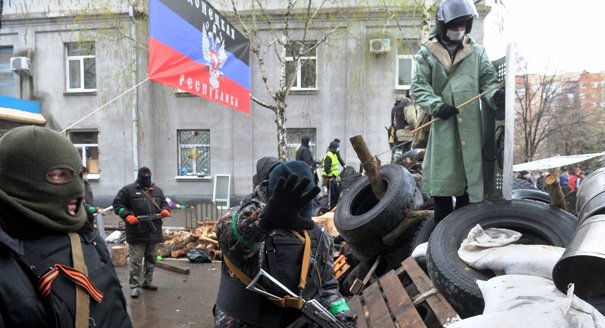
Sunday’s events put Ukraine on the brink of civil war. However, there is still a chance to prevent the worst, but it can only be used when those calling political shots inside and outside Ukraine rise to their responsibility.
In the developments in and over Ukraine, history is often made on weekends. The first gathering of the Euromaidan and its forcible dispersal by the police; the delayed capitulation by President Viktor Yanukovych before the maidan three months later and the maidan’s refusal to accept the delay, which sent the president fleeing Kiev; Vladimir Putin’s decision to seek the approval by the Russian parliament of the use of Russian military forces in Ukraine; and, most recently, the multiple seizures of government buildings in Eastern Ukraine and Kiev’s announcement of a “large-scale anti-terrorist operation” to dislodge them—all occurred on official days off.
The insiders are seemingly in disarray. Those who joined forces to oust Yanukovych are now competing for the spoils of power. Despite all the talk of revolution, too little has changed so far in the Ukrainian politico-economic system, which continues to be dominated by the oligarchs and their political proxies. Prime Minister Arseniy Yatsenyuk looks earnest and sounds desperate when he talks about Ukraine’s economic situation as de facto bankruptcy, but a lot of others continue to mind their own businesses. Their hopes that Russia will do the job for them of uniting the Ukrainian nation—against Moscow and in happy acceptance of the system existing in Ukraine—are not likely to withstand the economic hardships just down the road.
As to Russia, it is playing hardball. Moscow’s objective is, at minimum, to assure that Ukraine does not join NATO and does not associate itself too tightly with the European Union; it also seeks constitutional guarantees that the Russian language will continue to be used alongside Ukrainian in areas where ethnic Russians constitute a sizeable minority; Russians also want to preserve economic ties to a range of Ukrainian enterprises linked, in particular, to the Russian defense industry. Finally, Moscow insists on election of governors in Ukraine as a way to help raise new regional elites accountable to their own constituencies and forming a counterweight to the pro-Western and often anti-Russian elites in Kiev. Russia’s agenda can be described, in a nutshell, as Ukraine’s “neutralization through (its) federalization.”
At the moment, Russia does not have to and probably does not intend to move its military forces into south-eastern Ukraine. Contrary to Western expectations, Moscow is definitely not following the Crimea playbook there. Rather, it is satisfied with pro-Russian activists following the maidan techniques in multiple towns of the Donbass region, complete with seizures of government buildings, police stations, and security services headquarters. There is no doubt about Moscow’s support for these activities: in this way, Russia is returning the compliment to the backers of the Euromaidan. Moscow puts Kiev in front of an unpalatable dilemma: to use force against the “terrorists” (which Yanukovych did not do in western Ukraine, when government buildings were similarly seized, and arsenals looted), and possibly precipitate the country’s break-up, or to passively watch the proliferation of self-styled “people’s republics” and lose control of the south-east. Either way, Ukraine’s continued instability should cast a shadow over the May 25 presidential elections there and prevent the full legitimization of the pro-Western regime in Kiev.
Meanwhile, Kiev’s new backers in the European Union and the United States have been long on verbal support for Ukrainian democracy and in their condemnation of Russian actions, but rather tardy with financial relief. Yet, absent urgent and massive assistance to Ukraine coupled with a strategy of economic reform, Eastern Europe’s largest country will plunge into tailspin and likely disintegrate. In these circumstances, military exercises with NATO forces in Ukraine will hardly help.
A “battle for Ukraine” will bruise all its participants, and may well lead to the country’s partition. To forestall that scenario, Americans, Europeans, Russians, and Ukrainians themselves need to jointly discuss urgent economic steps in finance, energy, and trade, linked to a constitutional framework which would provide for a sort of balance within Ukraine and in its international relations and affiliations. A failure to come together on this issue would turn Ukraine into a failed state or a battleground in a new confrontation. There is still time—but just before the next fateful weekend.
Former Director, Carnegie Moscow Center
Trenin was director of the Carnegie Moscow Center from 2008 to early 2022.
Recent Work
Dmitri Trenin
Dmitri Trenin
Carnegie does not take institutional positions on public policy issues; the views represented herein are those of the author(s) and do not necessarily reflect the views of Carnegie, its staff, or its trustees.

European Commission President Ursula von der Leyen is about to give her annual address on the state of the EU. Here’s what she won’t—but should—say.

Rym Momtaz

The aftermath of the Ceuta crisis shows Europe has drawn the wrong lessons. Rather than doubling down on failed migration policies, the EU needs to address the underlying roots of such episodes.

Richard Youngs

Canadian Prime Minister Mark Carney has twice inspired praise for standing up to U.S. President Donald Trump: at the 2026 World Economic Forum in Davos and on Canada-U.S. trade negotiations. Is Carney showing a third way better than the EU has in dealing with the Trump administration?
Rym Momtaz, ed.

The EU’s responses to two recent incidents expose the gulf between European perceptions and capabilities. Unless the union can bridge that gap, it will never become a real geostrategic power.
Rym Momtaz

European states control several Overseas Countries and Territories around the world that carry strategic, economic, and environmental weight. As great powers challenge the rules-based order, defending them is a geopolitical imperative for Europe.

Marc Pierini