

Commentary
The European Commissioner for Trade is headed to China. But after President Xi’s bridge-building visit to Washington, can a more isolated EU overcome Beijing’s stranglehold on critical raw materials? Who will blink first?
Rym Momtaz, ed.
{
  "authors": [
    "Mikhail Krutikhin"
  ],
  "type": "commentary",
  "centerAffiliationAll": "",
  "centers": [
    "Carnegie Endowment for International Peace",
    "Carnegie Russia Eurasia Center"
  ],
  "collections": [],
  "englishNewsletterAll": "",
  "nonEnglishNewsletterAll": "",
  "primaryCenter": "Carnegie Russia Eurasia Center",
  "programAffiliation": "",
  "programs": [],
  "projects": [],
  "regions": [
    "East Asia",
    "China",
    "Russia"
  ],
  "topics": [
    "Economy",
    "Trade",
    "Climate Change",
    "Foreign Policy"
  ]
}
Source: Getty
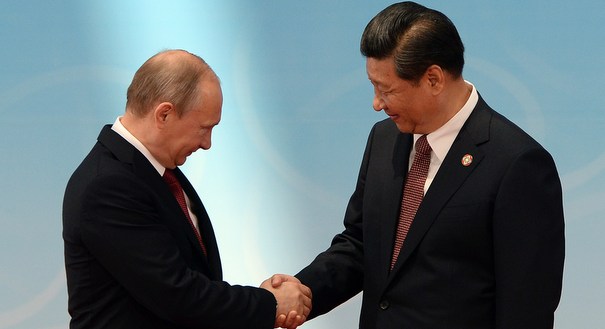
The secretive nature of the gas agreement between Gazprom and China National Petroleum Corp may show that the contract contains something the Russian negotiators could not be proud of in the limelight of Russian public opinion.
Russian negotiators certainly made a very big concession to their Chinese counterparts when they announced on May 21, more than ten years after talks started, that Gazprom and China National Petroleum Corp (CNPC) reached an agreement on terms of a gas contract. They had to do it. Vladimir Putin has been urging Gazprom to accelerate its eastern projects since October 23, 2012, when he admitted during a session of the presidential energy commission that Russia was losing the race for a sizeable niche on the global gas market because of the shale revolution in the United States, gas trade liberalization in Europe, and the emergence of new producers of liquefied natural gas.
Creating an Asian outlet for Russian gas became a geostrategic goal for the Russian president—especially in view of Moscow’s worsening relations with the west.
The terms of the contract have not been disclosed, and the secrecy may show that the contract contains something the negotiators could not be proud of in the limelight of Russian public opinion. They could have promised the Chinese a stake in gas production or transportation projects, or the basic price of gas under the contract could be below its costs, or they could have pledged future gas deliveries against a huge loan… whatever.
Gazprom CEO Alexey Miller announced that the price of the 30-year contract totaled 400 billion dollars. To get that money, however, Gazprom will have to start spending heavily on development of untapped gas reserves in the east of Russia and on new pipelines. Given the unknown—and therefore questionable—rate of return on these investments, the gas monopoly will remain a big spender rather than earner for at least a couple of decades, destroying its corporate value.
According to estimates of Gazprom planners, it will take the company at least five years to first bring gas to the Chinese border, and the annual volume in 2020 cannot be larger than 12 billion cubic meters (7-8 billion from Sakhalin and four billion from Yakutia). Another ten years will be needed to increase the capacity of gas fields and pipelines to the desired benchmark of 38 billion cubic meters a year. Will the prices of gas on the Asian-Pacific market in 2030 justify the costs, expected to exceed 60 billion dollars? So far, the prices have been showing a tendency to decline for the past two years…
To make even worse the impact of the project on the Russian economy, the bill for the pipelines under the Chinese project, in the neighborhood of 55 billion dollars, will be picked up by the National Prosperity Fund, as Minister of Economic Development Alexey Ulyukayev said on May 22 at the St. Petersburg Economic Forum.
Observers are beginning to wonder whether domestic gas prices will be raised to finance a portion of the ambitious Chinese project of Gazprom, too.
Mikhail Krutikhin is a partner at the independent RusEnergy consulting agency.
Mikhail Krutikhin
Carnegie does not take institutional positions on public policy issues; the views represented herein are those of the author(s) and do not necessarily reflect the views of Carnegie, its staff, or its trustees.

The European Commissioner for Trade is headed to China. But after President Xi’s bridge-building visit to Washington, can a more isolated EU overcome Beijing’s stranglehold on critical raw materials? Who will blink first?

Rym Momtaz, ed.

European NATO countries are wrestling with the possibility of U.S. disengagement from the alliance. With the continent’s security increasingly uncertain, governments must restore the credibility of their collective defense.



Hans-Dieter Lucas, Adam Thomson, Pierre Vimont

The domestic impacts of how long it is taking to end the war in Ukraine have pushed the French electorate to the political extremes and compromised the country’s diplomatic capacity.
Rym Momtaz

The new U.S.–Denmark–Greenland agreement will help Washington exert political, economic, and financial dominance under the guise of security. Yet, it acknowledged Copenhagen’s and Nuuk’s sovereignty on the island.

Marc Pierini

A summer of escalation in the Black Sea has hurt Ukraine economically and is exacerbating world food security. A truce is needed—as is a broader reframing of Europe’s Ukraine strategy.

Thomas de Waal