

In The Media
Lina Khatib
{
  "authors": [
    "Lina Khatib"
  ],
  "type": "legacyinthemedia",
  "centerAffiliationAll": "dc",
  "centers": [
    "Carnegie Endowment for International Peace",
    "Malcolm H. Kerr Carnegie Middle East Center"
  ],
  "collections": [],
  "englishNewsletterAll": "menaTransitions",
  "nonEnglishNewsletterAll": "",
  "primaryCenter": "Malcolm H. Kerr Carnegie Middle East Center",
  "programAffiliation": "MEP",
  "programs": [
    "Middle East"
  ],
  "projects": [],
  "regions": [
    "Gulf",
    "Levant",
    "Iraq",
    "Middle East"
  ],
  "topics": [
    "Political Reform",
    "Security"
  ]
}
Source: Getty
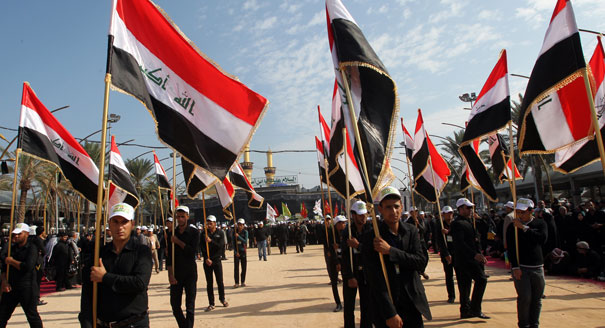
Fighters from ISIS have taken over the major towns of Mosul and Tikrit. If they manage to hang on to them, how are they likely to govern?
Source: BBC World Service’s Newshour
DAMIAN QUINN: Now let’s return to our main story–the struggle for power in Iraq. Fighters from ISIS, the Sunni extremist group that’s locked in a battle with Iraqi government forces have taken over the major towns of Mosul and Tikrit. If they manage to hang on to them, how will they likely to govern–as blood-thirsty radicals or as pragmatists? Well, one place to look for clues is across the border in Syria, where the town of Raqqa has been under ISIS control for more than a year. Lina Khatib is director of the Carnegie Middle East Center in Beirut. So how and why did ISIS take over Raqqa?
LINA KHATIB: ISIS has its roots in Iraq; the leader of ISIS is an Iraqi, in fact. However, Syrian ISIS fighters, before the uprising of 2011, were Islamists who Bashar Al-Assad used to use to put pressure on the Maliki government in Iraq, because they would cross over into Iraq and conduct terrorist attacks and then come back. These terrorists ended up in prison in Syria. But as soon as the uprising started, Bashar al-Assad released them from jail, and Raqqa happened to be the area where they were most present. And, also, Raqqa was attractive for them, because it’s rich in oil. So as a result of this, ISIS became very powerful in the area of Raqqa and managed to hold the area until today, and Raqqa is now the only governorate that is not under control of the regime itself.
DAMIAN QUINN: And what kind of governors are they?
LINA KHATIB: What happened in Raqqa is that ISIS tried to establish its own version of a state in the area. It started appropriating existing state institutions, like schools, like the police. So it established its own court system, its own police force. However, it did not completely run these institutions parallel to existing state ones, it actually took them over.
DAMIAN QUINN: What kind of institutions were they? Under what principles were they being run?
LINA KHATIB: Of course ISIS is an Islamist extremist group, and the way it’s ruling Raqqa is by imposing its own extreme version of Sharia law. So, for example, Christians in the area are supposed to pay tax to ISIS for so-called protection; women aren’t allowed to walk outside without covering up top to toe; they’re imposing very harsh penalties on people accused of theft and other crimes. So, it’s an Islamic caliphate that ISIS claims to want to establish in Syria and Iraq.
DAMIAN QUINN: But is there any sense of pragmatism in their ruling?
LINA KHATIB: ISIS is not really pragmatists. The reason why it’s been able to control Raqqa is because Raqqa from the very beginning has seen a lot of clashes between the regime and Islamist groups. And the people of Raqqa became very exhausted. So, what we’re seeing really is a case of acquiescence by a very tired population that is unfortunately now pushed to accepting harsh Islamist rule over the alternative, which would have been extreme chaos.
DAMIAN QUINN: So if we transpose what has happened in Raqqa to Mosul and Tikrit–the cities, which at the moment, ISIS seems to be holding in Iraq–how would you see their governance in comparison to what’s been happening in Syria?
LINA KHATIB: Of course, because ISIS has established its own version of a state in Raqqa, one might think that it will seek to do the same thing in Mosul. But we have to remember two things. First of all, Mosul is not an area that has seen people suffer, like the people did in Raqqa. So, the appetite for resistance is much greater in Mosul. Second of all, unlike Raqqa, which is an area that has a population of around 220,000, the population of Mosul is 1.8 million. And the number of ISIS fighters who have taken hold of Mosul is actually in the few hundreds. So, it will be very difficult for ISIS to replicate the system of rule that it has imposed in Raqqa, in Mosul and other areas in Iraq.
DAMIAN QUINN: That was Lina Khatib on the experience of the Syrian city of Raqqa under ISIS rule. You’re listening to Newshour from the BBC World Service.
This interview was originally broadcasted on BBC World Service’s Newshour.
Former Director, Middle East Center
Khatib was director of the Carnegie Middle East Center in Beirut. Previously, she was the co-founding head of the Program on Arab Reform and Democracy at Stanford University’s Center on Democracy, Development, and the Rule of Law.
Recent Work
Lina Khatib
Lina Khatib
Carnegie does not take institutional positions on public policy issues; the views represented herein are those of the author(s) and do not necessarily reflect the views of Carnegie, its staff, or its trustees.

European states control several Overseas Countries and Territories around the world that carry strategic, economic, and environmental weight. As great powers challenge the rules-based order, defending them is a geopolitical imperative for Europe.

Marc Pierini

Mounting economic strain and battlefield losses will not necessarily make the Kremlin less dangerous. They could instead push Moscow toward a more aggressive hybrid campaign designed to test NATO’s Eastern flank, exploit allied hesitation, and fracture European resolve.

Maksym Beznosiuk

Over the past ten years, NATO has held almost as many summits as it did during the entirety of the Cold War. Are they still useful, or is it time to stop holding annual meetings?

Rym Momtaz, ed.

As the EU confronts profound challenges, several leaders have called for fundamental reform to the union’s model—but only modest, superficial changes have resulted. What if Europe really could be reimagined from zero today: What should such a redesigned European order look like?

Richard Youngs, ed.
As Russia's war on Ukraine drags on, NATO is expanding its footprint in the Black Sea. Turkey, Romania, and Bulgaria are upgrading their fleets and deepening trilateral cooperation.

Dimitar Bechev