
French President Emmanuel Macron has unveiled his country’s new nuclear doctrine. Are the changes he has made enough to reassure France’s European partners in the current geopolitical context?
Rym Momtaz, ed.
{
"authors": [
"Lina Khatib",
"Joshua Landis",
"Mark Lynch",
"Aryn Baker"
],
"type": "legacyinthemedia",
"centerAffiliationAll": "dc",
"centers": [
"Carnegie Endowment for International Peace",
"Malcolm H. Kerr Carnegie Middle East Center"
],
"collections": [
"Arab Awakening"
],
"englishNewsletterAll": "menaTransitions",
"nonEnglishNewsletterAll": "",
"primaryCenter": "Malcolm H. Kerr Carnegie Middle East Center",
"programAffiliation": "MEP",
"programs": [
"Middle East"
],
"projects": [],
"regions": [
"Egypt",
"Levant",
"Syria",
"Middle East",
"North Africa"
],
"topics": [
"Political Reform",
"Security",
"Democracy"
]
}Source: Getty
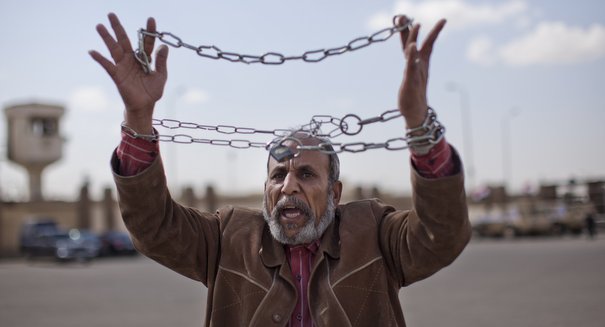
Just three years ago, it appeared that dictatorships in the Middle East might become replaced by democracies. Now, these same regimes have found ways to use the electoral process to maintain power or attain it.
Source: KCRW’s To The Point
Host of KCRW’s To The Point Warren Olney opened up the discussion on Whatever Happened to the ‘‘Arab Spring?’’ with Carnegie’s Lina Khatib, the Center for Middle East Studies at the University of Oklahoma’s Joshua Landis, the Institute for Middle East Studies at George Washington University’s Mark Lynch, and TIME’s Aryn Baker:
“Three years ago, it appeared that anti-government uprisings might lead to the spread of democracy in the Middle East. Now it appears that the democratic process is being used to sustain the power of dictatorships. Syria’s President Bashar al-Assad is staging a re-election campaign after destroying major cities, killing more than 160,000 people and driving millions of refugees to other countries. But many of those refugees are voting to re-elect him. Is tyrannical order the only alternative to chaos and the spread of terror? Egypt’s former general Abdel Fattah al-Sisi overthrew an elected government, outlawed political opposition and staged his presidential election. Is another military dictatorship preferable to the Muslim Brotherhood? With the collapse of the so-called ‘freedom agenda,’ we look at the options for U.S. influence in the Middle East.”
This interview was originally broadcasted on KCRW’s To The Point.
Former Director, Middle East Center
Khatib was director of the Carnegie Middle East Center in Beirut. Previously, she was the co-founding head of the Program on Arab Reform and Democracy at Stanford University’s Center on Democracy, Development, and the Rule of Law.
Joshua Landis
Mark Lynch
Aryn Baker
Carnegie does not take institutional positions on public policy issues; the views represented herein are those of the author(s) and do not necessarily reflect the views of Carnegie, its staff, or its trustees.
French President Emmanuel Macron has unveiled his country’s new nuclear doctrine. Are the changes he has made enough to reassure France’s European partners in the current geopolitical context?
Rym Momtaz, ed.
The drone strike on the British air base in Akrotiri brings Europe’s proximity to the conflict in Iran into sharp relief. In the fog of war, old tensions in the Eastern Mediterranean risk being reignited, and regional stakeholders must avoid escalation.
Marc Pierini
European reactions to the war in Iran have lost sight of wider political dynamics. The EU must position itself for the next phase of the crisis without giving up on its principles.
Richard Youngs
Europe’s reaction to the war in Iran has been disunited and meek, a far cry from its previously leading role in diplomacy with Tehran. To avoid being condemned to the sidelines while escalation continues, Brussels needs to stand up for international law.
Pierre Vimont
New thinking is needed on how global civil society can be protected. In an era of major-power rivalry, competitive geopolitics, and security primacy, civil society is in danger of getting squeezed – in some countries, almost entirely out of existence.
Richard Youngs, ed., Elene Panchulidze, ed.