

Commentary
Balázs Jarábik
{
  "authors": [
    "Balázs Jarábik"
  ],
  "type": "commentary",
  "centerAffiliationAll": "",
  "centers": [
    "Carnegie Endowment for International Peace",
    "Carnegie Russia Eurasia Center"
  ],
  "collections": [],
  "englishNewsletterAll": "",
  "nonEnglishNewsletterAll": "",
  "primaryCenter": "Carnegie Endowment for International Peace",
  "programAffiliation": "",
  "programs": [],
  "projects": [],
  "regions": [
    "Eastern Europe",
    "Ukraine",
    "Western Europe"
  ],
  "topics": [
    "Political Reform",
    "Foreign Policy"
  ]
}
Source: Getty
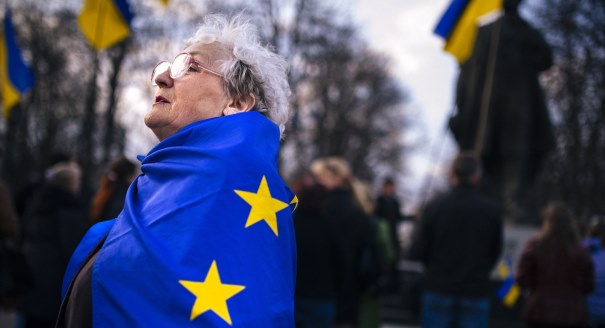
Ukraine is certainly a different country compared to seven months ago. The challenges of implementing the EU Association Agreement that it signed on June 27 are still tremendous, though. Reform, management of expectations, and reality is what is needed now.
Nothing can be more symbolic of Ukraine's bumpy transition than the notorious conditions of the country's roads. After independence, Kyiv was investing in connections from East to South (Odessa, Crimea) leaving the roads to the West in catastrophic conditions. The change came with the 2012 European football championship. As a symbolic prelude toward the association agreement with the European Union, the roads from Kyiv to the Western borders were re-built and are now in the best quality. The story, however, has a flip side: the tremendous costs. The roads were built by Turkish or Macedonian sub-contractors, while Ukrainian contractors pocketed the rent.
The local context should be taken much more seriously into account after Ukraine signed the Association Agreement with the EU on June 27. Ukraine is certainly a different country compared to seven months ago. But exactly due to the change making the association agreement more sober, assessment of the huge and technically complicated agenda is needed, along with a greater capacity to mobilize and support its implementation than was originally foreseen.
But Ukraine is capable of surprise as so many times in the past seven months. Who believed three months ago that the country could muster a legitimate presidential election? It is still the (lack of) legitimacy of the care taker government and the current parliament that keep politics fragmented. Early elections are not an easy call, though: populists can easily win and Ukrainian lawmakers "would rather fight in the Eastern front than vote to shorten their mandate" as a popular saying in Kyiv goes.
Although citizens’ participation has been dramatically increased, its focus is on resistance and fighting—much less to convince and build. Successful implementation of the EU association agenda requires much of the latter. The West deserved credit for rapidly mobilizing financial assistance, the EU set up a support group and organized a donor conference. European mechanisms, however, were designed with the assumptions of a different economic and political situation as well as with the belief that (free) trade will (still) do a miracle. But in the rapidly depressing economy it will be increasingly about the costs of transition. These were under-calculated even before the Vilnius Summit. As a result, Western support may appear too little and too thin, particularly if the fighting will continue in the East and/or the central government won’t be apply to fully control and restore order in these territories.
Brussels is well aware that key Ukrainian officials left the line ministries, while civil society's expertise is rather weak. What they should also notice is that the vast majority of tens of thousands of Ukrainian bureaucrats do not understand "Eurospeak." Most of them are now underpaid and cut from the usual kickbacks. Although reforms are widely supported, the (revolutionary) fervor may erode when feeding of families (existential threat) becomes a priority. Implementing reforms will need to bring back a key amount of professionals, educate the rest and provide necessary incentives in terms of professional remuneration—otherwise resistance toward reforms will grow inside the state apparatus and among the population.
Management of expectations will also be key. In the current, emotionally charged (geopolitical) atmosphere, misunderstandings are natural, but yet may be fatal. Not because Russia is around the corner, but to fulfill Ukraine's pro-European choice and ambition, clear expectations and not (counter) propaganda should frame a credible partnership. Reality—and not another promise—is what both Ukraine and the EU now need from each other.

Political analyst, former Slovak diplomat, and consultant specializing in Eastern Europe
Recent Work
Balázs Jarábik
Balázs Jarábik
Carnegie does not take institutional positions on public policy issues; the views represented herein are those of the author(s) and do not necessarily reflect the views of Carnegie, its staff, or its trustees.

Before the next wave of EU enlargement takes place, the union needs to grapple with thorny questions of how power is distributed among its members.


Emil Sondaj Hansen, Ditte Brasso Sørensen

The new U.S.–Denmark–Greenland agreement will help Washington exert political, economic, and financial dominance under the guise of security. Yet, it acknowledged Copenhagen’s and Nuuk’s sovereignty on the island.

Marc Pierini

A summer of escalation in the Black Sea has hurt Ukraine economically and is exacerbating world food security. A truce is needed—as is a broader reframing of Europe’s Ukraine strategy.

Thomas de Waal

Are Germany’s economic, industrial, and political struggles becoming a liability for the EU’s ability to rise to the geopolitical moment?

Rym Momtaz, ed.

European Commission President Ursula von der Leyen is about to give her annual address on the state of the EU. Here’s what she won’t—but should—say.
Rym Momtaz