

Commentary
Dmitri Trenin
{
  "authors": [
    "Dmitri Trenin"
  ],
  "type": "commentary",
  "centerAffiliationAll": "",
  "centers": [
    "Carnegie Endowment for International Peace",
    "Carnegie Russia Eurasia Center"
  ],
  "collections": [],
  "englishNewsletterAll": "",
  "nonEnglishNewsletterAll": "",
  "primaryCenter": "Carnegie Russia Eurasia Center",
  "programAffiliation": "",
  "programs": [],
  "projects": [],
  "regions": [
    "North America",
    "United States",
    "Western Europe",
    "Germany"
  ],
  "topics": [
    "Security",
    "Foreign Policy"
  ]
}
Source: Getty
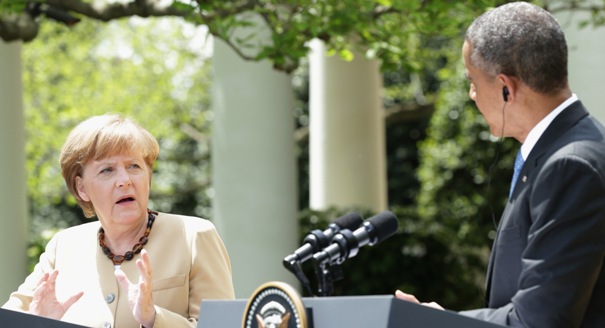
German protestations over recent allegations of U.S. espionage point to the fact that the Federal Republic is rediscovering its dignity. As Germany emerges as one of Eurasia's major powers, a sense of “normalcy” will return to relationships that used to be special, the United States being no exception.
There is something touching about Germany's outrage at the United States spying in the country. Allies do spy on each other, but they are supposed to do so more carefully. From its very foundation in 1949, the Federal Republic has been watched not only by the Soviet Union, and then Russia, but by the Western powers as well. The NSA scandal, touched off by Edward Snowden's revelations last year, should have dispelled the last remaining illusions. Yet, the most recent charges against an agent within the Bundesnachrichtendienst, the German intelligence service, allegedly spying for the United States, has brought matters to a head again.
Yet, the fact that the German protestations become ever louder and ever angrier may point also to something else. Germany is rediscovering its dignity. Just thirty years ago, the phrase "German national interest" was taboo. Just fifteen years ago, an open disagreement on a major international issue between Germany and the United States was unthinkable. Just five years ago, Germany abstaining at the UN Security Council alongside Russia and China was hard to imagine. Things keep changing, and the old relationships like the Franco-German tandem or the Russo-German partnership are being recast.
Eventually, this will also be true of the U.S.-German alliance. Spying scandals accelerate the process somewhat, and give it a public spin, but they do not drive it. Slowly, Germany is emerging as the sole leader of the EU, and as a major power in Eurasia, alongside China and Russia. One result of this will be providing a sense of "normalcy" to Berlin's formerly special relationships, which used to extend privileges to its allies. The United States will be no exception.
Former Director, Carnegie Moscow Center
Trenin was director of the Carnegie Moscow Center from 2008 to early 2022.
Recent Work
Dmitri Trenin
Dmitri Trenin
Carnegie does not take institutional positions on public policy issues; the views represented herein are those of the author(s) and do not necessarily reflect the views of Carnegie, its staff, or its trustees.

Are Germany’s economic, industrial, and political struggles becoming a liability for the EU’s ability to rise to the geopolitical moment?

Rym Momtaz, ed.

European Commission President Ursula von der Leyen is about to give her annual address on the state of the EU. Here’s what she won’t—but should—say.
Rym Momtaz

Radical-right parties are expected to do well in upcoming elections in four of the EU's biggest member states. If successful, they could prevent the union from addressing key challenges ahead.

Stefan Lehne

The aftermath of the Ceuta crisis shows Europe has drawn the wrong lessons. Rather than doubling down on failed migration policies, the EU needs to address the underlying roots of such episodes.

Richard Youngs

An overwhelming victory by a far-right-wing party in a small state in eastern Germany will have major repercussions for Chancellor Friedrich Merz’s coalition.

Judy Dempsey