

Commentary
The EU had to compromise to adopt a twenty-first sanctions package against Russia, exposing growing cracks in the union’s resolve. Is this latest, weaker round worth it to keep pressure on Moscow?
Rym Momtaz, ed.
{
  "authors": [
    "Michele Dunne",
    "Nathan J. Brown"
  ],
  "type": "legacyinthemedia",
  "centerAffiliationAll": "dc",
  "centers": [
    "Carnegie Endowment for International Peace",
    "Malcolm H. Kerr Carnegie Middle East Center"
  ],
  "collections": [],
  "englishNewsletterAll": "menaTransitions",
  "nonEnglishNewsletterAll": "",
  "primaryCenter": "Carnegie Endowment for International Peace",
  "programAffiliation": "MEP",
  "programs": [
    "Middle East"
  ],
  "projects": [],
  "regions": [
    "Middle East",
    "Israel",
    "North Africa",
    "Egypt",
    "Palestine",
    "Levant"
  ],
  "topics": [
    "Political Reform",
    "Security",
    "Foreign Policy"
  ]
}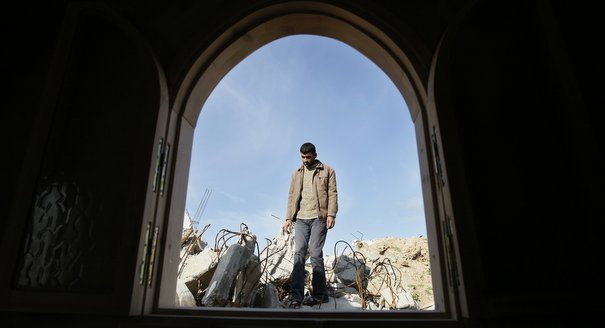
Source: Getty
As negotiations on a lasting cease-fire in Gaza grind on in Cairo, it’s not only the animosity between Israel and Hamas that is complicating the talks—it’s also Egypt’s role as mediator.
Source: Foreign Policy
As negotiations on a lasting cease-fire in Gaza grind on in Cairo, it's not only the animosity between Israel and Hamas that is complicating the talks -- it's also Egypt's role as mediator. Egypt's internal politics -- far more fraught and violent than they were during Hosni Mubarak's era -- have intruded on the attempts to reach an agreement, as the military-dominated government in Cairo attempts to use the talks as part of its war against the Muslim Brotherhood.
This subtle shift -- from mediator with interests, to interested party that also mediates -- has led to a longer and bloodier Gaza war than might otherwise have been the case. And while a strong Egypt-Israel alliance was supposed to cut Hamas down to size, this strategy has also backfired on the diplomatic front. However much it has bloodied Hamas -- and particularly the population of Gaza -- the war has actually led to a breaking of international taboos on dealing with Hamas, a former pariah.
Egypt has always brought its own long-standing national security interests to the table in previous Gaza mediation efforts. Cairo has never wanted militants or weapons to enter Egypt from Gaza, nor has it wanted to take over responsibility for humanitarian or security affairs there, having had the unhappy experience of occupying the Gaza Strip for almost 20 years following 1948. Egyptian intelligence officials have always taken the lead in dealing with Gaza -- even during the yearlong presidency of the Muslim Brotherhood's Mohamed Morsi. While one might have thought that Morsi would have opened the floodgates to Hamas, the Brotherhood's ideological bedfellow, in actuality Egypt kept the border with Gaza largely closed during his presidency and continued efforts to destroy tunnels. Whatever his personal sympathies, Morsi stayed within the lines of a policy designed to ensure that Egypt was not stuck holding the Gaza hot potato.But after removing Morsi in a July 2013 coup, Abdel Fattah al-Sisi, then defense minister and now president, transformed Egypt's policy toward Gaza into part of his larger domestic and international political agenda. He is clearly using Gaza to prosecute his own relentless crackdown against the Brotherhood -- an effort that also helps cement his alignment with Saudi Arabia and the United Arab Emirates.
In the first phase of Egyptian diplomacy during this recent Gaza war, Egyptian mediators played their hand transparently -- and ruthlessly. They attempted to corner Hamas by publicly announcing a cease-fire proposal on July 15 that had only been coordinated with Israel; when Hamas balked, Israeli Prime Minister Benjamin Netanyahu promptly announced that the rejection provided "international legitimacy" for an expanded Israeli operation. Thus what was touted as a proposal to end the conflict actually enabled a ground incursion, which resulted in a more thorough elimination of Hamas tunnels and rockets than Israeli missiles alone would have been able to accomplish.
The ground invasion also led to at least 1,600 more Palestinian deaths. Previous Egyptian presidents would have blanched at complicity in such violence.As the conflict continued, however, Sisi found that he could no longer completely exclude Hamas if he also wanted to preserve Egypt's role as mediator between Israel and the Palestinians. And indeed, for all the ways in which the diplomatic efforts to manage the Gaza war have worked against Hamas, one of the most striking aspects of the current Egyptian-led effort has been how it has shattered the fiction that Israel and Hamas will not negotiate.
The two parties have conducted diplomacy before, of course -- but it was also carried out with levels of deniability, indirectness, and distaste. Each round of fighting chipped away at the principle that Israel and Hamas do not deal with each other diplomatically. Now the only dimension missing is direct contact: Diplomacy takes place in Cairo, with delegations arriving in daylight and exchanging positions (and threats) not merely in public, but through Egyptian mediators.
This process has also shattered another myth -- that the primary game in town is about how to achieve a two-state solution between Israel and the PLO. Today, two-state diplomacy seems to be at best in hibernation. The talks in Cairo, on the other hand, are substantial. They cover violence, security, reconstruction, living conditions in Gaza, movement and access to the territory, Hamas-Fatah reconciliation, and internal Palestinian governance.
In that sense, Cairo is presiding over a process that follows the priorities of Hamas, which has always rejected the diplomatic process that began with the 1993 Oslo Accords. The current state of negotiations reflects Hamas's position that only talks about interim arrangements and truces are acceptable; conflict-ending diplomacy is not. The Israeli right can also feel vindicated, as the talks suggest that the conflict might be managed, but that it will not be resolved anytime soon.
The Palestinian Islamist camp and the Israeli right, however, should take little joy in this accomplishment. The diplomatic efforts led by Egypt will likely give Hamas little, and the new Egypt-Israel alliance is based on a short-term coincidence of interests rather than any strategic consideration. Israeli and Palestinian societies, meanwhile, are already paying a high price for the continuing failure to reach a lasting peace accord.
There is one more troubling aspect of Cairo's diplomacy that has largely escaped notice. While Egyptian mediators were forced in the end to deal directly with Hamas's leadership in order to reach a cease-fire, they have tried to mitigate this unpleasant reality in two ways. They have not only been seeking to enhance the role of Palestinian President Mahmoud Abbas -- something Mubarak always did in his day -- but may also be flirting with Palestinian Islamic Jihad (PIJ), a group far more committed to violence against Israel than Hamas. PIJ leaders such as Khaled al-Batsh have been quoted in the Egyptian government-owned media recently insisting that no other state can take Egypt's place as mediator.
Egypt's military-dominated regime, then, has proved that it is not against forging alliances with violent Islamists; its only feud is with those allied with the Muslim Brotherhood. The apparent Egypt-PIJ flirtation highlights how the country's highly polarized politics might cause Cairo's military-dominated leadership to cultivate clients that are hardly in the interests of the United States or Israel. An Egypt that looks and acts more and more like Pakistan is not something to celebrate.

Former Nonresident Scholar, Middle East Program
Michele Dunne was a nonresident scholar in Carnegie’s Middle East Program, where her research focuses on political and economic change in Arab countries, particularly Egypt, as well as U.S. policy in the Middle East.

Nonresident Senior Fellow, Middle East Program
Nathan J. Brown, a professor of political science and international affairs at George Washington University, is a distinguished scholar and author of nine books on Arab politics and governance, as well as editor of five books.
Carnegie does not take institutional positions on public policy issues; the views represented herein are those of the author(s) and do not necessarily reflect the views of Carnegie, its staff, or its trustees.
The EU had to compromise to adopt a twenty-first sanctions package against Russia, exposing growing cracks in the union’s resolve. Is this latest, weaker round worth it to keep pressure on Moscow?

Rym Momtaz, ed.

Trump is distracted and Ukraine wants Europe to step up. The continent’s leaders must find their voice and assert it in talks with Russia.

Alissa de Carbonnel

Mounting economic strain and battlefield losses will not necessarily make the Kremlin less dangerous. They could instead push Moscow toward a more aggressive hybrid campaign designed to test NATO’s Eastern flank, exploit allied hesitation, and fracture European resolve.

Maksym Beznosiuk

Over the past ten years, NATO has held almost as many summits as it did during the entirety of the Cold War. Are they still useful, or is it time to stop holding annual meetings?
Rym Momtaz, ed.

As the EU confronts profound challenges, several leaders have called for fundamental reform to the union’s model—but only modest, superficial changes have resulted. What if Europe really could be reimagined from zero today: What should such a redesigned European order look like?

Richard Youngs, ed.