

Article
Thomas de Waal
{
  "authors": [
    "Thomas de Waal"
  ],
  "type": "commentary",
  "centerAffiliationAll": "",
  "centers": [
    "Carnegie Endowment for International Peace",
    "Carnegie Europe",
    "Carnegie Russia Eurasia Center"
  ],
  "collections": [],
  "englishNewsletterAll": "",
  "nonEnglishNewsletterAll": "",
  "primaryCenter": "Carnegie Europe",
  "programAffiliation": "",
  "programs": [],
  "projects": [],
  "regions": [
    "Caucasus",
    "Russia",
    "Armenia",
    "Western Europe"
  ],
  "topics": [
    "Economy",
    "Foreign Policy"
  ]
}
Source: Getty
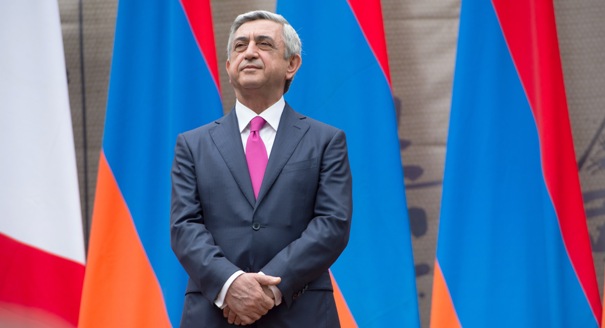
Last year, Armenian President Sargsyan committed his country to joining Putin’s Eurasian Union, instead of going toward the EU. A year on, serious discussions between the EU and Yerevan on how to re-launch the relationship have yet to start.
Those who want to see the Caucasus as a tidy geopolitical chessboard will be disappointed.
Despite evident Russian displeasure, Armenian President Serzh Sargsyan decided to attend last week's NATO summit in Wales.
Armenia used to have a foreign policy strategy it called "complementarity," balancing between Russia, the West, and Iran. Nowadays, the vector is strongly with Russia. On September 3 last year—a date that Armenians now use as a shorthand to mark a momentous shift in its strategic direction—Sargsyan committed his country to joining Vladimir Putin's Eurasian Union. In March, Armenia was one of the handful of nations which supported Russia at the United Nations over Crimea.
That was in part a gesture of gratitude to Sargsyan for his courage in making the trip and also the strong element in the Armenian armed forces, led by Deputy Defense Minister David Tonoyan, which collaborates well with NATO.
Russia is trying to increase its influence in Armenia in multiple ways. Recently an initiative was announced to open a branch of Moscow State University in Yerevan.
But there is a lot of mistrust between the two sides. Armenians are angry with Russia for selling weapons to its enemy, Azerbaijan. And everyone recalls that in the summer of 2013, Sargsyan was discussing the final details of a far-reaching Association Agreement with the European Union, when he made a sharp U-turn and announced he had chosen to go in a totally different direction—toward the Eurasian Union.
Now pro-European Armenians are looking to a couple of unlikely potential saviors to help them out: Kazakhstan's President Nursultan Nazarbayev and Belarusian leader Alexander Lukashenko. Neither has hidden their lack of enthusiasm at Armenia's efforts to become the fourth member of their economic union project. After Armenia secured exemptions for 800 products from the higher duties of the Customs Union, Lukashenko expressed displeasure at “any special terms or statuses” being granted to new members.
But even if the Eurasian Union project comes apart under its own contradictions, Armenia has still lost a lot of ground with Brussels. A year on, serious discussions between the European Union and Yerevan on how to re-launch the relationship have yet to start.

Senior Fellow, Carnegie Europe
Thomas de Waal is a senior fellow at Carnegie Europe, specializing in Eastern Europe and the Caucasus.
Recent Work
Thomas de Waal
Thomas de Waal
Carnegie does not take institutional positions on public policy issues; the views represented herein are those of the author(s) and do not necessarily reflect the views of Carnegie, its staff, or its trustees.

As we close out another season of Strategic Europe, it is worth taking stock of the deep shifts underway.

Rym Momtaz

The hybrid warfare landscape is evolving rapidly, leaving policymakers without clear strategies. To better inform their work in addressing emerging challenges, governments must dig deeper into the underlying dynamics at play.


Raluca Csernatoni, Alicia Wanless
The EU had to compromise to adopt a twenty-first sanctions package against Russia, exposing growing cracks in the union’s resolve. Is this latest, weaker round worth it to keep pressure on Moscow?
Rym Momtaz, ed.

Trump is distracted and Ukraine wants Europe to step up. The continent’s leaders must find their voice and assert it in talks with Russia.

Alissa de Carbonnel

Mounting economic strain and battlefield losses will not necessarily make the Kremlin less dangerous. They could instead push Moscow toward a more aggressive hybrid campaign designed to test NATO’s Eastern flank, exploit allied hesitation, and fracture European resolve.

Maksym Beznosiuk