

Commentary
Bayram Balci
{
  "authors": [
    "Bayram Balci"
  ],
  "type": "commentary",
  "centerAffiliationAll": "",
  "centers": [
    "Carnegie Endowment for International Peace",
    "Carnegie Russia Eurasia Center"
  ],
  "collections": [],
  "englishNewsletterAll": "",
  "nonEnglishNewsletterAll": "",
  "primaryCenter": "Carnegie Endowment for International Peace",
  "programAffiliation": "",
  "programs": [],
  "projects": [],
  "regions": [
    "Middle East",
    "Türkiye",
    "Iraq",
    "Syria"
  ],
  "topics": [
    "Security",
    "Military",
    "Foreign Policy"
  ]
}
Source: Getty
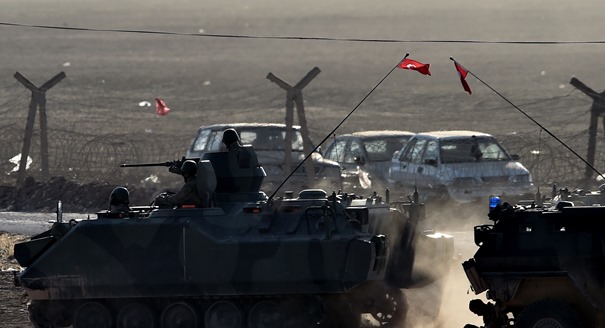
Turkey hesitates to fully embrace the U.S.-led coalition’s actions against the Islamic State. Ankara’s most crucial hesitation relates to the Kurdish issue which plays such a central role in Turkish policy in the Middle East.
Over the past few months, Western allies have criticized Turkey for its ambiguous policies toward the jihadist forces in Syria and Iraq. Preoccupied by the Syrian crisis and desperate to topple Bashar al-Assad, Turkey has adopted a “blind eye” policy toward several jihadist organizations like the Jabhat al-Nusra and the Islamic State in Iraq and Syria (ISIS), after having supported the moderate opposition.
The aggravation of the situation in Syria and Iraq, where the jihadists have created an “Islamic State” (IS) with a self-proclaimed caliph, Ibrahim al-Baghdadi, and the intensification of the policies of its Western allies, have led Ankara to change its position. On October 2, the Turkish parliament adopted tezkere, a bill authorizing the government to send troops abroad in case of emergency. The same bill authorizes the deployment of foreign military forces on Turkish territory in defense of the country.
Ankara will not actively participate in the coalition and in its strikes against the Islamic state because of Turkey’s own security concerns. Ankara managed to release the hostages held by the Islamic State and wants to avoid further hostage issues with this terrorist organization. Yet, to a large extent, Turkey itself is still a hostage of the Islamic State. Indeed, the small Turkish enclave on Syrian territory, the Suleyman Shah Tomb, is guarded by at least 40 Turkish soldiers. Media sources have recently reported that “Islamic State” forces have encircled the enclave since Turkey announced its intention to join the coalition.
Ankara fears that its large-scale participation in coalition activities could lead to retaliation by the IS. The security of its enclave is not the only point of concern for Ankara. As a consequence of its laissez-faire policy toward jihadists coming from different parts of the world to join the war in Syria via Turkish territory, Ankara has allowed the IS to develop support networks and probably hidden cells in Turkey. If it became more involved in the war against IS, these cells could perpetrate terrorist attacks on Turkish territory, similar to the Reyhanli bombings that killed more than 50 people in May 2012.
Though crucial, Turkey’s security considerations are not the main reason for Turkey’s hesitation to fully embrace the coalition’s actions in the Middle East. Turkey’s allies appear shocked by their ally’s lack of solidarity in the fight against the “Islamic State.” However, they forget that Ankara has always been reluctant to support foreign military intervention in the region. Turks believe that the U.S. intervention in Iraq in 1991 and more obviously in 2003 brought about negative consequences for the region and for Turkey itself. The Turkish economy suffered and the Kurdish issue was regionalized to the detriment of Ankara. Recent polls in Turkey showed that public opinion is against any Turkish military involvement in Syria and Iraq, as it has always been against any Turkish military intervention in the Middle East.
But Ankara’s most crucial hesitation relates to the Kurdish issue which plays such a central role in Turkish policy in the Middle East. Since the beginning of the crisis, Turkey has been concerned by the ambiguity of the relationship between the Kurds of Syria, mainly dominated by the Partiya Yekîtiya Demokrat (Democratic Union Party), and the Syrian regime. When the Syrian revolution started, the PYD, an offshoot of the Partiya Karkerên Kurdistan (Kurdistan Workers’ Party), that Turkey has fought since 1984, prevented Kurds from joining the uprising against Bashar al-Assad. Additionally, when Ankara increased its support for the Syrian opposition in its attempt to topple the Assad regime, the latter played the Kurdish card to punish Ankara for its interference in Syrian affairs.
Assad has withdrawn his forces from the Kurdish regions, letting Syrian Kurds form a de facto autonomous region on the border with Turkey. Ankara is troubled by the fact that this Kurdish region is ruled by the PYD, a party completely alienated from the PKK. The Syrian war, which has strengthened Kurds in Syria and Turkey in the same way, has obliged Ankara to engage in a political process with the PKK to find a solution for the Kurdish question in Turkey. The strengthening of Kurdish autonomy in Syria reinforces Kurds in Turkey in their negotiations with Ankara. In other words, strong Kurdish autonomy in Syria may force Turkey to provide the same degree of autonomy to its own Kurds, a process that could be the first step toward Turkey’s dismemberment.
Since the beginning of the crisis in Syria, Turkey has had one priority: ending the Assad regime. As long as Assad is in power, there will be no long-term solution to the “Islamic State” problem in the region. Another crucial question for Turkey in the region is whether Ankara is more threatened by the Islamic State, the Assad regime or the Kurdish issue. Turkish experts argue that the emergence of a strong Kurdish actor in Syria spells imminent danger for Turkey. But Turkey is also threatened by Assad’s hold on power, which continues to result in more refugees arriving in Turkey, and by the “Islamic State” that manifests hatred and animosity against Western countries and the Shia minority.
In his hesitation to join the coalition, President Recep Tayyip Erdoğan sends a message to his allies, accusing them of having double standards. Silently but clearly, he asks them why they did not intervene against Assad when he killed more than 200,000 Muslims, but energetically mobilized a huge coalition as soon as the “Islamic State” began killing religious minorities and beheading Western hostages. He also sends a message to the PYD in Syria, asking why its leaders prevented some Kurdish organizations from joining the uprising against Assad in 2011. With his inaction and hesitations towards the “Islamic State,” Erdoğan is settling scores with his Western allies as well as with the Syrian Kurds.
Former Nonresident Scholar, Russia and Eurasia Program
Balci was a nonresident scholar in Carnegie’s Russia and Eurasia Program, where his research focuses on Turkey and Turkish foreign policy in Central Asia and the Caucasus.
Recent Work
Bayram Balci
Bayram Balci, Daniyar Kosnazarov
Carnegie does not take institutional positions on public policy issues; the views represented herein are those of the author(s) and do not necessarily reflect the views of Carnegie, its staff, or its trustees.

Funding Ukraine remains a priority for European leaders. As Russia’s war of aggression heads into another winter, two feasible options to mobilize support for Kyiv should be fast-tracked.


Vladyslav Rashkovan, Gregory P. Wilson

While the EU and European governments are embracing the much-lauded middle-power moment, this entails three difficult conundrums.

Richard Youngs

Europe is facing rising populism internally as well as external pressures from Russia, China, Turkey, and the United States.

Dimitar Bechev

Much has been said of the changes Brussels is trying to make to the EU enlargement process. Here’s why gradual integration might—or might not—be the answer.
Dimitar Bechev

The European Commissioner for Trade is headed to China. But after President Xi’s bridge-building visit to Washington, can a more isolated EU overcome Beijing’s stranglehold on critical raw materials? Who will blink first?

Rym Momtaz, ed.