

Q&A
Matt Ferchen
{
  "authors": [
    "Matt Ferchen"
  ],
  "type": "questionAnswer",
  "centerAffiliationAll": "",
  "centers": [
    "Carnegie Endowment for International Peace",
    "Carnegie China"
  ],
  "collections": [
    "China and the Developing World",
    "China’s Foreign Relations"
  ],
  "englishNewsletterAll": "",
  "nonEnglishNewsletterAll": "",
  "primaryCenter": "Carnegie China",
  "programAffiliation": "",
  "programs": [],
  "projects": [],
  "regions": [
    "North America",
    "South America",
    "East Asia",
    "China"
  ],
  "topics": [
    "Economy",
    "Foreign Policy"
  ]
}
Source: Getty
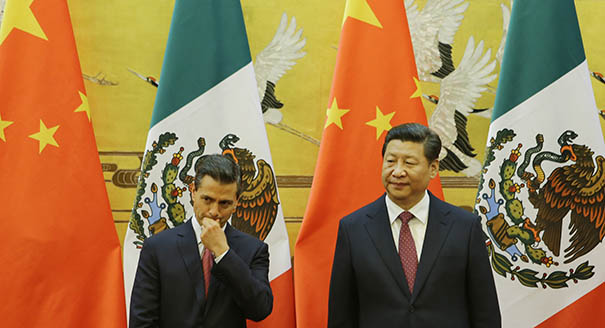
Mexico City’s cancellation of a rail contract with Beijing underscores why Chinese government and commercial actors must demonstrate a sophisticated grasp of Mexican political and regulatory realities.
Source: World Politics Review
Mexico’s recent decision to cancel a high-speed rail contract with the China Railway Construction Company (CRCC) is the latest example of the unsettled relationship between two of the largest emerging economies. In an email interview, Matt Ferchen, associate professor at Tsinghua University in Beijing and resident scholar at the Carnegie-Tsinghua Center for Global Policy, discussed China’s economic ties with Mexico.
The takeoff in China-Latin America commercial and diplomatic relations began just about a decade ago in response to booming Chinese demand for the region’s commodities. Chilean copper, Brazilian iron ore, Argentine soybeans and Venezuelan oil were all flowing to China to feed Chinese industry and consumers.
However, these were all resource-rich South American countries, and Mexico was the one major Latin American country that was conspicuously left out of the excitement. This is because even before China’s accession to the WTO, the Mexican and Chinese economies had become direct competitors, including for production and export to the U.S. Until recently, Mexico was losing that competition, as seen in Mexico’s massive trade deficits with China. However, in the last couple of years these imbalances have begun to change, due in part to rising labor costs in China and increased Mexican competitiveness. At the same time, under Presidents Enrique Pena Nieto in Mexico and Xi Jinping in China, both countries have made a concerted effort to deepen Chinese investment in Mexico, including in the reformed energy sector.In the near term, TPP is probably less important for China-Mexico economic ties than the outcome of Mexico’s ongoing economic reforms and Mexico’s role in the Pacific Alliance. In a sense, all of these reflect a Mexican commitment to further domestic and regional economic liberalization and integration, processes that have been underway since the 1980s. For China, interest in increased investment in Mexican manufacturing, in the automobile sector for instance, is on the rise. But the primary source of excitement and interest is in the Mexican energy sector, where Chinese financial and energy firms hope to be a major player.
Regionally, Mexico’s role in the liberal Pacific Alliance—along with Chile, Peru, Colombia and soon Costa Rica—symbolizes how for China, Latin America’s Pacific coast is the most dynamic and open regional grouping in terms of trade and investment. For China-Mexico ties, Mexico’s role in that bloc would mostly be an extension of these trends toward greater domestic and regional openness and integration.
From the point of view of Mexico’s diplomatic ties to China, the cancellation of the train contract amounts to a major faux pas and a blow to the positive momentum of China-Mexico ties built during the last couple of years. The Chinese firms and government ministries involved in the deal have been clear to declare that they did nothing wrong in the bidding process.
However, whatever the final story of why exactly the contract was canceled, there are two important lessons for China. First, Chinese firms, especially those that are state-owned, must work extra hard to guarantee that the legal and public relations aspects of such high-profile contracts both adhere to local laws and are seen to do so. Second, and more difficult, Chinese foreign policy in Latin America and elsewhere in the developing world is keen to emphasize the win-win benefits of infrastructure investment and cooperation. Yet in this case, as in other much more unstable parts of the world, domestic concerns about good governance will require China to have a much more sophisticated understanding of local politics.
This interview was originally published by World Politics Review.

Former Nonresident Scholar, Carnegie-Tsinghua Center for Global Policy
Ferchen specializes in China’s political-economic relations with emerging economies. At the Carnegie–Tsinghua Center for Global Policy, he ran a program on China’s economic and political relations with the developing world, including Latin America.
Recent Work
Matt Ferchen
Matt Ferchen, Anarkalee Perera
Carnegie does not take institutional positions on public policy issues; the views represented herein are those of the author(s) and do not necessarily reflect the views of Carnegie, its staff, or its trustees.

The European Commissioner for Trade is headed to China. But after President Xi’s bridge-building visit to Washington, can a more isolated EU overcome Beijing’s stranglehold on critical raw materials? Who will blink first?

Rym Momtaz, ed.

European NATO countries are wrestling with the possibility of U.S. disengagement from the alliance. With the continent’s security increasingly uncertain, governments must restore the credibility of their collective defense.



Hans-Dieter Lucas, Adam Thomson, Pierre Vimont

The domestic impacts of how long it is taking to end the war in Ukraine have pushed the French electorate to the political extremes and compromised the country’s diplomatic capacity.
Rym Momtaz

The new U.S.–Denmark–Greenland agreement will help Washington exert political, economic, and financial dominance under the guise of security. Yet, it acknowledged Copenhagen’s and Nuuk’s sovereignty on the island.

Marc Pierini

A summer of escalation in the Black Sea has hurt Ukraine economically and is exacerbating world food security. A truce is needed—as is a broader reframing of Europe’s Ukraine strategy.

Thomas de Waal