

Commentary
Are Germany’s economic, industrial, and political struggles becoming a liability for the EU’s ability to rise to the geopolitical moment?
Rym Momtaz, ed.
{
  "authors": [
    "Pavel Shlykov"
  ],
  "type": "commentary",
  "centerAffiliationAll": "",
  "centers": [
    "Carnegie Endowment for International Peace",
    "Carnegie Russia Eurasia Center"
  ],
  "collections": [],
  "englishNewsletterAll": "",
  "nonEnglishNewsletterAll": "",
  "primaryCenter": "Carnegie Endowment for International Peace",
  "programAffiliation": "",
  "programs": [],
  "projects": [
    "Eurasia in Transition"
  ],
  "regions": [
    "Middle East",
    "Türkiye",
    "Central Asia",
    "Turkmenistan"
  ],
  "topics": [
    "Economy",
    "Trade",
    "Climate Change",
    "Foreign Policy"
  ]
}
Source: Getty
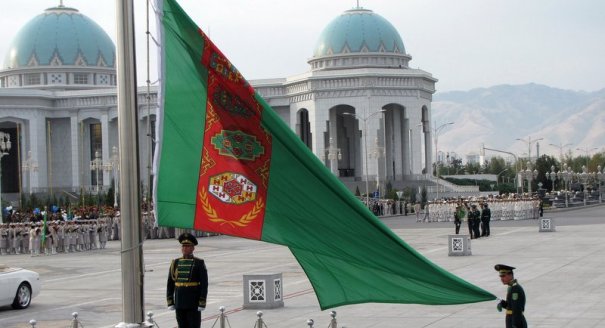
Turkey sees the acute energy market competition as an opportunity to establish itself both as an influential energy state and as a central Eurasian power. In this regard, choosing Turkmenistan as the site of one of the first state visits by the new Turkish president was not accidental.
The issue of diversification of sources and routes of gas supplies to Europe in recent years has become a focus of politicians and experts. Concerns about Europe’s dependence on Russian gas and oil have caused the oil-producing countries of the Middle East and Central Asia to offer their own alternatives. A large number of existing suppliers creates the illusion that there are enough choices. One of them is the “Southern Gas Corridor” project, in which Turkey is seeking to play an important role.
In this respect, Ankara’s efforts in the Turkmen direction deserve special attention. The Turkish President Recep Tayyip Erdoğan’s last visit to Ashgabat on November 7, which was held within the background of another surge of criticism of the Turkish leader domestically and in the West, should be considered within the context of the overall dynamics of Turkish politics in the region.
Choosing Turkmenistan as the site of one of the first state visits by the new Turkish president was not accidental; it reflects the foreign policy priorities of the “new Turkey.”
For the last six years, the two countries have been actively developing trade, economic, and political relations. With the bilateral volume of trade rising 30-40 percent per year, Turkey has become Turkmenistan’s largest trade partner. In 2013, more than 600 Turkish companies were working in Turkmenistan, and the trade volume index reached 4,746 billion dollars. This “Golden Age” of bilateral relations gives Ankara an opportunity to leverage its relationship with Turkmenistan to pursue its Central Asian strategy. The strategy focuses on issues of energy and regional security—especially with regard to Afghanistan where Turkey has been active since the early 2000s.
Turkmenistan has about 10 percent of the world’s natural gas (25.213 trillion cubic meters in absolute figures) which is sufficient to meet Turkey’s current annual natural gas demands of 46.5 billion cubic meters for the next 540 years. Over the last few years, the Turkmen government has worked to increase the attractiveness of its oil and gas markets to international investment and to diversify its export destinations. In addition to its existing exports to China, Russia, and Iran, Ashgabat would like to develop new export routes to Afghanistan, Pakistan, and India. Such an expansion would be possible with the realization of the Turkmenistan-Afghanistan-Pakistan-India gas pipeline (the TAPI project). Regarding its aspirations in the European market, Turkmenistan is banking on active cooperation with Turkey.
For Turkmenistan, Turkey is a vast and rapidly growing gas market with a strategically convenient geographic location.Tweet This
For Turkmenistan, Turkey is a vast and rapidly growing gas market with a strategically convenient geographic location. Over the last decade, the volume of the Turkish natural gas market has tripled and there is serious potential for further growth. Turkey’s current annual natural gas consumption of 46.5 billion cubic meters (greater than that of many EU countries) is expected to exceed 65 billion cubic meters by 2023. By that time, most of Turkey’s current gas supply contracts will have expired and the competition for the Turkish gas market will become more acute.
However Turkey’s ambitions in this sphere are not limited to increasing its natural gas consumption or optimizing the import of gas. Turkey aspires to become a key player in the global energy market. The fact that Turkey exports almost all of the natural gas that it produces (about 1 billion cubic meters per year) is not insignificant. Turkey is aiming to consolidate its position in the natural gas trade.
Thus, Turkmen gas is critical for Turkey not only for the purposes of assuring its own energy security but also as an instrument that will help Ankara become a significant player in European energy affairs as a transit country for Turkmen gas. For Ankara and Ashgabat, there are obvious economic benefits to increasing their energy cooperation: the growing export of Turkmen gas through Turkey will fuel Turkmenistan’s resource-based economy and provide for lucrative new contracts for Turkish construction companies. The agreements between Turkmen company “Türkmengaz” and Turkish company “Atagaz Doğalgaz A.Ş.,” which were signed during Erdoğan’s visit to Ashgabat, only confirm the importance of the bilateral relationship.
Turkey is aiming to consolidate its position in the natural gas trade.Tweet This
The goal behind Turkey’s strategy to strengthen its cooperation with Turkmenistan is to realize an old Turkish dream of turning Ankara into a global energy hub. The realization of this goal is tied to the development of the Southern Gas Corridor and the construction of the Trans-Caspian gas pipeline that would deliver Turkmen natural gas to Turkey via Azerbaijan and Georgia, thereby bypassing Russia.
However, the realization of this plan can be likened to a multi-variable equation for which Ankara has yet to find a solution. The Fourth Caspian Summit that took place in September in Astrakhan has shown that the construction of a pipeline at the bottom of the Caspian Sea will require Moscow’s consent. For obvious reasons, Russia intends to block this project. Meanwhile, Turkmen President Gurbanguly Berdimuhamedov continues to voice his country’s position by declaring that the construction of a pipeline is a sovereign right of the state through whose territory the pipeline is to be laid.
Another element of Turkey’s strategy is the Trans-Anatolian gas pipeline project (TANAP) which is set be completed by 2019. Ankara plans to use this pipeline in the delivery of natural gas from Azerbaijan’s Shah Deniz gas field to Europe. Erdoğan has already called for the inclusion of Turkmenistan in the TANAP.
Turkey’s plans obviously run counter to Russian interests since they aim to force Russian gas out of the European gas market and seek to substitute it with natural gas from Azerbaijan and Turkmenistan. The Turkey-Azerbaijan-Turkmenistan triangle has gained support not only from the EU (Ankara always appeals to European energy) and the United States but also from Georgia and Ukraine.
Turkey sees the acute energy market competition as a chance to take advantage of serious tensions between the West and Russia and use it as an opportunity to establish itself both as an influential energy state and as a central Eurasian power. In other words, it is revisiting the idea of turning Turkey into the political and economic nucleus of the Turkic world. During his visit to Turkmenistan, Erdoğan again confirmed Turkey’s ambitions to become the “super-power of the Middle East” through his severe criticism of Israel which Turkish people–according to the latest public opinion polls–dislike more than ISIS, Hezbollah, and Hamas.
Pavel Shlykov is a senior research fellow at the Institute of Asian and African Studies, Moscow State University.
Pavel Shlykov
Carnegie does not take institutional positions on public policy issues; the views represented herein are those of the author(s) and do not necessarily reflect the views of Carnegie, its staff, or its trustees.

Are Germany’s economic, industrial, and political struggles becoming a liability for the EU’s ability to rise to the geopolitical moment?

Rym Momtaz, ed.

European Commission President Ursula von der Leyen is about to give her annual address on the state of the EU. Here’s what she won’t—but should—say.
Rym Momtaz

The aftermath of the Ceuta crisis shows Europe has drawn the wrong lessons. Rather than doubling down on failed migration policies, the EU needs to address the underlying roots of such episodes.

Richard Youngs

Canadian Prime Minister Mark Carney has twice inspired praise for standing up to U.S. President Donald Trump: at the 2026 World Economic Forum in Davos and on Canada-U.S. trade negotiations. Is Carney showing a third way better than the EU has in dealing with the Trump administration?
Rym Momtaz, ed.

The EU’s responses to two recent incidents expose the gulf between European perceptions and capabilities. Unless the union can bridge that gap, it will never become a real geostrategic power.
Rym Momtaz