

Commentary
Dmitri Trenin
{
  "authors": [
    "Dmitri Trenin"
  ],
  "type": "legacyinthemedia",
  "centerAffiliationAll": "",
  "centers": [
    "Carnegie Endowment for International Peace",
    "Carnegie Russia Eurasia Center"
  ],
  "collections": [],
  "englishNewsletterAll": "",
  "nonEnglishNewsletterAll": "",
  "primaryCenter": "Carnegie Russia Eurasia Center",
  "programAffiliation": "",
  "programs": [],
  "projects": [],
  "regions": [
    "Russia"
  ],
  "topics": [
    "Political Reform",
    "Economy",
    "Foreign Policy"
  ]
}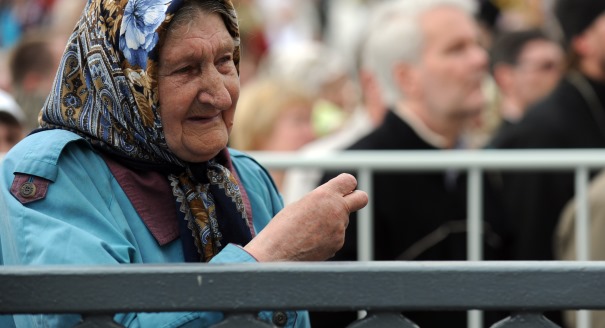
Source: Getty
For the Russian economic and political system, as well as for the country’s foreign relations, the current economic crisis is an existential one. Russia will exit from it in a very different form from what it is today.
Source: Global Times
Russia has entered an economic crisis, which will probably be more severe than the one it went through in 2008 and 2009. It will last a number of years and may lead to major changes.
According to the former finance minister Alexei Kudrin, Russia's GDP will contract by 2-4 percent in 2015 even if the oil price is at $80, inflation will shoot up to 12-15 percent, the country's and companies' credit ratings will be degraded to the junk level, and economic hardships may spark off social protests.
Unlike in the 2008 crisis or the default of 1998, Russia is facing the present troubles against a background of sharp and growing hostility in its relations with the US and the EU. For the Russian economic and political system, and for the country's foreign relations, this is an existential crisis. Russia will exit from it in a very different form from what it is today. How and when it will happen is anyone's guess.Many factors will determine the outcome. The most obvious one is the political will of the Russian government and its direction. The Kremlin could see the present crisis as a blessing in disguise. The plunge in the oil price at last gives a powerful argument for those who genuinely want to reduce Russia's overdependence on hydrocarbons.
With oil at $90 or $100 per barrel, leaders could only give lip service to the need of reform. With oil at $60 or $50, they have to start doing something about it.
This, however, is only true so far as the people in charge of Russia are really interested in reforming the economy, something which has not been in evidence over the last decade. It is thus conceivable, even likely, that now, under very difficult circumstances, they would still prefer to muddle through the rough patch for the next couple of years and keep the model which makes them feel comfortable and complacent. Unfortunately, this should be the basic assumption about Russia's future until there is evidence suggesting otherwise.
It's possible that the sharp devaluation of the ruble could make the Russian economy more competitive. Russian workers' wages had been rising steadily during Russian President Vladimir Putin's entire reign, including through the crisis years, but labor productivity in Russia had been lagging behind. Now, a sort of balance has been restored, even if in a typically abrupt and brutal fashion.
This, however, can only work if the state apparatus and state-owned corporations, in an act of solidarity, trim their own expenses. Inequality in Russia is among the highest in the world. Questions are already being raised about the compensation levels of the top managers appointed by the Kremlin.
Systemic corruption is an even more serious and pressing challenge. What thrived in the fat years of the oil boom is alive and well as Russia enters the lean years of crisis, but the consequences are no longer confined to the economy. It is the right time, one might argue, to move toward a system where rules and laws apply equally to all, administered by an independent judiciary. Skeptics, however, will respond that it is a wishful thinking to expect change from a system where corruption is not a bug, but a feature. The jury is still out.
In foreign policy, Russia needs to find a way to reduce the risk of the conflict in Ukraine spiraling out of control and leading to a major war. It has to adjust to a situation in which its relations with the West will be severely limited, but keep them stable, preventing further deterioration.
It needs to expand and deepen relations with non-Western nations, in Asia, Latin America and elsewhere, that have not joined the sanctions coalition, and make the most of those ties. It should not slide into autarky and self-imposed isolation.
In sum, the challenges before Russia are higher than at any moment in the last two decades. The genuine patriotic mobilization that sees Western sanctions as an act of aggression against Russia and its legitimate interests will help the Kremlin only if it comes up, for the first time in 15 years, with a credible strategy of economic development, coupled with an accountable government and equal justice for all. This will also require a serious rotation of the elites. Failing that, this crisis will either lead to Russia's irreversible decline into irrelevance or to upheavals and chaos.
Former Director, Carnegie Moscow Center
Trenin was director of the Carnegie Moscow Center from 2008 to early 2022.
Recent Work
Dmitri Trenin
Dmitri Trenin
Carnegie does not take institutional positions on public policy issues; the views represented herein are those of the author(s) and do not necessarily reflect the views of Carnegie, its staff, or its trustees.
As geopolitical rivalry weaponizes global supply chains, the EU’s true vulnerability lies in emerging-risk imports. For these goods, suppliers are growing more concentrated, substitution more difficult, and political risk is looming.

Sinan Ülgen
The EU is putting together a new security strategy to meet today’s myriad challenges. But for any proposal to be effective, the union needs to grapple with its identity and ambitions.

Pierre Vimont
Three years after the Ohrid Agreement, Kosovo and Serbia remain far from normalization. To revive implementation, the EU should abandon its ambiguity and act as an even-handed arbitrator.

Miloš Pavković, Fitim Gashi, Iliriana Gjoni, …
The EU’s new migration policy is not suited to today’s realities. With climate change increasingly becoming a driver of displacement, Europe needs to rethink its deterrence-focused approach.

Shana Tabak
Europe seems to have accepted its sidelining in the Middle East. The EU must reassert its support for the international rules-based order and step up engagement.

Rym Momtaz