

Commentary
Alexander Gabuev
{
  "authors": [
    "Alexander Gabuev"
  ],
  "type": "commentary",
  "centerAffiliationAll": "",
  "centers": [
    "Carnegie Endowment for International Peace",
    "Carnegie Russia Eurasia Center"
  ],
  "collections": [],
  "englishNewsletterAll": "",
  "nonEnglishNewsletterAll": "",
  "primaryCenter": "Carnegie Endowment for International Peace",
  "programAffiliation": "",
  "programs": [],
  "projects": [],
  "regions": [
    "Russia"
  ],
  "topics": [
    "Economy",
    "Foreign Policy"
  ]
}
Source: Getty
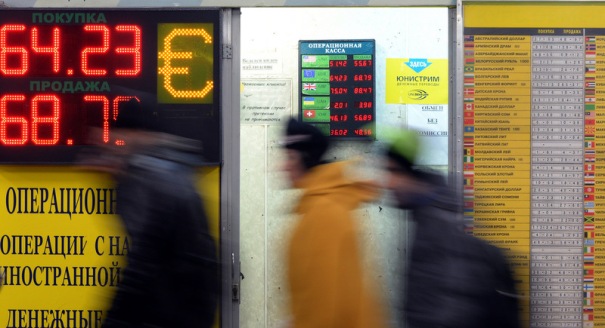
The falling oil price and rapid devaluation of Russian currency not only affect the economy, the budget, and the joking habits of the elite, but also have an effect on Moscow’s foreign policy.
“One day soon the ruble and the oil price will meet each other at 60.” So goes the joke of the day in Moscow. The falling oil price and rapid devaluation of Russian currency not only affect the economy, the budget and the joking habits of the elite, but also have an effect on Moscow’s foreign policy. The most recent case is Vladimir Putin’s decision to opt out of his long supported South Stream project aimed at constructing a 63 bcm a year underwater pipeline to Southern Europe and replace it with a new project connecting Russia with Turkey (parallel to the existing Blue Stream pipeline). Russian government officials and Gazprom managers have attributed the sudden U-turn to the European Commission’s pressure on Bulgaria, which recently recalled a permit to construct the South Stream on its territory. But the real cause, as many insiders privately admit, is the falling oil price—the Kremlin can no longer afford a new expensive pipeline bypassing Ukraine while existing pipelines are not operating at full capacity.
The Kremlin’s pipeline diplomacy has not only been affected in Europe. Gas pipeline “Power of Siberia,” which will be the first to link Russia with the booming Chinese market, is now under threat, although nobody in the government will admit it. The 400 billion dollars deal, signed in May during Putin’s visit to Shanghai, was hailed as a cornerstone of Russia’s new “Eastern policy.” With the price of Russian gas to China undisclosed by the parties and official estimates of construction costs running to 55 billion dollars (while unofficial ones show even higher figures), experts have argued whether the project will be economically feasible or not. When the contract was signed, the price of oil (to which the price of Russian gas is linked through a complicated formula) was about 100 dollars per barrel. Now it’s less than 70 dollars. It is difficult to penetrate Gazprom’s calculations, but people with knowledge of the situation say that price estimates were far from conservative. It remains to be seen whether Gazprom will manage to commission the pipe on time using its own funds, or will be forced to take money from the Chinese with new conditions imposed.
The second effect of current hardships on Russian policy toward Asia is visible on the investment track. The Kremlin has hoped to replace outflowing Western (and some domestic) capital by inviting the Chinese to invest in Russian assets. Chinese investors were cautious even in the past, but now to speak of Russia as a future destination for Asian investment makes one look insane. A good recent example was Russia’s showing at the MIPIM Asia in Hong Kong, the largest developers’ conference in the region. It was the first time the Russians showed interest in the event and appeared in large numbers. But all the attempts to pitch Russia’s case to the Asians were very awkward. In one session Moscow’s powerful deputy mayor Marat Khusnullin, rebuffing an investor’s skepticism, remarked that the Russian capital’s residential property is an “eternal value” and that profit margins are about 30 percent. Minutes later he was providing figures for budget expenditures on infrastructure, trying to impress the audience. “We are going spend 10 billion dollars, that makes 7 billion dollars in current prices.” “And that makes zero profit,” an Asian investor remarked. Predicting when the ruble or the oil price will stabilize is unreasonable—one is tied to another, and the oil price is beyond Moscow’s control. So the impact of Russia’s attempt to diversify away from Europe toward Asia may be crushed—just like the grand pipeline plans of Gazprom.
The only significant policy area which has not yet been affected is Kremlin policy toward Ukraine. At least in this point Moscow remains consistent and predictable.
Alexander Gabuev is deputy editor-in-chief of Kommersant Vlast.

Director, Carnegie Russia Eurasia Center
Alexander Gabuev is director of the Carnegie Russia Eurasia Center. Gabuev’s research is focused on Russian foreign policy with particular focus on the impact of the war in Ukraine and the Sino-Russia relationship. Since joining Carnegie in 2015, Gabuev has contributed commentary and analysis to a wide range of publications, including the Financial Times, the New York Times, the Wall Street Journal, and the Economist.
Recent Work
Alexander Gabuev
Alexander Gabuev
Carnegie does not take institutional positions on public policy issues; the views represented herein are those of the author(s) and do not necessarily reflect the views of Carnegie, its staff, or its trustees.

The European Commissioner for Trade is headed to China. But after President Xi’s bridge-building visit to Washington, can a more isolated EU overcome Beijing’s stranglehold on critical raw materials? Who will blink first?

Rym Momtaz, ed.

European NATO countries are wrestling with the possibility of U.S. disengagement from the alliance. With the continent’s security increasingly uncertain, governments must restore the credibility of their collective defense.



Hans-Dieter Lucas, Adam Thomson, Pierre Vimont

The domestic impacts of how long it is taking to end the war in Ukraine have pushed the French electorate to the political extremes and compromised the country’s diplomatic capacity.
Rym Momtaz

The new U.S.–Denmark–Greenland agreement will help Washington exert political, economic, and financial dominance under the guise of security. Yet, it acknowledged Copenhagen’s and Nuuk’s sovereignty on the island.

Marc Pierini

A summer of escalation in the Black Sea has hurt Ukraine economically and is exacerbating world food security. A truce is needed—as is a broader reframing of Europe’s Ukraine strategy.

Thomas de Waal