

Commentary
Andrei Kolesnikov
{
  "authors": [
    "Andrei Kolesnikov"
  ],
  "type": "commentary",
  "centerAffiliationAll": "",
  "centers": [
    "Carnegie Endowment for International Peace",
    "Carnegie Russia Eurasia Center"
  ],
  "collections": [],
  "englishNewsletterAll": "",
  "nonEnglishNewsletterAll": "",
  "primaryCenter": "Carnegie Endowment for International Peace",
  "programAffiliation": "",
  "programs": [],
  "projects": [],
  "regions": [
    "Russia",
    "Eastern Europe",
    "Ukraine",
    "Western Europe",
    "France",
    "Germany"
  ],
  "topics": [
    "Foreign Policy"
  ]
}
Source: Getty
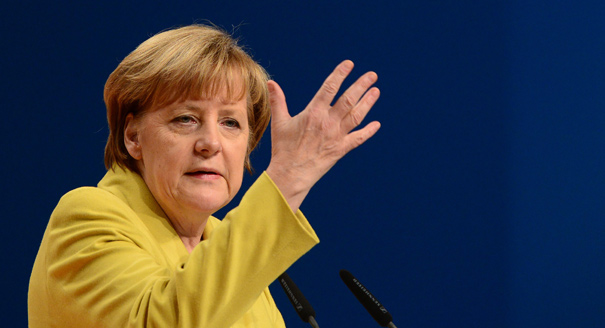
If Merkel is synonymous with Germany, then German political and diplomatic weight has certainly risen to the height of true European leadership.
Of course, nothing would have happened without Angela Merkel, the most influential European politician of our time. We wouldn’t have seen her and Francois Hollande in Moscow for a weekend blitz, nor would we have witnessed the magical night at the Normandy Four summit in Minsk, which conjures up associations with the Normandie-Niemen operation.
If Merkel is synonymous with Germany, then German political and diplomatic weight has certainly risen to the height of true European leadership. It is telling that Germany and France—two key states with a complicated history of bilateral relations and a baggage of past wars against each other—spearheaded the efforts to save peace in Europe. In fact, the Merkel-Hollande initiative looks quite symbolic and historically relevant in the context of the countries’ track record of military confrontation, as did the roles played by Jean Monnet, Robert Schuman, and Konrad Adenauer. Of similar importance was the French participation in constructing united Europe, which would have been impossible without Germany, and the reunification of Germany, which grew out of the collapse of the Iron Curtain and Berlin Wall.
If #Merkel is synonymous with #Germany, then German political and diplomatic weight has certainly risen.Tweet This
Vladimir Putin was once considered “a German in the Kremlin.” From a psychological and linguistic standpoint, he has an easier time communicating with the West through Germany. Being a responsible and forward-thinking politician, Merkel understands that and has been trying to translate Putin’s “dialect” of Russian into the language understandable to the Europeans. And being the most influential woman in the world, she is bound to share part of her charisma with the rest of Germany.
Former Senior Fellow, Carnegie Russia Eurasia Center
Kolesnikov was a senior fellow at the Carnegie Russia Eurasia Center.
Recent Work
Andrei Kolesnikov
Andrei Kolesnikov
Carnegie does not take institutional positions on public policy issues; the views represented herein are those of the author(s) and do not necessarily reflect the views of Carnegie, its staff, or its trustees.

Radical-right parties are expected to do well in upcoming elections in four of the EU's biggest member states. If successful, they could prevent the union from addressing key challenges ahead.

Stefan Lehne

The aftermath of the Ceuta crisis shows Europe has drawn the wrong lessons. Rather than doubling down on failed migration policies, the EU needs to address the underlying roots of such episodes.

Richard Youngs

An overwhelming victory by a far-right-wing party in a small state in eastern Germany will have major repercussions for Chancellor Friedrich Merz’s coalition.

Judy Dempsey

Canadian Prime Minister Mark Carney has twice inspired praise for standing up to U.S. President Donald Trump: at the 2026 World Economic Forum in Davos and on Canada-U.S. trade negotiations. Is Carney showing a third way better than the EU has in dealing with the Trump administration?

Rym Momtaz, ed.

The EU’s responses to two recent incidents expose the gulf between European perceptions and capabilities. Unless the union can bridge that gap, it will never become a real geostrategic power.
Rym Momtaz