

Commentary
Alexander Gabuev
{
  "authors": [
    "Alexander Gabuev"
  ],
  "type": "commentary",
  "centerAffiliationAll": "",
  "centers": [
    "Carnegie Endowment for International Peace",
    "Carnegie Russia Eurasia Center"
  ],
  "collections": [],
  "englishNewsletterAll": "",
  "nonEnglishNewsletterAll": "",
  "primaryCenter": "Carnegie Endowment for International Peace",
  "programAffiliation": "",
  "programs": [],
  "projects": [],
  "regions": [
    "North America",
    "United States",
    "Russia",
    "Eastern Europe",
    "Ukraine",
    "Western Europe"
  ],
  "topics": [
    "Foreign Policy",
    "Economy"
  ]
}
Source: Getty
When Russian diplomats talk about Ukraine, they are actually speaking to just one man—Vladimir Putin. Moscow does not see any value in reaching out to the broad policy community in the West. The scary thing is that this behavior is not a consequence of the Ukrainian crisis, but one of its major sources.
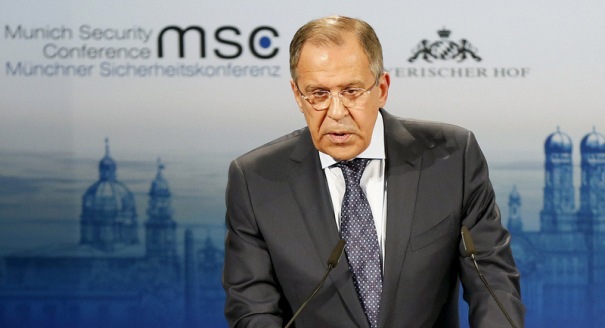
Russia’s performance at the recent Munich Security Conference (MSC), which culminated in Sergey Lavrov’s speech and the Western reaction to it, was accurately described by my Carnegie colleague Judy Dempsey as a “depressing and dangerous dialogue of the deaf.” Lavrov and later Konstantin Kosachev, head of the Russian Federation Council’s committee on foreign affairs, didn’t make any real attempt to reach out to the audience using language and arguments that could have made the Munich crowd understand Moscow’s stance on Ukraine and lay the foundations for dialogue. It’s not that Lavrov and Kosachev are incapable of this. They are among the most capable members of the current Russian foreign policy team—they speak good English, have vast experience with the West and could have found an appropriate way to present their narrative in a digestible format. Their actual performance shows not incompetence, but the delicate balancing act in which many members of Russia’s current foreign policy establishment find themselves.
The problem goes deeper than the desire to toe the boss’s line, so rooted in Russian bureaucratic culture. The critical issue is that Moscow doesn’t see any value in reaching out to the broad policy community in the West. Kremlin bosses are simply mirroring the Russian system. They think that only talking to “the real bosses” makes sense. At the heart of this attitude lies a deep misunderstanding of how the foreign policy making process in the United States and in EU is structured. For the Russian elite, only top-level decision makers (say Angela Merkel) and to some extent CEOs of international corporations (like BP’s head Bob Dudley) matter, as power is understood as a concentration of money and bureaucratic position. That’s why Russia’s presence is so much more visible in Davos than in Munich. (Sberbank President Herman Gref is the only regular visitor to MSC, while moguls like Oleg Deripaska and Victor Vekselberg who came to Munich for the first time this year appeared awkward and lost.) Near complete neglect of Western MPs, mid-level officials, think tankers and journalists merely mirrors the minimal level of influence Russian experts have on decision-making back home.
Russia’s previous attitude toward the MSC is very illustrative. Russian experts who are invited to Munich on a regular basis may be very experienced, smart and well-connected, but the reports and policy recommendations they send to the Kremlin may never reach Putin’s desk. No one in the current Russian leadership tries to use experts’ contacts in the West, no one gives them sanction to negotiate meaningfully in the track two format. And when key Russian officials come to Munich, they don’t appreciate the opportunities this platform provides for informal negotiations. There are multiple examples of this. Current chief of the Presidential Administration Sergey Ivanov, who used to attend MSC as the vice premier in charge of the military industry, used to throw small dinner parties for the Russian delegation and instead of going to networking dinners with international decisionmakers hosted by the MSC. Russians representing the state usually don’t show up at the cocktail reception on the first evening of the conference, where the foreign policy heart of the West beats. “It’s possible to bump into an enemy like Mikhail Saakashvili, so it’s better to minimize the risk and drink in familiar Russian company instead,” an official once explained to me. Last year, when Petro Poroshenko and Arseniy Yatsenyuk were desperate to meet Russian representatives in Munich and start dialogue, they were turned down. “Why should we send the wrong signal to Yanukovych and speak to nobodies?” was the reaction. Just two weeks later Yatsenyuk became Ukraine’s prime minister, and several months later Poroshenko was inaugurated as president. Examples of Russia’s inability to use the MSC go on and on.
The scary thing is that this behavior is not a consequence of the Ukrainian crisis, but one of its major sources. Relying on this type of understanding and attitude, Moscow first overestimated the significance of the EU’s Eastern Partnership initiative, then misunderstood the nature of the crisis in Kiev, and finally ended up overreacting to what it perceived as a coordinated effort by the West to steal Ukraine from Russia. A more engaged approach to venues like the MSC could have provided Moscow with a more balanced and accurate picture, and probably would have helped to prevent dangerous steps with grave consequences to Russia’s long-term interest. No less worrying is that, against this background, the frustrated Western foreign policy community may also be misguidedly leading both sides into a spiral of serious mistakes with grave consequences.

Director, Carnegie Russia Eurasia Center
Alexander Gabuev is director of the Carnegie Russia Eurasia Center. Gabuev’s research is focused on Russian foreign policy with particular focus on the impact of the war in Ukraine and the Sino-Russia relationship. Since joining Carnegie in 2015, Gabuev has contributed commentary and analysis to a wide range of publications, including the Financial Times, the New York Times, the Wall Street Journal, and the Economist.
Recent Work
Alexander Gabuev
Alexander Gabuev
Carnegie does not take institutional positions on public policy issues; the views represented herein are those of the author(s) and do not necessarily reflect the views of Carnegie, its staff, or its trustees.

Are Germany’s economic, industrial, and political struggles becoming a liability for the EU’s ability to rise to the geopolitical moment?

Rym Momtaz, ed.

European Commission President Ursula von der Leyen is about to give her annual address on the state of the EU. Here’s what she won’t—but should—say.
Rym Momtaz

Radical-right parties are expected to do well in upcoming elections in four of the EU's biggest member states. If successful, they could prevent the union from addressing key challenges ahead.

Stefan Lehne

The aftermath of the Ceuta crisis shows Europe has drawn the wrong lessons. Rather than doubling down on failed migration policies, the EU needs to address the underlying roots of such episodes.

Richard Youngs

Canadian Prime Minister Mark Carney has twice inspired praise for standing up to U.S. President Donald Trump: at the 2026 World Economic Forum in Davos and on Canada-U.S. trade negotiations. Is Carney showing a third way better than the EU has in dealing with the Trump administration?
Rym Momtaz, ed.