

Commentary
Alexey Malashenko
{
  "authors": [
    "Alexey Malashenko"
  ],
  "type": "commentary",
  "centerAffiliationAll": "",
  "centers": [
    "Carnegie Endowment for International Peace",
    "Carnegie Russia Eurasia Center"
  ],
  "collections": [],
  "englishNewsletterAll": "",
  "nonEnglishNewsletterAll": "",
  "primaryCenter": "Carnegie Russia Eurasia Center",
  "programAffiliation": "",
  "programs": [],
  "projects": [],
  "regions": [
    "Caucasus",
    "Russia"
  ],
  "topics": [
    "Political Reform",
    "Religion"
  ]
}
Source: Getty
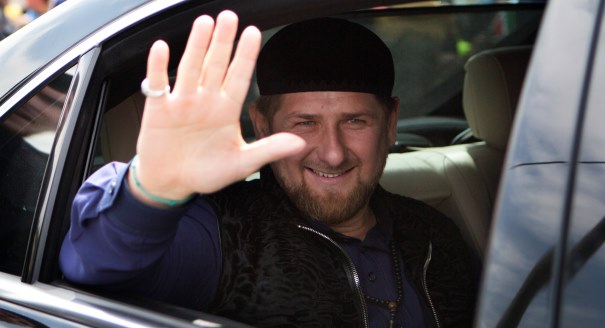
Putin and Kadyrov resemble Siamese twins, whose separation will result in complication for both of them, and thus for the country at large. Neither one of them stood to benefit from Boris Nemtsov’s death.
The Chechen connection has been discovered behind the murder of Boris Nemtsov, one of the Russian opposition leaders. This discovery has catapulted the Chechen head, Ramzan Kadyrov, to the center stage. Some consider him the chief organizer of the crime, while others think he fell victim to Russian special services’ efforts to besmirch his reputation in the eyes of Vladimir Putin.
The intrigue around Nemtsov’s murder once again highlighted the fact that Kadyrov is a federal-level politician whose reach extends well beyond the Chechen border.
But Putin made the right choice on two accounts. First, Ramzan is deeply grateful to the Russian president for his appointment (after all, Chechen elections have long been just a formality). Second, he was able to restore order in Chechnya, quite often resorting to blatantly brutal methods, which included killing his rivals and any other enemies of political stability in his republic. Putin, who is well aware of such “peacekeeping methods,” forgives Ramzan these “stabilization costs.” Perhaps, this was the reason why Putin went ahead with awarding Kadyrov the Order of Honor this March, despite the allegations that Kadyrov is tied to Nemtsov’s killing. By bestowing this award on Kadyrov, Putin was in effect saying, “I trust you, Ramzan.”
Putin also turned a blind eye to Chechnya’s Islamization: sharia laws and prohibitions are in full force in the republic, and Islam is used by Kadyrov to consolidate the society around his personal power. Essentially, we are dealing with an Islamic space within the borders of the Russian Federation, where traditional rules take precedence over federal laws. It is true that islamization is also a factor in other republics of the North Caucasus, but only in Chechnya is it initiated by a secular politician.
The Russian president and the Chechen head enjoy a special relationship tinged with mutual personal attachment. Putin generally tends toward informal ties. As a result, the Chechen relations with the federal center also have an air of intimacy to them.
The problem is that Kadyrov believes that these informal relations apply to all of Russia. He believes that he and all other Chechens have a right to extraterritoriality and thus can be either punished or exempt from punishment for violating Russian law when they so choose. He effectively removes himself from the jurisdiction of the Russian authorities, including special services, which are understandably extremely displeased with such independence on Kadyrov’s part.
All of this begets the question of how firmly the Kadyrov regime depends on Putin, and how self-sufficient he really is. It is likely that the “Putin factor” is decisive. Apparently, Ramzan understands it too. In 2013, he frankly admitted, “as long as I am supported by Putin, I can do anything.” We can also remember Ramzan’s statements that the current president of Russia should remain in office for life. The October 2014 rally in honor of Putin’s birthday, which attracted thousands of supporters, looks symbolic as well. Finally, it is also appropriate to recall how alarmed Kadyrov was when Dmitry Medvedev came to power in 2008.
Another amazing and rather eccentric pledge of fealty to the Russian president came in the form of Kadyrov’s support for the Russian position in the Ukraine crisis. Kadyrov stated that he could deploy 74,000 Chechens that could march all the way to Kiev to fight in Ukraine, and that he is personally ready to go there to sort out the local chaos. It is hard to say how much Putin liked the idea, since it did cast a shadow on his reputation; nevertheless, despite its restraint, the Kremlin was quite understanding of these pronouncements.
Vladimir Putin needs Ramzan Kadyrov as a guarantor of stability in the Chechen republic and, by extension, in the entire North Caucasus region. But during my visits to Chechnya, I heard numerous comments that Kadyrov could actually be replaced. In early 2015, it was rumored in Moscow that Putin was disappointed with Kadyrov, which gave rise to the theory that Nemtsov’s murder was a tactical move by some politicians directed at Ramzan’s elimination. It might be true, but no clear alternative to Kadyrov has emerged as of yet. His departure will inevitably destabilize the situation in Chechnya.
In this context, Putin and Kadyrov resemble Siamese twins, whose separation will result in complication for both of them, and thus for the country at large.
At the same time, Ramzan Kadyrov’s career plateaued after he became a federal-level politician. Where can he go next? There is simply no higher position that he can hold. Of course, we can hypothesize that such a position can in fact be invented to suit him—for instance, he could become a deputy prime minister, but what issues would he be responsible for?
On the other hand, Kadyrov clearly wants to claim the mantle as one of the leaders of Russia’s Muslim community, which includes 16 million Russian citizens and 4 to 5 million migrants from Central Asia and Azerbaijan. He is constantly meeting influential Muslim spiritual leaders and hosting countrywide religious and political-religious events. Kadyrov finances the construction of a mosque in Yekaterinburg as well as the repair and reconstruction of mosques in several other Russian cities. The higher echelons of Russia’s Muslim clergy willingly cooperate with him, both for financial and political reasons; such a friendship serves as an additional, albeit indirect, demonstration of their loyalty to the regime.
In another attempt to assert his leadership position in the Muslim community, Kadyrov organized a 700,000-strong rally in Grozny in connection with the Charlie Hebdo attack in Paris, when terrorists killed magazine staffers for publishing Prophet Muhammad cartoons (Kadyrov claims that close to a million people took to the streets). However, instead of being directed at the terrorists, the Grozny protests assailed the blasphemous Europeans who also betrayed their own traditions and chose the path of total permissiveness.
In fact, this position is in line with official Russian ideology and can therefore be embraced by Vladimir Putin. But even if we are to assume that the idea to hold the rally belongs to the Kremlin, Kadyrov’s actions were genuine and reflected his own beliefs.
It was not a present for Putin, and neither was Boris Nemtsov’s death. Neither one of them stood to benefit from it.
This publication originally appeared in Russian.
Former Scholar in Residence, Religion, Society, and Security Program
Malashenko is a former chair of the Carnegie Moscow Center’s Religion, Society, and Security Program.
Recent Work
Alexey Malashenko
Alexey Malashenko
Carnegie does not take institutional positions on public policy issues; the views represented herein are those of the author(s) and do not necessarily reflect the views of Carnegie, its staff, or its trustees.

Before the next wave of EU enlargement takes place, the union needs to grapple with thorny questions of how power is distributed among its members.


Emil Sondaj Hansen, Ditte Brasso Sørensen

A summer of escalation in the Black Sea has hurt Ukraine economically and is exacerbating world food security. A truce is needed—as is a broader reframing of Europe’s Ukraine strategy.

Thomas de Waal

European Commission President Ursula von der Leyen is about to give her annual address on the state of the EU. Here’s what she won’t—but should—say.

Rym Momtaz

The EU’s responses to two recent incidents expose the gulf between European perceptions and capabilities. Unless the union can bridge that gap, it will never become a real geostrategic power.
Rym Momtaz

European states control several Overseas Countries and Territories around the world that carry strategic, economic, and environmental weight. As great powers challenge the rules-based order, defending them is a geopolitical imperative for Europe.

Marc Pierini