

Commentary
Five countries staged the biggest political boycott in Eurovision history over Israel’s participation. With the FIFA World Cup and other sporting or cultural touchstones on the horizon, are boycotts effective?
Rym Momtaz, ed.
{
  "authors": [
    "Marc Pierini",
    "Sinan Ülgen"
  ],
  "type": "questionAnswer",
  "centerAffiliationAll": "dc",
  "centers": [
    "Carnegie Endowment for International Peace",
    "Carnegie Europe",
    "Malcolm H. Kerr Carnegie Middle East Center"
  ],
  "collections": [
    "Turkey’s Transformation"
  ],
  "englishNewsletterAll": "ctw",
  "nonEnglishNewsletterAll": "",
  "primaryCenter": "Carnegie Europe",
  "programAffiliation": "EP",
  "programs": [
    "Europe"
  ],
  "projects": [],
  "regions": [
    "Middle East",
    "Europe",
    "Türkiye",
    "Iran"
  ],
  "topics": [
    "Political Reform",
    "Foreign Policy"
  ]
}
Source: Getty
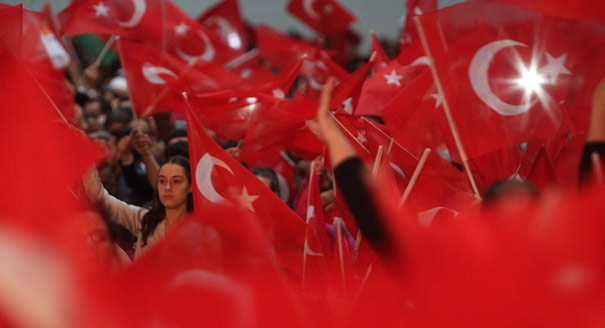
Turkey’s parliamentary election will mark a pivotal moment for the country’s future. Yet for the first time in over a decade, the outcome is clouded in uncertainty.
The outcome of Turkey’s parliamentary election on June 7, 2015, will mark a pivotal moment for the country’s future. Postelection scenarios include, at one extreme, a move by President Recep Tayyip Erdoğan to centralize power in the presidency and, at the other, the possibility of a coalition government after twelve years of single-party rule.
In this Q&A, Marc Pierini and Sinan Ülgen walk through the fundamentals of Turkey’s critical vote and explain its high stakes. Pierini and Ülgen say that the election is marked by several divisive issues, including the peace process to settle Turkey’s Kurdish problem and the integrity of the country’s democracy. Yet perhaps the defining feature of this election is that the outcome, for the first time in over a decade, is clouded in uncertainty.
This contest will center on the performance of Turkey’s pro-Kurdish Peoples’ Democratic Party (HDP). For the first time, the HDP is running as a political party instead of fielding independent candidates. The party is hoping to pass the 10 percent electoral threshold needed to secure representation in the parliament.
Meanwhile, the ruling Justice and Development Party (AKP), which has won every single election—presidential, legislative, and municipal—without serious opposition since first coming to power in 2002, is looking to introduce an executive presidency. After serving three terms as prime minister, the AKP’s charismatic leader, Recep Tayyip Erdoğan, became the country’s first directly elected president by winning 51.8 percent of the popular vote in August 2014.
Turkey’s social democratic Republican People’s Party (CHP), the current main opposition group, and the right-wing Nationalist Movement Party (MHP) are both expected to retain representation in the Grand National Assembly with hopes of becoming the junior partner in an eventual coalition with the AKP.
Erdoğan’s main objective is for the AKP to secure three-fifths of the seats—330 out of 550—in the Turkish assembly. This is the number needed to organize a referendum on constitutional amendments designed to introduce a powerful executive-style presidential system in Turkey.
Erdoğan’s campaign narrative is almost entirely geared toward achieving this presidential system. His stature makes this objective the de facto central focus of the current election, but this goal has drawn the opposition of all other political parties, as well as some discontent within the AKP itself.
A related and equally important outcome of the election will be the clarification of the future relationship between the presidency and the executive. If the country adopts a presidential system by referendum, the current president will be greatly empowered. On the contrary, if the election brings about a thin majority for the AKP or a coalition government, the executive will be strengthened, to the detriment of the president.
The future of the talks on a settlement of the Kurdish problem is also at stake, as a result of the HDP’s high-risk decision to run as a political group. If the Kurdish party fails to meet the 10 percent electoral threshold, ballots cast for the party will be proportionally redistributed in every electoral district among other groups represented in the legislature. That will mean huge gains for the AKP.
The HDP’s absence from the Turkish parliament could ensure the three-fifths majority that the AKP needs to initiate a constitutional referendum. At the same time, the disappearance of Kurdish representation in the parliament could lead to civil unrest in Turkey’s southeast, where the Kurds are primarily concentrated.
For this, the electorate has rewarded the AKP at the polls, but the economy is now suffering from a slowdown and is starting to be seen as a liability for the government. It is no surprise that the main opposition, the CHP, has very much focused its electoral rhetoric on an economic platform.
Democratic freedoms have also become an electoral issue. The AKP has lost its initial position as a pro-reform party, especially since the mid-2013 Gezi Park protests, which brought millions of Turks to the streets in growing frustration over rollbacks of social freedoms and Erdoğan’s increasingly top-down rule. A wave of corruption allegations against the AKP followed. But so far, neither development has significantly dented the AKP’s support base.
In contrast, the pro-Kurdish HDP has adopted a more inclusive rhetoric, aspiring to move beyond its traditional ethnic vote and embrace Turkey’s more liberal constituencies. The HDP’s championing of gender equality, with significantly more female candidates than all other parties, is also of note.
The final result is too close to call, as small, last-minute shifts in electoral preferences could make all the difference.
On average, recent opinion polls suggest that the ruling AKP has the support of 43 percent of the electorate. The main opposition CHP is polling at approximately 26 percent, the nationalist MHP at around 17 percent, and the pro-Kurdish HDP at close to 10 percent of the votes (see figure 1).

Seat simulations show that minute variations for the HDP around the 10 percent threshold produce very different postelection scenarios (see figure 2).
According to one simulation, the HDP clears the 10 percent hurdle and secures representation in the parliament. The AKP does not reach a simple majority of 276 seats and has to form a coalition government.
In a second scenario, the HDP falls short of the 10 percent threshold. The AKP gets a simple majority in the parliament and is able to form a single-party government, but the party falls short of the three-fifths majority of seats needed to introduce a referendum on amending the constitution.
In a third outcome, the HDP again falls short of the 10 percent threshold. The AKP reaches a three-fifths majority, having won more than 330 seats, and is therefore able to hold a constitutional referendum.
In a fourth possibility, the HDP wins 10 percent of the vote and enters the parliament, while the AKP secures a simple majority. If this happens, the AKP can form a single-party government but will not be able to propose a constitutional referendum on its own.

How bumpy the road is for Turkey in the months and years to come will depend in part on the composition of the new parliament.
If the AKP does not manage to win a three-fifths majority, Erdoğan could still trigger a referendum by forming a coalition—with the HDP, for example. In general, Turkey has not had long-term stability under multiparty governments, and the emergence of a coalition may be the harbinger of more elections to come.
If the HDP fails to clear the 10 percent hurdle, the Kurdish movement—without any representation in the parliament—may move to unilaterally implement its agenda of autonomous rule for Turkey’s southeast. The real risk is that popular support might shift from the HDP to more radical elements of the Kurdish movement. Such a scenario could trigger a confrontation with the government, against the backdrop of rising regional instability.
Even if the AKP wins a three-fifths majority and the president decides to go for a referendum on introducing an executive presidency, Turkey will be in the grips of another year or so of intense political campaigning about changing its current political system. That is itself a very divisive issue.
A single-party AKP government would continue Turkey’s recent efforts to recalibrate its foreign policy. Following a string of post–Arab Spring policy failures and its growing regional isolation, Ankara has shown a willingness to improve its relationships with some of its key regional and Western allies.
Regionally, Turkey started to normalize its ties with Saudi Arabia, as illustrated by the visit Erdoğan paid to Saudi King Salman in March 2015 and Turkey’s political support for the Saudi-led operation against Houthi rebels in Yemen. The Turkish leadership had also greatly scaled back its heavy criticism of the Egyptian government of President Abdel Fattah el-Sisi—until a court in Egypt sentenced the country’s deposed president Mohamed Morsi to death in May 2015.
Looking West, Ankara concluded an important agreement with Washington to train and equip Syrian opposition members and opened up a Turkish air base for use by armed U.S. drones. More recently, Turkey’s government confirmed its willingness to start negotiations with the EU on deepening the country’s economic integration with Europe.
But a more permanent improvement of Turkey’s relationships—with its Western partners in particular—will depend on urgently needed improvements to Turkey’s democratic practices and the rule of law.
An AKP-HDP coalition government could accelerate this process of democratic reform, especially as the settlement of the Kurdish problem will depend on the adoption of a large-scale democratization package.
An AKP-MHP coalition, however, may be less conducive to such an outcome. The inherently more nationalistic structure of such a pairing may also be an impediment to resolving the division of Cyprus between Greek Cypriots and Turkish Cypriots. On this issue, a window of palpable opportunity seems to have emerged with the April 2015 election of Mustafa Akıncı as the leader of the Turkish Cypriots.
Whatever the result of the forthcoming vote in Turkey, the country’s political landscape is perhaps becoming less predictable than it has been during the last twelve years, with major consequences both at home and abroad. Turkey’s June 7 election is one to watch.

Senior Fellow, Carnegie Europe
Marc Pierini is a senior fellow at Carnegie Europe, where his research focuses on developments in the Middle East and Turkey from a European perspective.

Senior Fellow, Carnegie Europe
Sinan Ülgen is a senior fellow at Carnegie Europe in Brussels, where his research focuses on Turkish foreign policy, transatlantic relations, international trade, economic security, and digital policy.
Carnegie does not take institutional positions on public policy issues; the views represented herein are those of the author(s) and do not necessarily reflect the views of Carnegie, its staff, or its trustees.
Five countries staged the biggest political boycott in Eurovision history over Israel’s participation. With the FIFA World Cup and other sporting or cultural touchstones on the horizon, are boycotts effective?

Rym Momtaz, ed.
The full list of humiliations Europe has endured since Donald Trump returned to the White House makes for grim reading. But Washington’s adversarial approach to its allies undermines its own power base.
Rym Momtaz
The U.S.-Iran war has crossed a dangerous threshold: water infrastructure in the Gulf is now a target. Ecological statecraft is no longer peripheral to security, it's part of its foundations.


Olivia Lazard, Ali Bin Shahid
The closure of the Strait of Hormuz has triggered a global energy crisis, but Europe is stuck in reaction mode. Without more strategic foresight, the EU will remain dependent on fossil fuels and will never be truly secure.


Milo McBride, Pauline Gerard
Debate is heating up on how Turkey could be integrated into a common European defense framework. Commercial and industrial deals offer a better chance at alignment than sweeping political efforts.
Marc Pierini