

Commentary
Alexey Malashenko
{
  "authors": [
    "Alexey Malashenko"
  ],
  "type": "legacyinthemedia",
  "centerAffiliationAll": "",
  "centers": [
    "Carnegie Endowment for International Peace",
    "Carnegie Russia Eurasia Center"
  ],
  "collections": [],
  "englishNewsletterAll": "",
  "nonEnglishNewsletterAll": "",
  "primaryCenter": "Carnegie Russia Eurasia Center",
  "programAffiliation": "",
  "programs": [],
  "projects": [
    "Eurasia in Transition"
  ],
  "regions": [
    "South Asia",
    "Afghanistan",
    "Pakistan"
  ],
  "topics": [
    "Security",
    "Religion"
  ]
}
Source: Getty
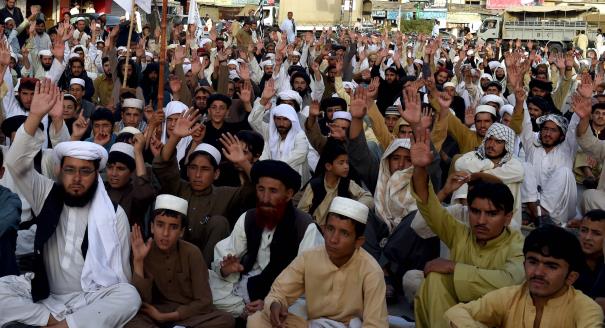
The appointment of Mullah Akhtar Mohammad Mansour as leader of the Taliban in Afghanistan can be viewed in two ways: as a victory for Pakistan (which clearly supports Mansour) or as the strengthening of radical tendencies within the Taliban.
Source: Russian International Affairs Council
What does the appointment of Mullah Akhtar Mohammad Mansour as the Supreme Commander of the Taliban in Afghanistan mean? What could it lead to?
The Taliban was founded by Mullah Mohammed Omar, who also served as Head of the Supreme Council of the Islamic Emirate of Afghanistan from 1996 to 2001. Mullah Omar could hardly claim supreme leadership, but at the same time, however, nobody ever seriously doubted it. He used his charisma, although not all-encompassing, to mediate between the various factions of the group. When Mullah Omar died in 2013, the Taliban saw fit to hide the fact from the rest of the world and even ignore it. After all, why aggravate the already difficult situation within the Taliban? After his death (possibly from tuberculosis, possibly as the result of poisoning), Mullah Omar’s representatives and members of his family continued to make official statements in his name.
But even Afghanistan couldn’t keep a secret this big, and the death of Mullah Omar was finally recognized as fact, meaning that the time had come to choose a successor.This didn’t take long, as Akhtar Mansour, who had been considered Mullah Omar’s right-hand man since 2010, was named new leader of the Taliban. Following the war against the Soviets, Mansour fled to Peshawar, where he continued his studies in a local madrassa. It was here that he most likely met Mullah Omar. He returned to Afghanistan in 2006, where he was active in recruiting new members to the Taliban. Mansour held several high-ranking positions in the Taliban, including Deputy Chairman of the Quetta Shura, Head of the Military Division and Governor of the (Taliban) province of Kandahar.
Mansour does not have the authority that the late Sheikh enjoyed. Moreover, the legitimacy of his appointment is shrouded in doubt. Initially, he was not elected to the Quetta Shura (council). Additionally, and this is particularly important, many within the organization believed that Mullah Omar’s successor should be someone from his own family and the most likely candidates would, therefore, be his brother Abdul Manan and his son Yaqoob. Mullah Omar did not support such initiatives himself, however.
The announcement of Mullah Omar’s death and subsequent appointment of Mansour as the new leader of the movement can be explained by two factors. First, it can be seen as a result of the deepening split within the ranks of the Taliban, between the moderates on the one hand and the radicals on the other. The moderates are involved in negotiations in Qatar with the United States and the Kabul leadership on the possibility of reaching a compromise and creating a coalition leadership that would include the Taliban. Many experts believe that there is no such thing as “moderate Taliban”, and there never can be. On the other hand, it cannot be denied that there are many pragmatists among the ranks of the Taliban.
It is also worth mentioning that an official statement made in July 2015 on Mullah Omar’s behalf expressed support for the negotiation process taking place in Qatar. We can add to this the fact that Mullah Omar resisted the Taliban’s subjugation to Al-Qaeda and frequently disagreed with Osama bin Laden.
Pragmatists oppose the so-called “Pakistan Taliban”, which continues to take a tough stance in its policies and seeks to overthrow the current Afghan regime of Mohammad Ashraf Ghani.
The struggle between the two sides will continue, contributing further to the split within the organization, which currently control’s up to 70 per cent of the territory of Afghanistan. Even in Kabul the saying is that the government rules the country during the day, while the Taliban rules at night. The question is which members of the Taliban? And where? One way or another, the split is weakening the organization.
The second factor concerns the situation in Afghanistan, including the spread of the Islamic State (ISIS) and its influence on the Taliban. ISIS already has a presence in 25 provinces in Afghanistan, and this number will only grow. And Akhtar Mansour has declared that the jihad will be fought until the bitter end. He favours cooperation with Islamists in the Middle East and, just like his predecessor, supports the idea of the Taliban joining ISIS.
Pakistan is also interested in this and is counting on the help of ISIS to strengthen its positions in Afghanistan and, having weakened the “pragmatists”, bring the entire movement under its control.
The appointment of Akhtar Mansour as leader of the Taliban can be viewed in two ways: as a victory for Pakistan or as the strengthening of the radical tendencies within the Taliban. Akhtar Mansour is clearly supported by Pakistan. Now it is up to opponents of the new leader to make their voice heard.
This article originally appeared on the Russian International Affairs Council site.
Former Scholar in Residence, Religion, Society, and Security Program
Malashenko is a former chair of the Carnegie Moscow Center’s Religion, Society, and Security Program.
Recent Work
Alexey Malashenko
Alexey Malashenko
Carnegie does not take institutional positions on public policy issues; the views represented herein are those of the author(s) and do not necessarily reflect the views of Carnegie, its staff, or its trustees.

European states control several Overseas Countries and Territories around the world that carry strategic, economic, and environmental weight. As great powers challenge the rules-based order, defending them is a geopolitical imperative for Europe.

Marc Pierini

Mounting economic strain and battlefield losses will not necessarily make the Kremlin less dangerous. They could instead push Moscow toward a more aggressive hybrid campaign designed to test NATO’s Eastern flank, exploit allied hesitation, and fracture European resolve.

Maksym Beznosiuk

Over the past ten years, NATO has held almost as many summits as it did during the entirety of the Cold War. Are they still useful, or is it time to stop holding annual meetings?

Rym Momtaz, ed.
As Russia's war on Ukraine drags on, NATO is expanding its footprint in the Black Sea. Turkey, Romania, and Bulgaria are upgrading their fleets and deepening trilateral cooperation.

Dimitar Bechev
For ninety years, Turkey has been positioned as the principal gatekeeper of Black Sea security. As a result, European and NATO efforts to support Ukraine will require closer engagement with Ankara.

Thomas de Waal