

Commentary
Sarah Chayes
{
  "authors": [
    "Sarah Chayes"
  ],
  "type": "legacyinthemedia",
  "centerAffiliationAll": "dc",
  "centers": [
    "Carnegie Endowment for International Peace"
  ],
  "collections": [
    "Arab Awakening",
    "Democracy and Governance"
  ],
  "englishNewsletterAll": "democracy",
  "nonEnglishNewsletterAll": "",
  "primaryCenter": "Carnegie Endowment for International Peace",
  "programAffiliation": "DCG",
  "programs": [
    "Democracy, Conflict, and Governance"
  ],
  "projects": [],
  "regions": [
    "North Africa",
    "Tunisia"
  ],
  "topics": [
    "Political Reform",
    "Democracy",
    "Civil Society"
  ]
}
Source: Getty
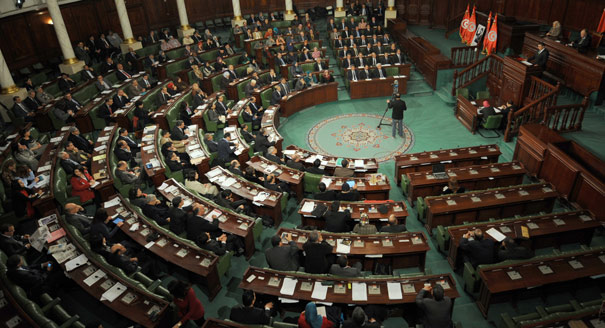
The selection of a coalition of labor union leaders, businesspeople, lawyers, and human rights activists for the 2015 Nobel Peace Prize raised attention and hopes for Tunisia’s transition process.
Source: WNYC Takeaway
The Norwegian Nobel Committee awarded the 2015 Nobel Peace Prize to a coalition of labor union leaders, businesspeople, lawyers, and human rights activists in recognition of their efforts to negotiate a peaceful end to the political crisis in Tunisia in 2013-14. Speaking on WNYC Takeaway with John Hockenberry, Carnegie’s Sarah Chayes explained who these groups were, how they achieved this breakthrough, and why the regional and local political context of the Arab Spring was key to the process. She pointed out that Tunisia’s political leaders after the Arab Spring had little experience in negotiation and revealed how the labor and business leaders taught the political leaders to resolve their differences peacefully. In addition, the government crackdown on Islamists in Egypt following the fall of President Morsi in Egypt as well as a number of assassinations of leftist political leaders in Tunisia spurred the resolution of the crisis, Chayes explained.
Former Senior Fellow, Democracy, Conflict, and Governance Program
Sarah Chayes is internationally recognized for her innovative thinking on corruption and its implications. Her work explores how severe corruption can help prompt such crises as terrorism, revolutions and their violent aftermaths, and environmental degradation.
Recent Work
Sarah Chayes
Carnegie does not take institutional positions on public policy issues; the views represented herein are those of the author(s) and do not necessarily reflect the views of Carnegie, its staff, or its trustees.

Radical-right parties are expected to do well in upcoming elections in four of the EU's biggest member states. If successful, they could prevent the union from addressing key challenges ahead.

Stefan Lehne

An overwhelming victory by a far-right-wing party in a small state in eastern Germany will have major repercussions for Chancellor Friedrich Merz’s coalition.

Judy Dempsey

In supporting Europe’s far-right, MAGA and Russia both want the same thing: a weaker EU. Europe must defend itself without abandoning the openness these forces exploit.

Armida van Rij

The hybrid warfare landscape is evolving rapidly, leaving policymakers without clear strategies. To better inform their work in addressing emerging challenges, governments must dig deeper into the underlying dynamics at play.


Raluca Csernatoni, Alicia Wanless

As the EU confronts profound challenges, several leaders have called for fundamental reform to the union’s model—but only modest, superficial changes have resulted. What if Europe really could be reimagined from zero today: What should such a redesigned European order look like?

Richard Youngs, ed.