

Article
C. Raja Mohan, Darshana M. Baruah
{
  "authors": [
    "C. Raja Mohan"
  ],
  "type": "legacyinthemedia",
  "centerAffiliationAll": "dc",
  "centers": [
    "Carnegie Endowment for International Peace",
    "Carnegie India"
  ],
  "collections": [],
  "englishNewsletterAll": "ctw",
  "nonEnglishNewsletterAll": "",
  "primaryCenter": "Carnegie India",
  "programAffiliation": "SAP",
  "programs": [
    "South Asia"
  ],
  "projects": [],
  "regions": [
    "Asia",
    "South Asia",
    "India",
    "East Asia",
    "Japan"
  ],
  "topics": [
    "Foreign Policy",
    "Security",
    "Military"
  ]
}
Source: Getty
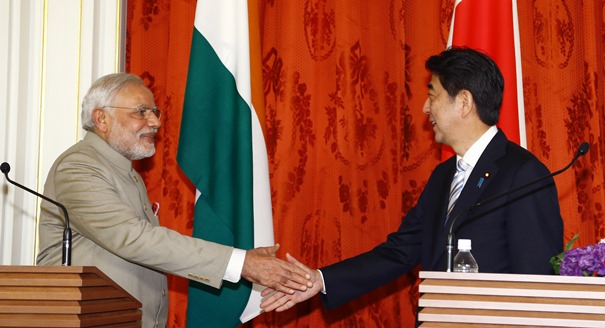
Narendra Modi and Shinzo Abe are betting that Japan and India can influence Asia’s strategic future by reclaiming regional leadership.
Source: Indian Express
It has been the received wisdom for decades that neither Japan nor India can lead Asia in the 21st century. After its Asian ambition was gutted by a comprehensive defeat in World War II, Japan was constrained by its peace constitution. Newly independent India began with the dream to lead Asia. But by the 1960s, New Delhi was tied down by conflict in the subcontinent. Delhi’s Look East policy, unveiled at the turn of the 1990s, was about catching up with Asia that had meanwhile surged way ahead of India.
In the second half of the 20th century, Japan earned an unenviable reputation as an “economic giant, but a political pygmy”. India, by opting out of Asia’s power politics, had made itself into “a big tree that gave no shade”. As Tokyo’s pacifism and Delhi’s non-alignment marginalised Japan and India, it was not difficult to believe that the destiny of Asia was in the hands of China and America.But the nationalist premiers of Japan and India — Shinzo Abe and Narendra Modi — who are meeting this weekend in Delhi have a very different set of ideas. They are betting that Japan and India can influence Asia’s strategic future by reclaiming regional leadership. Translating this ambition into reality, Abe and Modi know, will depend to a large extent on their ability to build an alliance between Tokyo and Delhi.
But the idea of an India-Japan alliance goes against the grain of postwar political traditions in both capitals. India says it does not do alliances. Japan insists that it’s wedded to strict monogamy; its only alliance will be with America. But the assertiveness of a rising China and the growing salience of the US-China relationship are compelling Delhi and Tokyo to rethink their default positions.
As part of his bold effort to make Japan a normal nation, Abe has loosened the constitutional restrictions on Japan’s military policies, accepted a larger share of the American defence burden in Asia, demonstrated the political nerve to stand up to China’s military provocations and expanded security cooperation with a large number of Asian nations, including Australia, the Philippines, Vietnam and India. Abe has also offered an alternative to Beijing’s Silk Road initiatives on infrastructure development in Eurasia and the Indo-Pacific.
Modi, for his part, has begun to shed many of the strategic inhibitions that prevented his predecessor, Manmohan Singh, from taking full advantage of the geopolitical opportunities that have come India’s way over the last decade.
Modi has also begun to move Delhi away from the ideological burden of non-alignment to the concept of a “leading power”, demonstrating a commitment to defending India’s core interests and building more wide-ranging partnerships.
As they reimagined the international roles of India and Japan, Modi and Abe were inevitably drawn together. Japan was on the top of Modi’s foreign destinations and he visited Tokyo in August 2014, weeks after taking charge as India’s prime minister. Abe, who had signalled his special interest in India during his first tenure as PM during 2006-07, has jumped at the prospect of transforming relations with India in partnership with Modi.
Over the last year and a half, Modi and Abe have pressed ahead on four major fronts. The first was to liberate the bilateral relationship from the nuclear issue that has hobbled bilateral relations since 1998, when India declared itself a nuclear-weapon power. Japan’s well-known nuclear allergy has posed difficulties in clinching an agreement on civil nuclear cooperation. Abe, who is working hard to overcome entrenched Japanese resistance, is close to delivering on nuclear cooperation with India.
Second, Abe and Modi have intensified bilateral defence cooperation, which had begun in the last decade. Besides an agreement on the sale of advanced amphibious aircraft, the US-2, Delhi and Tokyo are also likely to sign a framework agreement that will facilitate defence technology transfer and the co-production of weapons. Interesting ideas on maritime cooperation are also on the table.
Third, the two leaders are keen to lend credibility to the ambitious goals of economic cooperation they had set in Tokyo last year. An agreement on building a high-speed railway line between Mumbai and Ahmedabad could be one of the major highlights of Abe’s visit. The two leaders had worked overtime to convince sceptics on both sides to launch the ambitious project to bring the Indian Railways up to speed.
Fourth, Modi and Abe have looked beyond the bilateral to elevate the trilateral engagement with America to the ministerial level. Foreign Ministers Sushma Swaraj and Fumio Kishida sat down with US Secretary of State John Kerry on the margins of the United Nations meet in September. Modi has brought the Japanese navy back into the annual Malabar exercises with the US in the Indian Ocean. Delhi and Tokyo have also launched an official three-way conversation with Australia.
While this new mini-lateralism is important, the international future of India and Japan is inextricably tied to their bilateralism. Modi and Abe deeply appreciate America’s enduring significance as a security partner. They also acknowledge China’s centrality in their economic calculus. But without a strong India-Japan partnership, Delhi and Tokyo will have to either countenance a Sino-centric Asian order or cope with the wild oscillations in Sino-US relations.
An India-Japan alliance, in contrast, can actively shape the outcomes in US-China relations and promote a stable Asian balance of power. An alliance between India and Japan has been a tantalising idea for nearly a century. Modi and Abe can move Delhi and Tokyo closer to that goal by pushing for deeper economic interdependence, political coordination of their regional policies, and strategic collaboration between their armed forces.
Former Nonresident Senior Fellow, Carnegie India
A leading analyst of India’s foreign policy, Mohan is also an expert on South Asian security, great-power relations in Asia, and arms control.
Recent Work

C. Raja Mohan, Darshana M. Baruah


Alexander Gabuev, Paul Haenle, C. Raja Mohan, …
Carnegie does not take institutional positions on public policy issues; the views represented herein are those of the author(s) and do not necessarily reflect the views of Carnegie, its staff, or its trustees.

The EU can impose sanctions but struggles to enforce them without the United States. With Washington increasingly disinterested in backing European interests, the bloc must now fend for itself.


Nicu Popescu, Tiago Antunes

Russia is testing the waters of NATO’s mutual defense clause. What do strikes in Romanian territorial waters mean for the alliance’s posture toward Moscow?

Dimitar Bechev

With its public finances in shambles, the far right polling at 35 percent ahead of the 2027 presidential election, and a growing protest movement, is France’s crisis a threat to the EU’s geopolitical awakening?

Rym Momtaz, ed.

Ahead of a tough winter for Ukraine, Donald Trump’s swing back toward Russia bodes ill. But instead of panicking, Kyiv’s European allies are focusing on action.
Rym Momtaz

Funding Ukraine remains a priority for European leaders. As Russia’s war of aggression heads into another winter, two feasible options to mobilize support for Kyiv should be fast-tracked.


Vladyslav Rashkovan, Gregory P. Wilson