

Article
C. Raja Mohan, Darshana M. Baruah
{
  "authors": [
    "C. Raja Mohan"
  ],
  "type": "legacyinthemedia",
  "centerAffiliationAll": "dc",
  "centers": [
    "Carnegie Endowment for International Peace",
    "Carnegie India"
  ],
  "collections": [],
  "englishNewsletterAll": "ctw",
  "nonEnglishNewsletterAll": "",
  "primaryCenter": "Carnegie India",
  "programAffiliation": "SAP",
  "programs": [
    "South Asia"
  ],
  "projects": [],
  "regions": [
    "Asia",
    "South Asia",
    "India",
    "East Asia",
    "Japan"
  ],
  "topics": [
    "Economy",
    "Foreign Policy",
    "Trade"
  ]
}
Source: Getty
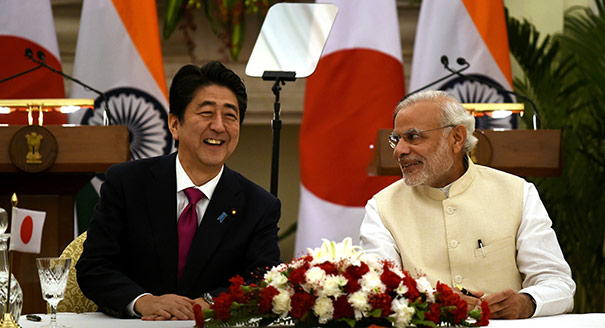
India’s unfolding partnership with Japan allows Delhi to respond more effectively to China’s One Belt, One Road initiative.
Source: Indian Express
Although very understated, there is no ignoring the hopes of Prime Ministers Narendra Modi and Shinzo Abe to develop their own version of the Silk Road in response to China’s expansive “One Belt, One Road” (OBOR) initiative in Eurasia and the Indo-Pacific.
In a statement issued at the end of their talks in Delhi over the weekend, Modi and Abe pointed to “the synergy between India’s ‘Act East’ policy and Japan’s ‘Partnership for Quality Infrastructure’”. The tongue-twisting acronym, PQI, will of course never compete with the OBOR for public attention.But Abe is betting that the attractive financial terms and the high quality of investment associated with Japan’s PQI, first articulated last May, will more than compensate for the lack of sex appeal associated with China’s Silk Road initiatives.
Abe’s PQI might not be as sweeping as Chinese President Xi Jinping’s ambition to expand rail, road and pipeline networks across Eurasia and promote maritime connectivity between the Indian and Pacific Oceans. But Japan, with its much longer experience in supporting infrastructure development in other countries, has finally begun to lend a strategic dimension to its very large overseas economic assistance.
For Modi, Abe’s initiative could not have come at a more opportune moment.
India has watched warily as Xi laid out bold plans to develop the $46 billion China-Pakistan economic corridor running across the Karakoram mountains to the Arabian Sea. India has finessed a proposal to build the so-called K2K corridor that connects Kolkata in the eastern subcontinent with Kunming in China’s southwestern province of Yunnan through Bangladesh and Myanmar. New Delhi has also been nervous about Beijing’s rapid modernisation of transport infrastructure in Tibet and its plans to extend road and rail networks into Nepal and Bhutan.
If Xi put all his political prestige behind the OBOR, India has been unwilling to say either yes or no to these initiatives.
Nor did it have the resources or the capability to develop alternative proposals, notwithstanding some facile talk about “Project Mausam”, “Spice Route” and “Cotton Route”.
The unfolding development partnership with Abe, however, allows Modi to respond more effectively to China’s OBOR. That Abe has his own reasons to compete with China on infrastructure exports has brought the interests of Delhi and Tokyo in alignment on promoting regional connectivity.
Abe’s agreement with Modi on building a high-speed railway system between Ahmedabad and Mumbai is a big boost to the Japanese strategy to promote infrastructure exports. Tokyo had recently lost the bidding war for a high-speed railway project in Indonesia and was not pleased with Beijing wrapping similar contracts in Thailand.
The ambitions of Modi and Abe go beyond linking Ahmedabad with Mumbai. As their joint statement noted, “the two prime ministers decided to develop and strengthen reliable, sustainable and resilient infrastructures that augment connectivity within India and between India and other countries in the region”.
And therein lies the big difference between Chinese and Japanese plans. Beijing’s plans, naturally, are about connecting China’s continental economy to India’s smaller neighbours. All roads in the OBOR lead to China. Tokyo, in contrast, is ready to promote India’s integration with its neighbours in the subcontinent and beyond. If Delhi can flesh out credible projects for regional economic connectivity within and across the subcontinent, it can now count on Japanese support.
Of special import are the very attractive financial terms that Japan has offered to fund the $15 billion high-speed railway system between Ahmedabad and Mumbai. The Japanese are offering $12 billion at very low interest rates, a liberal repayment schedule and the promise to produce some of the equipment in India.
These generous terms will inevitably be compared with those of China’s OBOR projects. In many countries, including Sri Lanka, there is strong concern that the long-term costs of Chinese assistance for infrastructure projects might be high and hidden.
Mindful of the widespread speculation about high-level corruption in the award of infrastructure contracts to Chinese companies, Modi and Abe insisted that they will advance “industrial networks and regional value chains with open, fair and transparent business environment in the region”. While few nations would want to dump the OBOR in favour of the PQI, the Japanese are improving their capacity to bargain with Beijing.
Modi and Abe also promised to enhance “their cooperation and coordination bilaterally and with other stakeholders to realise this strategic initiative”. If it is serious about a joint strategic regional infrastructure initiative with Japan, India must ask itself two big questions. Why is Delhi putting Indian taxpayer rupees into Beijing-led financial institutions like the BRICS Bank and the Asian Infrastructure Investment Bank, if it is politically uncomfortable with Chinese Silk Road projects in the neighbourhood? Might India be better off pooling its limited financial resources with Tokyo that promises to mobilise $110 billion behind the PQI?
Former Nonresident Senior Fellow, Carnegie India
A leading analyst of India’s foreign policy, Mohan is also an expert on South Asian security, great-power relations in Asia, and arms control.
Recent Work

C. Raja Mohan, Darshana M. Baruah


Alexander Gabuev, Paul Haenle, C. Raja Mohan, …
Carnegie does not take institutional positions on public policy issues; the views represented herein are those of the author(s) and do not necessarily reflect the views of Carnegie, its staff, or its trustees.

As we close out another season of Strategic Europe, it is worth taking stock of the deep shifts underway.

Rym Momtaz
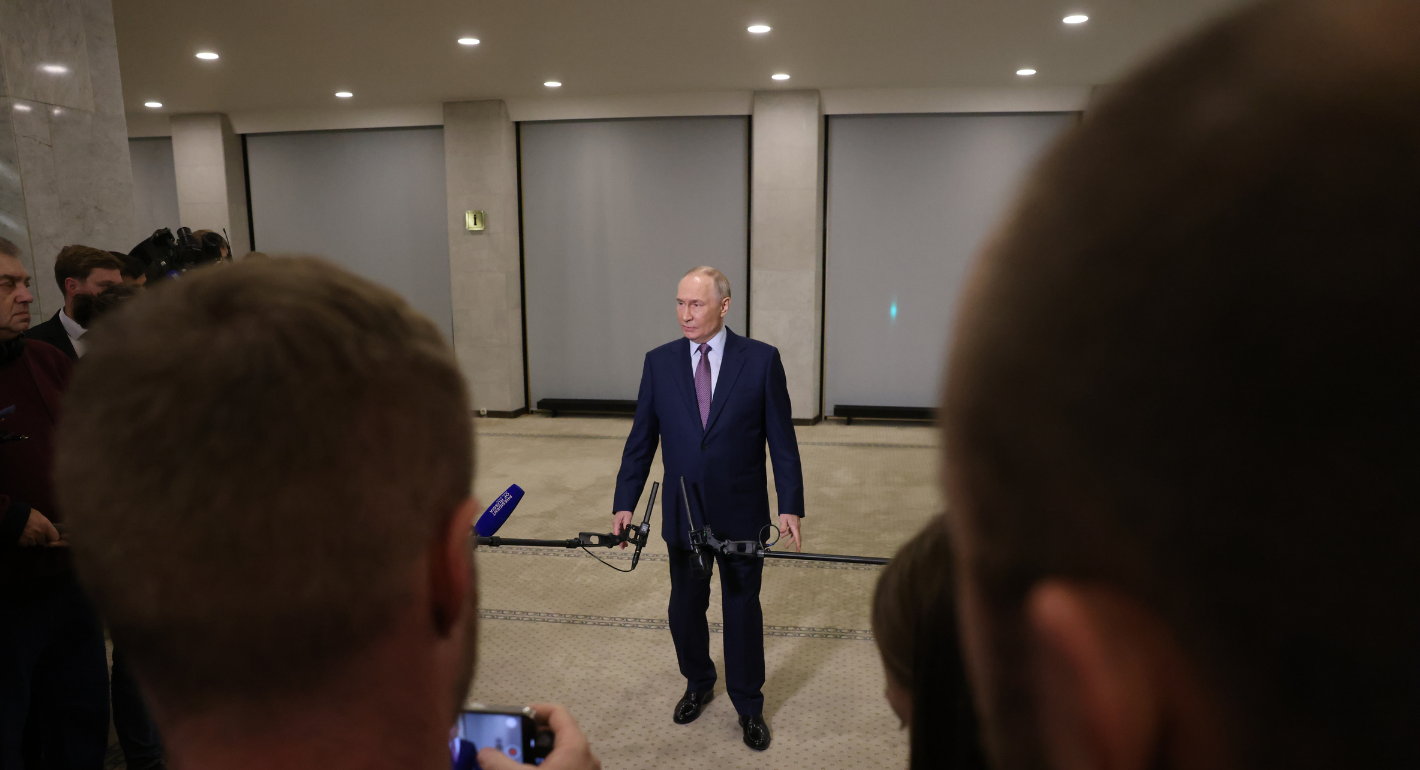
The EU had to compromise to adopt a twenty-first sanctions package against Russia, exposing growing cracks in the union’s resolve. Is this latest, weaker round worth it to keep pressure on Moscow?
Rym Momtaz, ed.

Trump is distracted and Ukraine wants Europe to step up. The continent’s leaders must find their voice and assert it in talks with Russia.

Alissa de Carbonnel

Mounting economic strain and battlefield losses will not necessarily make the Kremlin less dangerous. They could instead push Moscow toward a more aggressive hybrid campaign designed to test NATO’s Eastern flank, exploit allied hesitation, and fracture European resolve.

Maksym Beznosiuk
Over the past ten years, NATO has held almost as many summits as it did during the entirety of the Cold War. Are they still useful, or is it time to stop holding annual meetings?
Rym Momtaz, ed.