

Commentary
Perry Cammack, Cassia Bardos
{
  "authors": [
    "Perry Cammack"
  ],
  "type": "legacyinthemedia",
  "centerAffiliationAll": "dc",
  "centers": [
    "Carnegie Endowment for International Peace"
  ],
  "collections": [
    "Arab Awakening"
  ],
  "englishNewsletterAll": "menaTransitions",
  "nonEnglishNewsletterAll": "",
  "primaryCenter": "Carnegie Endowment for International Peace",
  "programAffiliation": "MEP",
  "programs": [
    "Middle East"
  ],
  "projects": [],
  "regions": [
    "Middle East",
    "Iran",
    "Türkiye",
    "Syria",
    "Saudi Arabia",
    "United Arab Emirates"
  ],
  "topics": [
    "Political Reform",
    "Security",
    "Foreign Policy"
  ]
}
Source: Getty
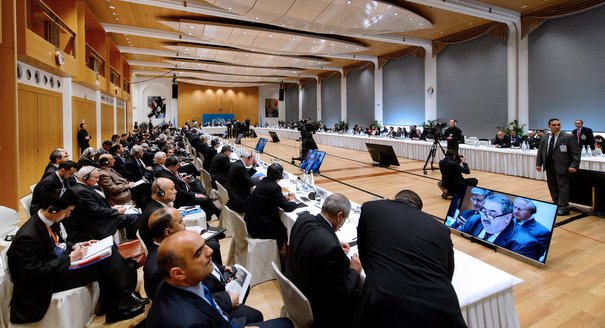
Even if the upcoming negotiations on the Syrian war fail to find a comprehensive political solution, the talks could still serve to address critical humanitarian issues and set the stage for a broader dialogue.
Source: Georgetown Journal of International Affairs
The pace of international diplomatic efforts to resolve the Syrian Civil War is accelerating. Last week’s Syrian opposition conference hosted by Saudi Arabia made some progress toward unifying the dizzying array of anti-Assad groups. A number of large armed factions that had previously rejected international mediation efforts participated in the conference. On Tuesday, U.S. Secretary of State John Kerry met with Russian President Vladimir Putin, setting the stage for the third meeting on December 18th of the so-called International Syrian Support Group(ISSG), the broader international Syrian peace process that began in Vienna in October.
While the ISSG’s objective is to create a framework for a political transition in Syria that eventually includes the participation of armed groups, realistically, the prospects for a short-term resolution to the Civil War are low. The ambitious timeline set out in theNovember 14th ISSG communiqué calls for reconciliation talks to begin in January 2016 and for new elections in Syria to take place within eighteen months. However, a number of issues could prevent this timeline from being realized. For one, the various fighting factions have not yet reached the point of military stalemate. And critically, the November communiqué papered over the fact that no international political consensus exists on the core issue of Bashar al-Assad’s future.
A more realistic goal would be to prioritize efforts to de-escalate violence and to alleviate the profound human suffering in Syria. Therefore, as negotiators prepare for the New York meeting, they must consider how to maximize the odds of success for this more practical goal, given the fraught mix of challenges.
First, the United States and its European allies should continue to reinvigorate the anti-ISIL military coalition. A clear symbiosis exists between the violence perpetrated by both the Assad regime and the Islamic State (ISIL), which has radicalized segments of Syrian society and forestalled the possibility of a moderate alternative emerging to eventually govern Syria. Compounding this problem is the fact that most countries in the region have, at least until recently, ranked ISIL as a secondary priority.
For instance, Russia has been more concerned with Assad’s preservation; Turkey with preventing a Kurdish state and Assad’s removal; while Saudi Arabia and Iran have been engaged in a regional power struggle. This multiplicity of priorities limits regional cooperation against ISIL and increases the terrorist group’s operational space. However, ISIL and al-Qaeda share a strategic weakness in that the more successful their global attacks are, the more they catalyze international retaliation. Since the horrific November 13th Paris attacks, both France and the UK have expanded military action against ISIL into Syria. The significance of this escalation may be more political than military, however, as the strikes increase the diplomatic leverage of the countries committed to Assad’s removal.
Second, the Vienna process must prioritize humanitarian assistance. Even if the Syrian reconciliation process initiated by the ISSG fails, at least in the short-term, the Vienna process is not without value. There is an emerging international understanding of the need for improved humanitarian relief and increased financial support for Syrian refugees. This understanding should translate into concrete actions to alleviate Syrian suffering. Further steps to enforce a broader de-escalation of violence, such as by persuading Russia and Iran to use their leverage with the Assad regime to stop the Syrian government’s indiscriminate barrel bombing of its own people, will likely prove more difficult. While such incremental measures, if achieved, cannot be sustained indefinitely without political progress, they should be prioritized – both for their own sake and to serve as a bridge to more productive reconciliation down the line.
Third, the peace talks should seek to capitalize on differing priorities between Russia and Iran. The two countries both support Bashar al-Assad, but their interests diverge in the perceived requirements for an acceptable outcome. Iran sees little need for compromise; its efforts to protect the Alawite minority and its partnerships with Hezbollah and other non-state militias have sectarian and ideological bases. In practice, this means working in parallel with the Syrian state, rather than in support of it, thereby undermining, over time, Syria’s military and its other national institutions. Russia, however, has more reason to seek a political settlement in order to protect its interests, including its naval facility in Tartus.
Prior to the commencement of the ISSG process in October, Iran had been excluded from international diplomatic efforts on Syria, despite Iran’s stake in the outcome. This exclusion was a recipe for continued violence. Unlike in the P5+1 nuclear negotiation with Iran, however, the Vienna talks should not be constructed around the need for consensus outcomes. If Iran is willing to eventually reorient its policies in support of Syrian sovereignty, it should be encouraged to do so. In the more likely event that it is not willing to do so, Iran could walk out and isolate itself as a spoiler, which would still serve to increase Assad’s international isolation.
Fourth, the Vienna talks should accommodate overlapping processes. The ISSG is comprised of seventeen countries, the United Nations, the European Union, and the Arab League. Clearly, significant progress on core political issues is unlikely to occur in such a context. However, the centrality of issues, such as the Iranian-Saudi rivalry, necessitated the unwieldy ISSG structure to facilitate the participation of both countries, which could pay important dividends over time in reducing sectarian tensions in the region. Ultimately, for the Vienna process to be successful, a mechanism must emerge to create a smaller contact group of core countries, including the P5 and other regional powers such as Turkey, Saudi Arabia, and Iran.
There are plenty of reasons to be skeptical of the Vienna process. However, no alternative resolution platform to the Syrian Civil War is apparent. With Iran’s participation, all major external actors with a stake in the outcome are involved for the first time. Even if the process fails to find a comprehensive political solution, the talks could still serve to address critical humanitarian issues and set the stage for a broader dialogue on the future of an increasingly distressed Middle East region.
This article originally appeared in the Georgetown Journal of International Affairs.
Former Nonresident Fellow, Middle East Program
Perry Cammack was a nonresident fellow in the Middle East Program at the Carnegie Endowment for International Peace, where he focuses on long-term regional trends and their implications for American foreign policy.
Recent Work
Perry Cammack, Cassia Bardos
Perry Cammack
Carnegie does not take institutional positions on public policy issues; the views represented herein are those of the author(s) and do not necessarily reflect the views of Carnegie, its staff, or its trustees.

With its public finances in shambles, the far right polling at 35 percent ahead of the 2027 presidential election, and a growing protest movement, is France’s crisis a threat to the EU’s geopolitical awakening?

Rym Momtaz, ed.

Ahead of a tough winter for Ukraine, Donald Trump’s swing back toward Russia bodes ill. But instead of panicking, Kyiv’s European allies are focusing on action.
Rym Momtaz

Funding Ukraine remains a priority for European leaders. As Russia’s war of aggression heads into another winter, two feasible options to mobilize support for Kyiv should be fast-tracked.


Vladyslav Rashkovan, Gregory P. Wilson

While the EU and European governments are embracing the much-lauded middle-power moment, this entails three difficult conundrums.

Richard Youngs

Europe is facing rising populism internally as well as external pressures from Russia, China, Turkey, and the United States.

Dimitar Bechev