

Commentary
Thomas de Waal
{
  "authors": [
    "Thomas de Waal"
  ],
  "type": "legacyinthemedia",
  "centerAffiliationAll": "dc",
  "centers": [
    "Carnegie Endowment for International Peace",
    "Carnegie Europe",
    "Carnegie Russia Eurasia Center"
  ],
  "collections": [
    "Europe’s Eastern Neighborhood"
  ],
  "englishNewsletterAll": "ctw",
  "nonEnglishNewsletterAll": "",
  "primaryCenter": "Carnegie Europe",
  "programAffiliation": "EP",
  "programs": [
    "Europe"
  ],
  "projects": [],
  "regions": [
    "Russia",
    "Europe",
    "Eastern Europe",
    "Western Europe",
    "Moldova",
    "Iran"
  ],
  "topics": [
    "Foreign Policy"
  ]
}
Source: Getty
The recent deal sealed with Russia over Transnistria is an example of the EU at its best, operating as a technocratic normative actor and letting trade lead geopolitics.
Source: Politico Europe
Even as Russia and the West rang in the new year still publicly at loggerheads over Ukraine, the EU sealed a deal with Russia over another Eastern European frozen conflict zone: Transnistria.
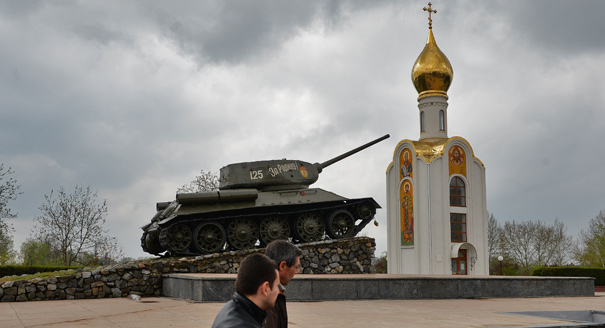
The unrecognized statelet of Transnistria broke away from newly independent Moldova in 1990, and is famous as a Soviet nostalgia theme park. Its statues of Lenin and red-star-encrusted factories all stand, and its parliament is called the Supreme Soviet. More than a thousand Russian troops uphold the territory’s independence and posters of Vladimir Putin are even more ubiquitous than in Russia.
In 2014 there were many predictions that Transnistria would be the next flashpoint between Russia and the West, after Crimea and Donbas. That did not come to pass, mainly because Transnistria is a much complex place with multiple allegiances and separated from Russia by Ukraine. As one local resident told me in 2014, “My head is in Russia but my legs are walking to Europe.”Pragmatism governs relations between Chișinău-ruled Moldova on the right bank of the Dniester River and Transnistria. The conflict is about politics, rather than ethnicity: Ordinary people bear no hatred toward one another and travel freely back and forth across the river.
In many ways the two territories are one economic space. Soviet Moldova was a predominantly agricultural republic while Transnistria was its industrial zone. Nowadays, more than 70 percent of exports go to Moldova and, more crucially, to the European Union, with which trade was worth $258 million (€229 million) in 2014.
But that was all jeopardized when Moldova and the EU inked a free-trade deal in 2014 and Transnistria’s specially negotiated trade preferences with the EU were set to expire on January 1, 2016. The province’s only hope was to forge a new deal with Brussels that incorporated it into the Moldovan deal.
Now, two years of below-the-radar negotiations have delivered a quiet success that ensures trade with the EU will continue. The Transnistrians have agreed to a two-year transition period to a new trading regime, which meets key conditions of Moldova’s deal. They must drop customs duties on EU goods coming to Transnistria, provide “certificates of origin,” and meet EU food safety standards. Loss of customs revenue will be offset by the introduction of VAT charges.
“Effectively, in economic terms we are still open to the West,” said Sergei Shirokov, a political analyst in Tiraspol, Transnistria’s capital.
But the Transnistrian government had no choice. On one side is Moldova, moving closer to the EU. On the other is post-Maidan Ukraine, which has been squeezing Transnistria in a way that no previous Kiev administration has done before. Ukraine no longer allows Russian troops to access Transnistria through its territory, and it has signed a new border agreement with Moldova to curb contraband cigarette and alcohol smugglers coming from Transnistria, long a source of cash for the territory.
Moscow has so far gone along with the deal because it knows its influence in Transnistria is largely unaffected.
More to the point, Russia cannot afford to bail out Transnistria when it also has to foot the bill in Crimea and elsewhere. It already tops up small local pensions with a payment locals call Putinka, after the Russian president, and Gazprom transfers up to $400 million worth of gas to the territory annually. But last year, Transnistria’s trade with Russia fell by half and remittance payments from Russia, which were previously worth several times the Transnistrian budget, dropped sharply.
Transnistrian President Yevgeny Shevchuk’s popularity plummeted since his unexpected election in 2011. He was short of options.
Over in Moldova, opinion on the breakaway territory is sharply divided. Some view its problems with schadenfreude, seeing no reason why Chișinău should make any concessions to the separatists. Some of these Moldovans see the Transnistria conflict as a brake on unification with Romania — of which Moldova (minus Transnistria) was part until the Soviet annexation of 1940.
Other Moldovans say an economic crash in Transnistria would hurt its neighbors too. They still hold out for unification with Transnistria in the long term, but settle for economic convergence in the short term.
Valeriu Lazăr, a former minister of economy and now head of Moldova’s Chamber of Commerce, falls into this latter category.
The Moldovan Chamber of Commerce helps promote Transnistrian companies in the EU and provide them with international grants and training. Lazăr admitted it is a controversial policy as the tax revenues go to the authorities in Tiraspol rather than Chișinău, but he said the benefits strongly outweigh the negatives. A stronger Transnistrian economy was good for Moldova, he said, and new EU-friendly regulations would even be good for Russia, whose trading regulations were closer to Europe than those of Transnistria.
However, no one in Brussels, Chișinău or Tiraspol is keen to advertise the trade deal too loudly because of several potential spoilers, ranging from criminal-business groups who will be adversely affected, to Russian nationalists who see any agreement with the EU as a betrayal. Implementation of the new regulations will also be tough on a de facto government with no international legitimacy.
“Everyone is happy. It doesn’t mean that there won’t be problems in a year’s time,” said Shirokov.
Does the EU deal have political significance? Yes and no. Economic convergence is a necessary condition of political agreement, but it’s unlikely to deliver it in the medium term. It does bring the two territories closer together though, mitigating against future conflict.
The agreement also provides a stark contrast with Ukraine and its rebellious regions. Moldova uses trade to ease relations and build bridges. But the Ukrainian government does the opposite.
By the end of last year the government in Kiev had cut most transport links, trade and electricity shipments to Crimea. Social welfare payments are also cut to residents of Donbas. People in Crimea are experiencing blackouts and economic hardship. The blockade is unlikely to endear them to the prospect of re-joining Ukraine, even if that option were available.
Reports from Crimea tell of people redoubling their hopes of salvation from Russia, in the form of new electricity and water supplies and eventually a bridge to the Russian mainland. In January, when the government in Kiev offered to switch the power on again, a Crimean government minister declared: “We do not need it.” Severing trade cements facts on the ground.
In Transnistria, the doors are still all open. The recent deal is an example of the EU at its best, operating as a technocratic normative actor and letting trade lead geopolitics. Let’s hope the model works in the long run.

Senior Fellow, Carnegie Europe
Thomas de Waal is a senior fellow at Carnegie Europe, specializing in Eastern Europe and the Caucasus.
Recent Work
Thomas de Waal
Thomas de Waal
Carnegie does not take institutional positions on public policy issues; the views represented herein are those of the author(s) and do not necessarily reflect the views of Carnegie, its staff, or its trustees.

Russia is testing the waters of NATO’s mutual defense clause. What do strikes in Romanian territorial waters mean for the alliance’s posture toward Moscow?

Dimitar Bechev

With its public finances in shambles, the far right polling at 35 percent ahead of the 2027 presidential election, and a growing protest movement, is France’s crisis a threat to the EU’s geopolitical awakening?

Rym Momtaz, ed.

Ahead of a tough winter for Ukraine, Donald Trump’s swing back toward Russia bodes ill. But instead of panicking, Kyiv’s European allies are focusing on action.
Rym Momtaz

Funding Ukraine remains a priority for European leaders. As Russia’s war of aggression heads into another winter, two feasible options to mobilize support for Kyiv should be fast-tracked.


Vladyslav Rashkovan, Gregory P. Wilson

While the EU and European governments are embracing the much-lauded middle-power moment, this entails three difficult conundrums.

Richard Youngs