

Commentary
Dmitri Trenin
{
  "authors": [
    "Dmitri Trenin"
  ],
  "type": "legacyinthemedia",
  "centerAffiliationAll": "",
  "centers": [
    "Carnegie Endowment for International Peace",
    "Malcolm H. Kerr Carnegie Middle East Center",
    "Carnegie Russia Eurasia Center"
  ],
  "collections": [
    "Arab Awakening"
  ],
  "englishNewsletterAll": "",
  "nonEnglishNewsletterAll": "",
  "primaryCenter": "Carnegie Russia Eurasia Center",
  "programAffiliation": "",
  "programs": [],
  "projects": [],
  "regions": [
    "Levant",
    "United States",
    "Middle East",
    "Syria",
    "Russia"
  ],
  "topics": [
    "Political Reform",
    "Foreign Policy"
  ]
}
Source: Getty
In the Middle East, it is the regional actors that are at the forefront. They are calling the shots—literally. And they are yet to learn the fine art of co-operation alongside confrontation.
Source: Financial Times
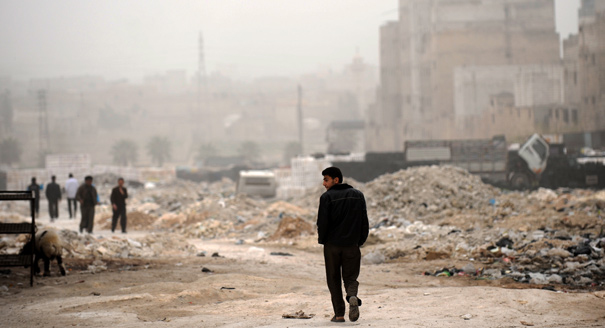
The Syrian army’s success at Aleppo was something Russia had been waiting for since the start of its military intervention last September. Russian air strikes were to soften up the diverse groups opposed to President Bashar al-Assad — Isis and others — and create conditions for Damascus to start a counter-offensive.
Until recently, however, there has been a disconnect between Russian activity in the air and the near-inability of Mr Assad’s forces to exploit it on the ground. Now this gap has been bridged. We should not expect a quick victory for Damascus, though Aleppo opposition groups may invite others into Syria: the Saudis and particularly the Turks. If this happens, the war will be transformed again. With the US, Russia and regional powers directly involved, Syria can become the first battleground in the global competition for power and influence that has restarted after a 25-year hiatus.
The consequences of such a development are hard to predict. But these are some of the questions that would surely arise. Would Turkey invade with ground troops to occupy the Kurdish-held areas? Would it bomb the Syrian army’s units? Would the Saudis attack just Isis targets or Iranian and Hizbollah formations, too? Would Iran send in more troops? What would the US military be doing? How would the Russians respond if their Syrian allies came under attack and sustained casualties? What would be the Russian reaction to the losses of their own at the hands of the Turks?Would they open fire at the Turkish tanks and shoot down Turkish fighter jets with the S-400 air defence systems already in place after the incident in November in which a Russian aircraft was shot down by a Turkish F-16? Would Moscow arm the Kurds in Turkey? Would any of this push Nato to invoke Article 5 of the Washington Treaty, which states that an attack on one ally is an attack on all allies? Should any of this happen, the entire global strategic environment would change.
Syria today has been occasionally compared to Spain in the 1930s. The analogy is growing sharper. But the bitter irony is that, at the end of January in Geneva, a negotiating process began that was aimed at bringing peace to Syria after almost five years of the devastating conflict.
Western policymakers and strategists are trying to figure out what Vladimir Putin’s military goals are in Syria — and if he intends to help the Assad regime regain territory lost to opposition forces
Blaming events in Aleppo for the breakdown of those talks misses the point. There was no ceasefire agreed beforehand. Had the rebels been able to score a significant success against Mr Assad, they would have probably pressed ahead, too. The real issue remains the unwillingness of regional actors — Damascus and Tehran, Ankara and Riyadh — to compromise.
The US and Russia have their own differences, some of which led to actual confrontation in important areas. Yet they have managed to co-operate so far over Syria, on the understanding that neither party will be able to have all it wants.
The world, however, has changed considerably since the cold war, when Moscow and Washington could decide for others and hold them accountable. In the Middle East, it is the regional actors that are at the forefront. They are calling the shots — literally. And they are yet to learn the fine art of co-operation alongside confrontation.
The Middle East has entered a period that will probably last a couple of decades, in which there will be little peace and a lot of fighting. Outsiders will have a limited role there, and often only a limited understanding of what is going on. Their prime responsibility is to work for solutions, however imperfect, that would save lives and create the conditions for post-conflict coexistence.
Should they give up these efforts and take sides in the conflict, Syria could very easily become another Spain — a warning that went unheeded and led to a much bigger calamity.
Former Director, Carnegie Moscow Center
Trenin was director of the Carnegie Moscow Center from 2008 to early 2022.
Recent Work
Dmitri Trenin
Dmitri Trenin
Carnegie does not take institutional positions on public policy issues; the views represented herein are those of the author(s) and do not necessarily reflect the views of Carnegie, its staff, or its trustees.

The European Commissioner for Trade is headed to China. But after President Xi’s bridge-building visit to Washington, can a more isolated EU overcome Beijing’s stranglehold on critical raw materials? Who will blink first?

Rym Momtaz, ed.
European NATO countries are wrestling with the possibility of U.S. disengagement from the alliance. With the continent’s security increasingly uncertain, governments must restore the credibility of their collective defense.



Hans-Dieter Lucas, Adam Thomson, Pierre Vimont

Before the next wave of EU enlargement takes place, the union needs to grapple with thorny questions of how power is distributed among its members.


Emil Sondaj Hansen, Ditte Brasso Sørensen

The new U.S.–Denmark–Greenland agreement will help Washington exert political, economic, and financial dominance under the guise of security. Yet, it acknowledged Copenhagen’s and Nuuk’s sovereignty on the island.

Marc Pierini

A summer of escalation in the Black Sea has hurt Ukraine economically and is exacerbating world food security. A truce is needed—as is a broader reframing of Europe’s Ukraine strategy.

Thomas de Waal