

Commentary
Dmitri Trenin
{
  "authors": [
    "Dmitri Trenin"
  ],
  "type": "legacyinthemedia",
  "centerAffiliationAll": "",
  "centers": [
    "Carnegie Endowment for International Peace",
    "Carnegie Russia Eurasia Center"
  ],
  "collections": [],
  "englishNewsletterAll": "",
  "nonEnglishNewsletterAll": "",
  "primaryCenter": "Carnegie Russia Eurasia Center",
  "programAffiliation": "",
  "programs": [],
  "projects": [],
  "regions": [
    "Russia"
  ],
  "topics": [
    "Security",
    "Foreign Policy"
  ]
}
Source: Getty
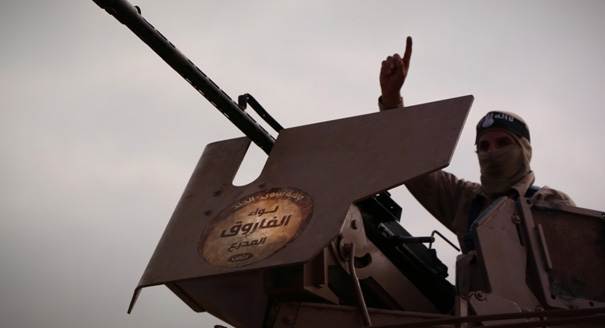
Even as Russia is again engaged in a confrontation with the West, it is confronted by very real threats coming from the south.
Source: Newsweek
To a casual observer, it may seem surprising. Russian speakers form one of the largest groups among Islamic State’s (ISIS) foreign fighters. For over 10 months, Russia has been actively involved in the conflict in Syria. The Russian North Caucasus remains a region of perennial instability. A Kiev-based Crimean Tartar group has vowed to take direct action against what it calls the Russian occupation of the peninsula. Yet, so far, Russia seems to have been spared the upsurge in extremist attacks which has affected France, Belgium and Germany. Why?
To begin with, this perception is wrong. Russia has lost more lives than France has in its recent attacks combined —224—as a result of the bombing of its passenger jet over Sinai on October 31, 2015. The perpetrators are widely believed to have been a local jihadist group which had pledged allegiance to the Islamic State militant group (ISIS). The attack happened just one month after the start of the Russian military campaign in Syria. Flights between Russia and Egypt, a favorite holiday destination for many Russians, have not been resumed since, which suggests that the threat persists.ISIS certainly has Russia in its sights. People pledging allegiance to ISIS have carried out several deadly strikes in Dagestan. The FSB, Russia’s domestic security agency, reports an increase in the activity of potential terrorists across the country. Would-be bombers and attackers have been apprehended in a number of Russian regions. One of the stated reasons for President Putin’s decision to go into Syria was to fight the enemy in its own territory, rather than wait for him to come to Russia.
So far, Russia itself has been spared major terrorist attacks. The October plane bombing occurred after the Russian jet had taken off from an Egyptian airport. More than a dozen Russian servicemen who were killed in Syria died on the battlefield. The concerns often expressed in the West ahead of the 2014 Sochi Olympics did not, fortunately, materialize. Clearly, the Russian security services have gained a lot of experience; Russia’s anti-terror legislation, already harsh, is getting harsher; and Chechnya, once the main trouble spot on Russia’s map, is tightly controlled by a strongman, Ramzan Kadyrov, who calls himself “Putin’s soldier”.
That said, there are considerable differences between Russia and Western Europe, the principal target of ISIS-inspired or –affiliated attackers. In Russia, Muslims and the Orthodox Christian majority have lived side-by-side for centuries. Integration has not always been perfect, but an acceptable modus vivendi exists, both at the grassroot and elite levels. Islam is an established religion in Russia, recognized by the state, alongside Orthodox Christianity, Buddhism and Judaism. The vast majority of Muslim migrants who come to work in Russia arrive from the former Soviet republics of Central Asia. Like guest workers in Europe in the 1960s and 1970s, they either come and go on a rotating basis or seek to stay and assimilate. In sum, Russia’s imperial legacy and its multi-ethnic, multi-religious nature are cushioning the impact of Islamist violence.
There is also the bitter experience of the 1990s and the early 2000s, the time of the war in Chechnya. Then, terrorism was a tool frequently used in Moscow and elsewhere. Passenger planes, metro stations and whole apartment blocks were blown up, and hundreds of hospital patients, theater goers and schoolchildren were taken hostage—against the background of bloody battles in the North Caucasus. That war is long over, but making sure that peace does not unravel in the region is a major concern for the Kremlin, which explains the unique contract that de facto exists between Putin and Kadyrov.
None of the above gives the Russian leadership any ground for complacency. Domestically radicalized jihadis, ISIS followers, and the returnees from the Syria war are currently the top concerns—in addition to the extremist groups who have continued to operate in the North Caucasus after the end of the Chechnya war. There are even bigger threats on the horizon. Russia’s participation in the Syria war, although limited, is essentially open-ended. It also looks like a first instalment in a series of possible future engagements along Russia’s southern periphery.
Afghanistan, almost a decade and a half after the start of the U.S.-led operation, remains unstable. Two of the biggest countries in Central Asia, Kazakhstan and Uzbekistan, face potentially difficult transitions as their founding presidents, in their mid-to-late 70s, prepare to leave the scene. The smaller countries of the region, Tajikistan and Kyrgyzstan, are facing mounting challenges to their stability. Given that Russia’s border with Kazakhstan, the world’s longest, is not controlled as closely as the country’s other frontiers, and that borders in Central Asia are not sufficiently secure, overflow of jihadis across them is a possibility they need to reckon with. Even as Russia is again engaged in a confrontation with the West, it is confronted by very real threats coming from the south.
Former Director, Carnegie Moscow Center
Trenin was director of the Carnegie Moscow Center from 2008 to early 2022.
Recent Work
Dmitri Trenin
Dmitri Trenin
Carnegie does not take institutional positions on public policy issues; the views represented herein are those of the author(s) and do not necessarily reflect the views of Carnegie, its staff, or its trustees.

The European Commissioner for Trade is headed to China. But after President Xi’s bridge-building visit to Washington, can a more isolated EU overcome Beijing’s stranglehold on critical raw materials? Who will blink first?

Rym Momtaz, ed.

European NATO countries are wrestling with the possibility of U.S. disengagement from the alliance. With the continent’s security increasingly uncertain, governments must restore the credibility of their collective defense.



Hans-Dieter Lucas, Adam Thomson, Pierre Vimont

The new U.S.–Denmark–Greenland agreement will help Washington exert political, economic, and financial dominance under the guise of security. Yet, it acknowledged Copenhagen’s and Nuuk’s sovereignty on the island.

Marc Pierini

A summer of escalation in the Black Sea has hurt Ukraine economically and is exacerbating world food security. A truce is needed—as is a broader reframing of Europe’s Ukraine strategy.

Thomas de Waal

Are Germany’s economic, industrial, and political struggles becoming a liability for the EU’s ability to rise to the geopolitical moment?
Rym Momtaz, ed.