

Commentary
There is an elephant in the room when it comes to the EU’s upcoming security strategy: Donald Trump. Unless European leaders acknowledge the depth of the transatlantic crisis, true autonomy will remain out of reach.
Stefan Lehne
{
  "authors": [
    "Ananth Padmanabhan",
    "Kira Huju"
  ],
  "type": "legacyinthemedia",
  "centerAffiliationAll": "",
  "centers": [
    "Carnegie Endowment for International Peace",
    "Carnegie India"
  ],
  "collections": [],
  "englishNewsletterAll": "",
  "nonEnglishNewsletterAll": "",
  "primaryCenter": "Carnegie India",
  "programAffiliation": "",
  "programs": [],
  "projects": [],
  "regions": [
    "South Asia",
    "India"
  ],
  "topics": [
    "Foreign Policy",
    "Technology"
  ]
}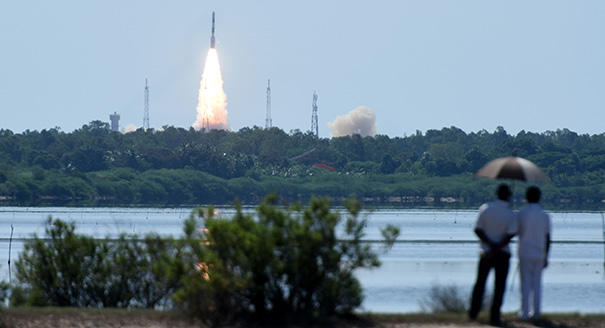
Source: Getty
India’s indigenous global navigation satellite system could help New Delhi’s credentials as a collaborative partner in the region.
Source: Live Mint
NAVIC (Navigation with Indian Constellation), India’s indigenous global navigation satellite system, is expected to become fully operational from this month. Consisting of a constellation of three geostationary, four geosynchronous and two on-standby satellites, NAVIC will facilitate accurate real-time positioning and timing services over India and the region around it extending to 1,500km. While India is joining a club of global powers—the US, EU, China and Russia—who control their own navigation satellite systems, NAVIC’s reach is regional. This is an auspicious occasion for South Asian cooperation.
While the Narendra Modi administration has sought to primarily draw attention to the benefits of NAVIC to Indian citizens, dedicating the acronym to Indian fishermen and navigators, its full operationalization carries profound implications and opportunities for the South Asian region at large. At a time when neighbours like Sri Lanka and Nepal harbour misgivings over Indian interference in their internal affairs and question the Indian commitment to a balanced regional order, sharing the benefits of NAVIC could countenance India’s credentials as a collaborative partner in the region.
“Net security providers” are states that deploy their surplus national assets for the safety and stability of other countries, including by way of responding to natural and man-made disasters. Having a global navigation system bolsters the ability of a nation to serve as a net security provider, especially through the guarantee of such assurance policies. The US equivalent, Global Positioning System (GPS), played a significant role in relief efforts post disasters such as the tsunami in the Indian Ocean region in 2004 and the Pakistan-India earthquake in 2005, and has delivered significant strategic and economic benefits to the US.
Through land-area mapping, yield monitoring and precision-planting of crops, NAVIC allows for the development of civic capabilities in food and livelihood security. In the wake of the 2015 earthquake in Nepal, NAVIC also arrives as an instrument for environmental and meteorological monitoring, as well as climate research. These capabilities can be leveraged to design reliable and efficient response mechanisms for natural disasters, alleviating the devastation they wreak through well-managed disaster relief.
Charting out growth routes for South Asian economies, South Asian Association for Regional Cooperation (Saarc) governments can also welcome the launch of NAVIC as an opening shot to accelerated innovation. Several present-day civilian and commercial pursuits, from vehicle tracking to mobile phone integration, owe their very existence to satellite navigation technologies. Much like government-funded space development has served as the backbone of the US’ expansive high-tech industry, NAVIC should also propel technological innovations and spin-offs that render South Asia progressively less reliant on technological imports from the West and elsewhere.
At the same time, NAVIC’s interoperability with GPS can ensure the minimization of technical snags when used complementarily with existing GPS-enabled solutions.
Weaving stronger bonds with India’s immediate neighbours, something Modi flagged as a priority during his 2014 election campaign, has come to be known as India’s “Neighbourhood First” policy. A month into his premiership, Modi commissioned the Indian Space Research Organisation to develop a South Asian satellite, which could extend applications such as telecommunications and broadcasting, tele-education and tele-medicine to the subcontinent. Accompanied by an anticipated price tag of Rs.235 crore, the government of India committed to absorbing all costs associated with the development and launch of the satellite. This endeavour would cover the skies of all Saarc members barring a cautious Pakistan, which opted out of the venture for fears of compromising its sensitive information database infrastructure. By comparison, NAVIC poses no such security concerns: unlike the South Asian satellite in the making, NAVIC does not by its nature necessitate shared intelligence.
Indeed, NAVIC might even go some way to mend and meliorate relations with a guarded Islamabad. Building on India’s offering of assistance to Pakistan during the floods in Pakistan-occupied Kashmir and other areas in 2014, NAVIC could establish a tradition of regional monitoring whereby India leverages its technological edge to safeguard citizens across the subcontinent. Such gestures could blunt the adversarial nature of Indo-Pakistan relations in the long run, signalling to the region and the globe alike that India values human security despite prevailing gridlock in strategic relations.
Global collaboration often comes apart at the seams under the sheer weight of diverging national interests, especially when security considerations are involved. NAVIC exemplifies a hybrid technology, providing both civilian and military benefits—it serves Indian security interests in the sense that many of India’s weapon systems, such as guided missiles and bombs, as well as fleet management, rely on satellite navigation.
Seeking to move away from the US-owned GPS system, India initially sought collaboration with the EU, entering into an agreement in 2005 to participate in its Galileo Satellite Project. But various security concerns, including China’s substantial involvement in the project, resulted in negotiations falling apart, and India deciding to chart an indigenous development course.
Now, India should work to shift the regional frame of mind from defence thinking to subcontinental cooperation, pushing back against isolationist impulses that stand in the way of realizing the civilian and commercial promise of NAVIC. An ability to integrate space infrastructure into the Indian state apparatus has fortunate ripple effects beyond Indian borders. In dedicating itself to exploring and actualizing the civilian and commercial potential of NAVIC, India can signal to its regional partners that its rise is not only passively peaceful but also directly beneficial to those it can lift up in its tide.
Former Fellow, Carnegie India
Ananth Padmanabhan was a fellow at Carnegie India, based in New Delhi. His primary research focus is technology, regulation, and public policy, and the intersection of these three fields within the Indian context.
Kira Huju
Carnegie does not take institutional positions on public policy issues; the views represented herein are those of the author(s) and do not necessarily reflect the views of Carnegie, its staff, or its trustees.

There is an elephant in the room when it comes to the EU’s upcoming security strategy: Donald Trump. Unless European leaders acknowledge the depth of the transatlantic crisis, true autonomy will remain out of reach.

Stefan Lehne
Europe’s industrial supply chains leave it vulnerable to global shocks. The EU needs a pragmatic green industrial strategy that balances durable partnerships and bolsters homegrown clean tech without sacrificing low-carbon ambition.


Milo McBride, Pauline Gerard

Defense tech innovations will be at the heart of Europe’s new security strategy. But so far, Brussels has been making moves without a broader plan, undermining readiness and credibility.

Raluca Csernatoni

When the U.S.-Iran memorandum of understanding was announced, the UK, France, Germany, and Italy declared their readiness to help demine the Strait of Hormuz and lift nuclear sanctions on Tehran. But does Europe need new tools to recover a diplomatic role?

Rym Momtaz, ed.
The Franco-German relationship is on the rocks again. But unlike previous moments of tension, the epochal changes on the world stage require that both step up investment in their bilateral ties.
Rym Momtaz