

Research
- +5
Alper Coşkun, Fatih Ceylan, Tacan İldem, …
{
  "authors": [
    "Sinan Ülgen"
  ],
  "type": "other",
  "centerAffiliationAll": "dc",
  "centers": [
    "Carnegie Endowment for International Peace",
    "Carnegie Europe"
  ],
  "collections": [
    "Turkey’s Transformation",
    "EU Integration and Enlargement",
    "Brexit and UK Politics"
  ],
  "englishNewsletterAll": "ctw",
  "nonEnglishNewsletterAll": "",
  "primaryCenter": "Carnegie Europe",
  "programAffiliation": "EP",
  "programs": [
    "Europe"
  ],
  "projects": [],
  "regions": [
    "Europe",
    "Türkiye",
    "Middle East",
    "Western Europe",
    "United Kingdom",
    "Iran"
  ],
  "topics": [
    "EU",
    "Economy",
    "Trade"
  ]
}
Source: Getty
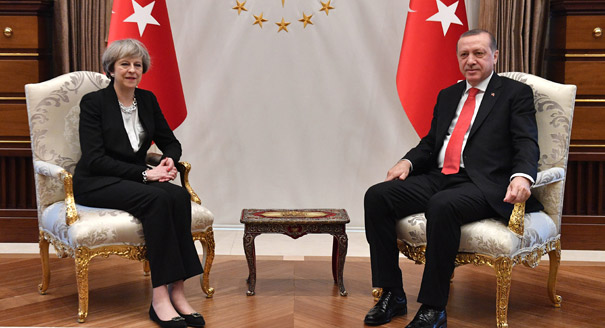
British and Turkish policymakers face a very similar conundrum: they both need to reconstruct a relationship with the EU under the newly changed assumptions about their future status.
Source: Brookings
Membership aspirations have long underpinned Turkey’s relationship with the European Union. Ever since the signing of the Ankara Association Agreement in 1963, Ankara’s formal objective has been to fulfill the necessary conditions to become an EU member. Yet, Turkey’s trajectory has been long and hazardous. Although formal accession talks were initiated in October 2005, Turkey’s path to membership was undermined by failure of the EU governments to embrace this objective with sincerity. The political difficulties associated with the ongoing division of Cyprus, combined with the more recent rise of populist movements in Europe, have also severely dented the credibility of this vision. The strengthening of populist and extreme-right political platforms in many key European countries has indeed created an increasingly challenging environment to safeguard the prospect of Turkish accession.
Progress has also stalled due to the loss of reform zeal in Ankara. Since the early part of this decade, Turkey’s democratic standards came under constant distress as illustrated by an increasingly alarming set of “progress reports” issued by the European Commission. The combination of these domestic and international developments have now reached a critical stage that are leading both sides to question the fundamentals of the Turkey-EU relationship. The European Parliament adopted a resolution in December 2016 recommending the European Council to freeze the accession negotiations with Turkey. The General Affairs Council that met the same month did not follow the EU Parliament’s injunctions, but nonetheless decided that no new chapters would be opened under prevailing conditions. The Council essentially expects Turkey to end the emergency rule and return to higher standards for the rule of law before revitalizing accession negotiations.
The ongoing difficulties have given force to the arguments that the pretense of an eventual Turkish accession is no more a useful ploy. It only generates frustration, disillusionment, and acrimony on both sides. There are therefore more frequent calls to review the scope as well as the finalité politique of this relationship. Turkish President Recep Tayyip Erdoğan suggested, for instance, to hold a referendum on the continuation of the accession talks and then join the Shanghai Cooperation Organization.
Against this backdrop, it certainly seems that some creative thinking will be needed to avert a total collapse of the Turkey-EU relationship. An option would be to define a novel framework of cooperation between Ankara and Brussels in areas of mutual interest. The aim would be to identify areas where mutual collaboration is likely and feasible. Such a collaborative framework could start to eliminate the trust deficit that has widened as the accession track has faltered. It is clear that the refugee deal could be a key component of this framework. Trade and energy relations, cooperation on foreign and security policy, as well as counterterrorism could be other important components of this still-to-be-defined association.
For many, this effort may be seen as a ploy to replace Turkey’s accession prospects with a lesser model of association. Turkey would thus exit from the accession track. Others, however, would view this new framework as being complementary to accession. By rebuilding trust and helping Turkey to converge towards EU norms, this more functional association could only positively impact the prospect of an eventual enlargement to Turkey. It may even be unnecessary to define ex ante the exact relationship between the officially adopted and recognized accession track and this novel framework for a “virtual membership.” A degree of constructive ambiguity may be unavoidable and even commendable.
Another country that is in need of defining a new framework for the future of its relations with the EU is the United Kingdom. The Brexit referendum heralds the beginning of this new reality.
British and Turkish policy makers thus face a very similar conundrum. They both need to reconstruct a relationship with Europe under the newly changed assumptions about their future status. The U.K. is on its way to becoming an EU non-member, while Turkey realizes that it may never get to be an EU member. They are therefore starting their political journey from different angles but may well end up at a very similar vantage point.
It follows from this premise that there will be some common challenges facing the two capitals as they strive to negotiate a new framework that would underpin their relations with the European Union. This report will focus on two such areas: trade policy and security policy. The aim will be to explore whether a more collusive Turkey-U.K. relationship can assist the two governments in improving their negotiating position. This does not necessarily mean that the U.K. and Turkey should jointly negotiate with Brussels; yet, it does mean that establishing regular bilateral consultations between Ankara and London in advance of and possibly in parallel to their several rounds of negotiations with the EU may be of mutual benefit. Identifying common concerns, establishing joint goals, and coordinating negotiating positions could serve these two countries during their critical negotiations with the EU.
There may be a benefit to Brussels as well. A more coordinated Turkey-U.K. position could allow the EU to demonstrate more institutional flexibility in devising common solutions to a set of common problems faced by two of its future and closest partners.

Senior Fellow, Carnegie Europe
Sinan Ülgen is a senior fellow at Carnegie Europe in Brussels, where his research focuses on Turkish foreign policy, transatlantic relations, international trade, economic security, and digital policy.
Recent Work

Alper Coşkun, Fatih Ceylan, Tacan İldem, …
Carnegie does not take institutional positions on public policy issues; the views represented herein are those of the author(s) and do not necessarily reflect the views of Carnegie, its staff, or its trustees.

Are Germany’s economic, industrial, and political struggles becoming a liability for the EU’s ability to rise to the geopolitical moment?

Rym Momtaz, ed.

European Commission President Ursula von der Leyen is about to give her annual address on the state of the EU. Here’s what she won’t—but should—say.
Rym Momtaz

Radical-right parties are expected to do well in upcoming elections in four of the EU's biggest member states. If successful, they could prevent the union from addressing key challenges ahead.

Stefan Lehne

The aftermath of the Ceuta crisis shows Europe has drawn the wrong lessons. Rather than doubling down on failed migration policies, the EU needs to address the underlying roots of such episodes.

Richard Youngs

An overwhelming victory by a far-right-wing party in a small state in eastern Germany will have major repercussions for Chancellor Friedrich Merz’s coalition.

Judy Dempsey