

Q&A
Darshana M. Baruah, Satyendra Prasad, Denghua Zhang
{
  "authors": [
    "Darshana M. Baruah"
  ],
  "type": "legacyinthemedia",
  "centerAffiliationAll": "",
  "centers": [
    "Carnegie Endowment for International Peace",
    "Carnegie India"
  ],
  "collections": [],
  "englishNewsletterAll": "",
  "nonEnglishNewsletterAll": "",
  "primaryCenter": "Carnegie India",
  "programAffiliation": "",
  "programs": [],
  "projects": [
    "Security Studies"
  ],
  "regions": [
    "India",
    "Indo-Pacific",
    "France",
    "South Asia"
  ],
  "topics": [
    "Foreign Policy",
    "Security"
  ]
}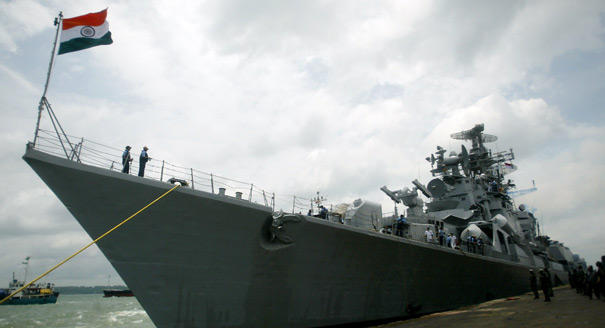
Source: Getty
India today has a serious chance to transform its navy from a reactive to a proactive one.
Source: Asia Maritime Transparency Initiative
Prime Minister Narendra Modi’s last-minute decision to add France to his Europe tour in early June is an indication of Delhi’s interest in engaging European powers in the Indian Ocean. India is reorienting its maritime policies, focusing on expanding naval engagement, and looking to increase its presence across the Indo-Pacific. Delhi is finally willing to exploit its maritime advantages to increase its profile as security actor in the region. As Delhi continues to consider its role and its approach, it is beginning to create new partnerships and explore existing ties to achieve those goals. As India warms up to the idea of playing a substantial role outside of the subcontinent, engaging with European maritime powers is a much-needed approach.
Despite its status as an Indian Ocean power, France’s strategic collaborations with Delhi there have been limited. While the two navies have traditionally interacted both bilaterally (Exercise VARUNA) and multilaterally (Indian Ocean Naval Symposium, Indian Ocean Rim Association, and anti-piracy operations), cooperation in the maritime domain has been limited and modest. France’s limited presence and Delhi’s focus on the northern Indian Ocean seemed to preclude the possibility of deeper collaboration in the region. But attitudes are beginning to shift, first in Paris and now in Delhi.
France has quietly but steadily indicated its interest in regaining its maritime profile and engaging more fully in the regional dynamics of the Indo-Pacific. Francois Fillon, as prime minister of France in 2008, put it bluntly, saying “France has decided to return to its historic maritime role.” With that agenda as a guidepost, France began reorienting its maritime strategy. Paris saw a changing strategic environment in the Indian Ocean and aligned its threat perceptions and priorities to match it. The French 2013 White Paper on Defense and Security highlighted these shifts, noting, “The equilibrium of East Asia has been radically transformed by the growing might of China”. In its 2015 National Strategy for security of maritime areas (PDF download), France related its concerns on freedom of navigation potentially suffering from a crisis in the “South or East China Seas”. A 2016 booklet by the French Defense Ministry, “France and security in the Asia-pacific,” also raised concerns regarding freedom of navigation, a growing Chinese profile, and a need for greater French presence in the Indian Ocean. Paris went on to note that the emerging situation would require more than American presence to maintain peace and stability in the region: “The strengthening of the American military presence in the region may contribute to control of tensions in Asia and …management of disputes. But American engagement does not relieve France…of its responsibilities.”
As France revised its strategy, collaboration in the Indian Ocean between like-minded navies became an obvious priority—creating new opportunities for India’s maritime engagement.
Delhi’s own response to an increasing Chinese presence in the Indian Ocean has been to revive its maritime partnerships and build new ties across the Indo-Pacific. Both Paris and Delhi are opening up to the idea of the wider “Indo-Pacific” and are keen to play an active role across the region. For India to continue building naval cooperation, it must look to the already-keen French as a credible partner in the Indian Ocean.
Among its new initiatives, Delhi has signed a White Shipping Agreement with France and conducted an annual maritime dialogue, providing a base for Indo-French collaboration. The two sides now must identify areas for further cooperation.
One such area could be maritime domain awareness (MDA). Although the White Shipping Agreement covers exchange of data on commercial ships, it has the potential for expansion that could amplify outreach efforts. French island territories, especially in the Indian Ocean, could form the basis for fresh cooperation through MDA. Access to and joint collaboration from French overseas territories such as Reunion Island and naval facilities in the Middle East and on the African coast could seriously boost India’s reach and capabilities across the region. Engagement with France would help India maintain a more influential presence across the Indian Ocean and beyond, a highly appealing prospect for Delhi.
India, for its part, should seek French involvement in the development of the neglected yet strategically crucial Andaman and Nicobar Islands. While India might be hesitant to open up the Andaman Islands for military collaboration, it is certainly open to economic development. France can assist India in bringing infrastructure and connectivity to the islands. Indo-French collaboration on energy and infrastructure development in the Andaman and Nicobar Islands would be a significant development in the strategic partnership. Joint exercises and collaboration on capacity building of small island states could be other areas for consideration.
India and France also enjoy a historical partnership in defense collaboration. There is massive potential for India to tap into French technological expertise, research, and development. The 2016 joint statement noted “co-development and co-production of defense equipment in India, including transfer of know-how and technologies”
Apart from bilateral collaboration, India and France could also consider trilateral and multilateral cooperation with like-minded countries in the region, such as Japan and Australia. Both India and France are engaging with Japan and Australia on maritime initiatives, and are keen to advance those partnerships. MDA, humanitarian assistance/disaster relief, White Shipping agreements, bilateral exercises, and capacity building of island states form a common interest among these players. The converging interests provide an excellent platform to bring the powers together in the Indian Ocean for cooperative development and strategic initiatives.
India today has a serious chance to transform its navy from a reactive to a proactive one. As nations across the Indo-Pacific revise their maritime strategy for the 21st century, Delhi is quickly emerging as a reliable partner. Delhi must find the political will and intent to drive new initiatives and take advantage of the multitude of opportunities ahead through economic and strategic cooperation. It must be able to articulate fresh ideas and begin discussing them with its partners such as France to maximize its maritime relationships, and must take the lead in initiating new partnerships in the Indian Ocean to shape the discourse over the Indo-Pacific. France most certainly should be in Delhi’s strategic calculations, as it continues to build its maritime partnerships across the Indian Ocean.
This article was originally published by the Asia Maritime Transparency Initiative.

Former Nonresident Scholar, South Asia Program
Darshana M. Baruah was a nonresident scholar with the South Asia Program at the Carnegie Endowment for International Peace where she directs the Indian Ocean Initiative.
Recent Work

Darshana M. Baruah, Satyendra Prasad, Denghua Zhang
Darshana M. Baruah
Carnegie does not take institutional positions on public policy issues; the views represented herein are those of the author(s) and do not necessarily reflect the views of Carnegie, its staff, or its trustees.

The European Commissioner for Trade is headed to China. But after President Xi’s bridge-building visit to Washington, can a more isolated EU overcome Beijing’s stranglehold on critical raw materials? Who will blink first?

Rym Momtaz, ed.

European NATO countries are wrestling with the possibility of U.S. disengagement from the alliance. With the continent’s security increasingly uncertain, governments must restore the credibility of their collective defense.



Hans-Dieter Lucas, Adam Thomson, Pierre Vimont

The domestic impacts of how long it is taking to end the war in Ukraine have pushed the French electorate to the political extremes and compromised the country’s diplomatic capacity.
Rym Momtaz

The new U.S.–Denmark–Greenland agreement will help Washington exert political, economic, and financial dominance under the guise of security. Yet, it acknowledged Copenhagen’s and Nuuk’s sovereignty on the island.

Marc Pierini

A summer of escalation in the Black Sea has hurt Ukraine economically and is exacerbating world food security. A truce is needed—as is a broader reframing of Europe’s Ukraine strategy.

Thomas de Waal