

Q&A
Sarah Yerkes
{
  "authors": [
    "Sarah Yerkes"
  ],
  "type": "legacyinthemedia",
  "centerAffiliationAll": "dc",
  "centers": [
    "Carnegie Endowment for International Peace",
    "Malcolm H. Kerr Carnegie Middle East Center"
  ],
  "collections": [
    "Arab Awakening"
  ],
  "englishNewsletterAll": "menaTransitions",
  "nonEnglishNewsletterAll": "",
  "primaryCenter": "Carnegie Endowment for International Peace",
  "programAffiliation": "MEP",
  "programs": [
    "Middle East"
  ],
  "projects": [
    "Tunisia Monitor"
  ],
  "regions": [
    "North Africa",
    "Tunisia",
    "Maghreb"
  ],
  "topics": [
    "Political Reform",
    "Security",
    "Military",
    "Foreign Policy"
  ]
}
Source: Getty
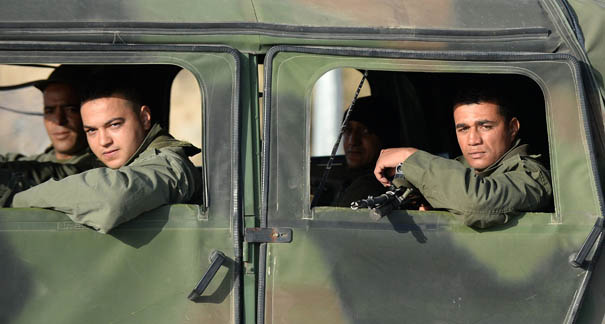
President Trump’s plan to slash military aid to Tunisia, a country on the front lines with the self-proclaimed Islamic State, is both misguided and dangerous.
Source: Hill
President Trump’s proposed budget, which cuts financial aid to Tunisia, not only represents a stark departure from the president’s plan to “demolish and destroy” the so-called Islamic State (ISIS), but could have dangerous consequences for Americans and our allies. Slashing military aid to a country on the front lines with ISIS is both misguided and dangerous.
The proposed cut is one of the more troubling aspects of Trump’s foreign aid budget, which decreases bilateral aid to Tunisia by 67 percent. The proposal would zero out the foreign military financing account by switching Tunisia’s military assistance package from a grant to a loan.
The United States has been instrumental in shoring up Tunisia’s security since the 2011 revolution. U.S. and European assistance has not only provided essential equipment for the Tunisian police and military, but also helped professionalize the security forces and train them in counter-terrorism tactics. This support has allowed Tunisia to build a partial border wall with Libya to prevent smuggling of goods and people. And in 2015, the U.S. designated Tunisia a Major Non-NATO Ally — only the 16th country worldwide to receive such a designation— that was meant to bolster the American-Tunisian security partnership.
But while Tunisia has not experienced a domestic terror attack in well over a year, the country is not as secure as it may seem. Tunisia continues to face dual threats — from ISIS next door in Libya and from al Qaeda affiliates along the border with Algeria. Tunisians make up one of the largest contingents of foreign fighters assisting ISIS in Iraq and Syria. And the country is currently struggling with how to handle hundreds of those fighters as they return home.
Additionally, ongoing protests in Tunisia’s south, while not directly linked to terrorism, have sown seeds of instability in these remote regions. The weeks-long protests reflect a growing sense of frustration among Tunisian youth, in particular, that keeps the extremist recruitment pipeline flowing.
Aside from foreign military aid, the 2018 budget request does provide a small amount ($14.6 million) between three other security-related accounts, but this is a significant decrease from the $21.4 million slotted for these categories last year and will not come anywhere close to meeting Tunisia’s security needs. Given all of Tunisia’s challenges, it is clear that Tunisia’s security assistance needs remain as high today as they have ever been.
The Trump administration and our lawmakers should care about Tunisia’s stability and security not because it is the “sole success story of the Arab Spring”— a trope often used to drum up support — but because instability in Tunisia is a direct threat to the interests of Americans and our allies in North Africa and Europe. General Thomas Waldhauser, commander of the military’s Africa Command (AFRICOM), recently testified before the Senate that instability in North Africa “may be the most significant near-term threat to U.S. and allies’ interests” in Africa and “ISIS-Libya remains a regional threat with intent to target U.S. persons and interests.”
It is therefore crucial to our national security that we help Tunisia keep ISIS-Libya at bay, rather than diminish Tunisia’s counter-terror capabilities.
Furthermore, many of the recent terror attacks in Europe have direct ties to ISIS in North Africa. A Tunisian living in France, who was inspired, if not aided, by ISIS killed more than 80 people in the July 2016 Bastille Day attack in Nice. And a Tunisian failed-asylum seeker, who had pledged allegiance to ISIS, killed 12 people in the December 2016 Berlin market attack.
Finally, the administration’s approach to Tunisia is a misstep because it could end up costing U.S. taxpayers more money than it saves. Tunisia, which is in the midst of a tremendous economic crisis, may not be able to afford the loan terms granted to them. Thus, as The Wall Street Journalreported, State Department officials are concerned that the shift to loans could cause recipients like Tunisia to turn to other countries such as Russia or China for their military needs.
While the loans appear to be a money-saving tool, by forcing recipient countries to “double-spend” — first by buying U.S. defense goods and then paying back the money they were loaned to make the purchase — the long-term implications of this method are not clear. If Tunisia were to accept the loan, there is no guarantee that they would be able to pay it back. Later on, if Tunisia were to default on its loan, the U.S. could enter into a more costly debt-relief program, negating any savings in the first place.
But regardless of Tunisia’s ability or willingness to accept the administration’s proposed approach to military aid, turning our back on Tunisia now sends a terrible signal that defeating and destroying ISIS is a priority — as long as someone else is paying the bills.

Acting Co-Director and Senior Fellow, Middle East Program
Sarah Yerkes is acting co-director and a senior fellow in the Middle East Program at the Carnegie Endowment for International Peace. Her research focuses on democracy and governance, U.S. foreign policy towards the Middle East and North Africa, and political and economic reform in Tunisia.
Recent Work
Carnegie does not take institutional positions on public policy issues; the views represented herein are those of the author(s) and do not necessarily reflect the views of Carnegie, its staff, or its trustees.

The European Commissioner for Trade is headed to China. But after President Xi’s bridge-building visit to Washington, can a more isolated EU overcome Beijing’s stranglehold on critical raw materials? Who will blink first?

Rym Momtaz, ed.

European NATO countries are wrestling with the possibility of U.S. disengagement from the alliance. With the continent’s security increasingly uncertain, governments must restore the credibility of their collective defense.



Hans-Dieter Lucas, Adam Thomson, Pierre Vimont

Before the next wave of EU enlargement takes place, the union needs to grapple with thorny questions of how power is distributed among its members.


Emil Sondaj Hansen, Ditte Brasso Sørensen

The new U.S.–Denmark–Greenland agreement will help Washington exert political, economic, and financial dominance under the guise of security. Yet, it acknowledged Copenhagen’s and Nuuk’s sovereignty on the island.

Marc Pierini

A summer of escalation in the Black Sea has hurt Ukraine economically and is exacerbating world food security. A truce is needed—as is a broader reframing of Europe’s Ukraine strategy.

Thomas de Waal