

Paper
Douglas H. Paal
{
  "authors": [
    "Douglas H. Paal"
  ],
  "type": "legacyinthemedia",
  "centerAffiliationAll": "dc",
  "centers": [
    "Carnegie Endowment for International Peace",
    "Carnegie China"
  ],
  "collections": [],
  "englishNewsletterAll": "asia",
  "nonEnglishNewsletterAll": "",
  "primaryCenter": "Carnegie China",
  "programAffiliation": "AP",
  "programs": [
    "Asia"
  ],
  "projects": [],
  "regions": [
    "North America",
    "United States",
    "East Asia",
    "China",
    "North Korea",
    "South Korea"
  ],
  "topics": [
    "Security",
    "Foreign Policy",
    "Nuclear Policy",
    "Arms Control",
    "Military"
  ]
}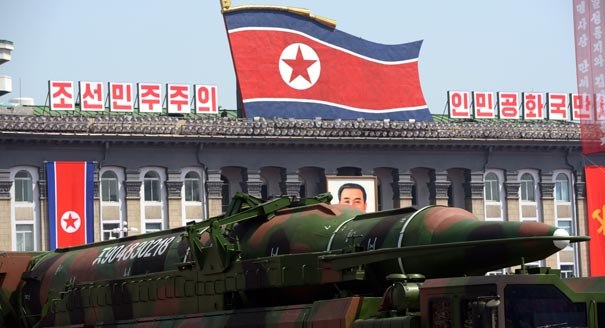
Source: Getty
While China can do more to crack down on trade with North Korea, the United States should work out the North Korea problem in a way that respects both China and its own national security interests.
Source: CNBC
Speaking on CNBC, Carnegie’s Douglas H. Paal stated his perspectives on the role of China in addressing the escalated North Korea threat, in the wake of the latest ICBM testing.
“The expectations around the Trump administration that China can deliver on North Korea have been too high,” Paal said. “China’s expectations about what they can get away with helping on this issue have been too low—and that gap between the two needs to be brought closer together.”
When asked about what the United States could expect if China were serious about cracking down the North Korea threat, Paal stated, “It would show up first and foremost in oil. And oil has been withheld in small measures from Korea [already], and that has been driving up the price of diesel and gasoline on the streets on North Korea—so that has a measurable effect.” Still, Pall noted that “China seems to be primarily concerned with preventing a new nuclear test, but they are not so much interested in the long ranged missile tests which bring the threat to the U.S. Since the nuclear threat is right on their border, they are more concerned about that.”
“One big step would be China interfering with the trade going on these dual-use industries, where they can provide chemicals and metals and finished products that could be put into a weapons program, but are not by themselves weapons in nature,” Paal said. He also added, “There is also a lot of banking activity. At this point a lot of that banking activity is really small-scale—you have to get out a fine tooth comb to find it and stop it. China could do a lot more if it wanted to on that front.”
When asked if China was the only way out of the North Korea problem, Paal responded, “China’s got to be part of the program, of the solution, but the U.S. has probably got to talk to North Korea directly. The evidence has been accumulating for decades now that they are mostly preoccupied with what they see as the threat of the United States. So if we are not part of that, leading the negotiations, we are going to have a problem. We got a reluctant China that wants to cap the nuclear program in North Korea, but not at the price of losing North Korea.”
“The U.S. has got to find a way, and it’s already started—Rex Tillerson spoke on this in New York earlier this past spring—that the U.S. reassures China we are not trying to bring down the regime and put our own best ally in Northeast Asia right on the border with China, thereby increasing China’s sense of threat from the United States. We want to work out this North Korean problem in a way that respects the equities in national security and otherwise of both the United States and China. And that’s going to take time and trust, and we are not there yet,” Paal said
After being asked if the United States should panic about the latest North Korean ICBM testing, Paal responded, “No, we have seen this coming for some time—it’s part of the same problem. It shows that that they are serious and stepped up the testing of the missiles in this last year to show that their reentry vehicles and their airframes are stable and effective. Building more than two or three of them will not be easy for them, so we don’t need to go to a panic mode. The problem is urgent, but not that urgent. So we have time to discuss with them possibilities of a freeze in their testing, a freeze in their manufacture of fissile material, and see what the price for that might be.”

Distinguished Fellow, Asia Program
Paal previously served as vice chairman of JPMorgan Chase International and as unofficial U.S. representative to Taiwan as director of the American Institute in Taiwan.
Recent Work
Douglas H. Paal


Douglas H. Paal, Tong Zhao, Chen Qi, …
Carnegie does not take institutional positions on public policy issues; the views represented herein are those of the author(s) and do not necessarily reflect the views of Carnegie, its staff, or its trustees.

As we close out another season of Strategic Europe, it is worth taking stock of the deep shifts underway.

Rym Momtaz
The hybrid warfare landscape is evolving rapidly, leaving policymakers without clear strategies. To better inform their work in addressing emerging challenges, governments must dig deeper into the underlying dynamics at play.


Raluca Csernatoni, Alicia Wanless
The EU had to compromise to adopt a twenty-first sanctions package against Russia, exposing growing cracks in the union’s resolve. Is this latest, weaker round worth it to keep pressure on Moscow?
Rym Momtaz, ed.

Trump is distracted and Ukraine wants Europe to step up. The continent’s leaders must find their voice and assert it in talks with Russia.

Alissa de Carbonnel

Mounting economic strain and battlefield losses will not necessarily make the Kremlin less dangerous. They could instead push Moscow toward a more aggressive hybrid campaign designed to test NATO’s Eastern flank, exploit allied hesitation, and fracture European resolve.

Maksym Beznosiuk