

Report
- +2
George Perkovich, Jessica Tuchman Mathews, Joseph Cirincione, …
{
  "authors": [
    "Jon Wolfsthal"
  ],
  "type": "legacyinthemedia",
  "centerAffiliationAll": "dc",
  "centers": [
    "Carnegie Endowment for International Peace"
  ],
  "collections": [
    "U.S. Nuclear Policy",
    "Korean Peninsula"
  ],
  "englishNewsletterAll": "ctw",
  "nonEnglishNewsletterAll": "",
  "primaryCenter": "Carnegie Endowment for International Peace",
  "programAffiliation": "NPP",
  "programs": [
    "Nuclear Policy"
  ],
  "projects": [],
  "regions": [
    "North America",
    "United States",
    "East Asia",
    "South Korea",
    "North Korea"
  ],
  "topics": [
    "Foreign Policy",
    "Nuclear Policy",
    "Arms Control"
  ]
}
Source: Getty
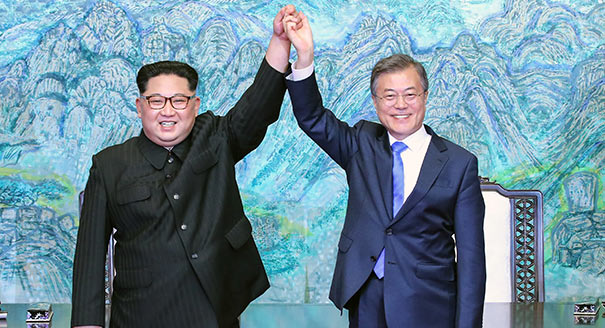
Despite the positive nature of the joint statement by the Korean leaders pledging to make progress on long-standing problems, the reality is that there is much hard work to do if the U.S.-North Korean summit is to be a success and lead to real progress.
Source: Kyodo News
At almost any other moment in history, the historic meeting between the leaders of North and South Korea and their optimistic statement seeking peace and the elimination of nuclear weapons would dominate global affairs.
The looming meeting between U.S. President Donald Trump and North Korea leader Kim Jong Un, however, means the Panmunjeom summit remains just a prelude to the main event later this spring.
Thus, despite the positive nature of the joint statement by the Korean leaders and their ambitious timeline to make progress on long-standing problems, the reality is there is much hard work to do if the U.S.-North Korean summit is to be a success and lead to real progress.
Many in the United States, Japan and even South Korea remain skeptical that North Korea's leadership has decided to turn its back on provocation and threats.
Given the long and negative history between North Korea and America and its partners, there is good reason for doubt.
North Korea has time and time again pledged to disarm, been given incentives to reform, and offered assurances for its security if it will eliminate its nuclear and missile programs. Time and time again these pledges have not been implemented.
But the fault is not all with North Korea. America, South Korea and Japan have all, too, played a part in the collapse of past agreements.
Is this time different? Only time will tell.
But despite healthy and legitimate skepticism about North Korea, Washington, Tokyo and Seoul continue to have an incentive to seek real peace, reconciliation and disarmament.
We have the most to gain from a resolution of tensions, and the most to lose should North Korea's stated willingness to disarm not come to pass.
Thus, it remains in the interest of the alliance partners to test the proposition that North Korea is willing to change, and to take yes for an answer if we get one from Kim.
The challenge is how to ensure this possible opening is not a mirage, and can be captured.
The uncertainty emanating from the White House makes this harder than it should be, and puts greater obligations on Prime Minister Shinzo Abe and President Moon Jae In to work together, and to ensure President Trump approaches the summit with Kim not just as the president of the United States, but as the leader of alliances that benefit us all.
For long-standing defenders of the U.S.-Japan and U.S.-ROK alliance, this means any agreement on disarmament has to include not just weapons that can reach America, but also those that threaten our friends and allies in the region.
This raises the stakes of the U.S.-DPRK summit even higher than the one just completed in Panmunjeom, putting the pressure on President Trump to succeed where all others have failed.
Former Nonresident Scholar, Nuclear Policy Program
Jon Wolfsthal was a nonresident scholar with the Nuclear Policy Program.
Recent Work



George Perkovich, Jessica Tuchman Mathews, Joseph Cirincione, …
Jon Wolfsthal
Carnegie does not take institutional positions on public policy issues; the views represented herein are those of the author(s) and do not necessarily reflect the views of Carnegie, its staff, or its trustees.

European Commission President Ursula von der Leyen is about to give her annual address on the state of the EU. Here’s what she won’t—but should—say.

Rym Momtaz

Radical-right parties are expected to do well in upcoming elections in four of the EU's biggest member states. If successful, they could prevent the union from addressing key challenges ahead.

Stefan Lehne

The aftermath of the Ceuta crisis shows Europe has drawn the wrong lessons. Rather than doubling down on failed migration policies, the EU needs to address the underlying roots of such episodes.

Richard Youngs

Canadian Prime Minister Mark Carney has twice inspired praise for standing up to U.S. President Donald Trump: at the 2026 World Economic Forum in Davos and on Canada-U.S. trade negotiations. Is Carney showing a third way better than the EU has in dealing with the Trump administration?
Rym Momtaz, ed.

The EU’s responses to two recent incidents expose the gulf between European perceptions and capabilities. Unless the union can bridge that gap, it will never become a real geostrategic power.
Rym Momtaz