

Research
- +11
Frances Z. Brown, Nate Reynolds, Priyal Singh, …
{
  "authors": [
    "Frances Z. Brown"
  ],
  "type": "legacyinthemedia",
  "centerAffiliationAll": "dc",
  "centers": [
    "Carnegie Endowment for International Peace",
    "Malcolm H. Kerr Carnegie Middle East Center"
  ],
  "collections": [
    "Violence and Conflict"
  ],
  "englishNewsletterAll": "democracy",
  "nonEnglishNewsletterAll": "",
  "primaryCenter": "Carnegie Endowment for International Peace",
  "programAffiliation": "DCG",
  "programs": [
    "Democracy, Conflict, and Governance"
  ],
  "projects": [],
  "regions": [
    "Middle East",
    "Syria",
    "Levant"
  ],
  "topics": [
    "Political Reform",
    "Democracy",
    "Security",
    "Foreign Policy"
  ]
}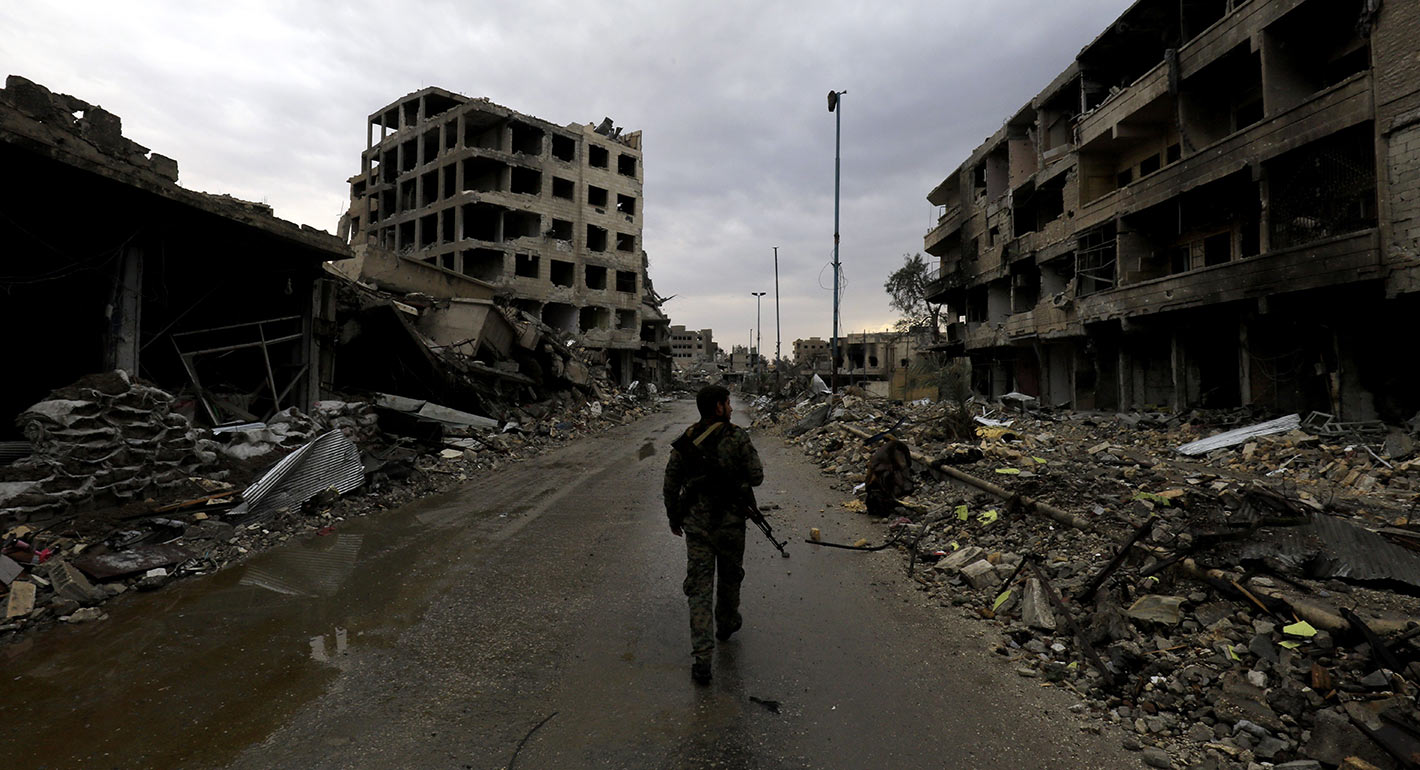
Source: Getty
Unless the United States redirects its approach in Syria, civilian stabilization programs will not achieve their stated objective: the “enduring defeat” of the Islamic State.
Source: Washington Post
This spring, U.S. troops and their coalition partners, the Syrian Democratic Forces (SDF), captured the final outpost of the Islamic State territory in eastern Syria. But the United States has yet to achieve its stated policy objective: the “enduring defeat” of the Islamic State in the region. In just the past few weeks, the congressionally-mandated Syria Study Group warned the group has already begun reconstituting in Syria and Iraq — and the Islamic State’s leader released a defiant video message aimed at galvanizing more attacks like those in Sri Lanka.
So how does the United States plan to achieve the Islamic State’s enduring defeat in Syria? In addition to the (wavering) military support to the SDF, officials emphasize that civilian “stabilization” assistance is a crucial tool. Through stabilization programs, the United States and its partners remove rubble, clear mines and restart basic services such as electricity, sanitation and water.
These programs are vital in their own right in helping Syrians recover. But U.S. policymakers also argue that this assistance will help achieve their strategic goal — the enduring defeat of the Islamic State — by addressing factors fueling the group’s resurgence. What does the evidence say?
The good news: research by myself and others offers valuable, if not unlimited, indications of how stabilization projects can advance this strategic objective. The bad news: the current U.S. approach won’t cut it. Here are four lessons on how stabilization projects can help advance the enduring defeat of the Islamic State.
Most studies suggest that aid can dampen violence in areas that already have a modicum of stability or a significant troop presence. But in contested areas, aid can actually be associated with increased violence, since insurgent groups may sabotage or attack donor-funded projects.
My own research on stabilization aid in Syria uncovered a related shortcoming of assistance in contested places. Donors often supported “moderate opposition” local councils, hoping to help these communities resist armed extremist groups or the Assad regime. But unfortunately, civilian aid ultimately could not shape outcomes in an environment that armed actors increasingly dominated.
In northeast Syria today, there remains adequate security for civilian projects in many areas. But as implementers are asked to expand into more dangerous areas in the Lower Middle Euphrates River valley, and reports of Islamic State sleeper cells emerge, this could unravel. Looking ahead, the regime’s attempts to undermine stability in SDF-held areas, and the immense Islamic State detainee population, will pose further security risks.
Further, local perceptions of security also matter — and the United States undermined these perceptions through a series of flip-flops regarding U.S. troop commitment. After President Trump’s most recent proclamation that U.S. troops would be leaving Syria, administration officials have seemingly walked this back. But the president has eroded any trust that the United States will be a steadfast security guarantor.
Research shows that successful civilian assistance in counterinsurgency or conflict contexts requires enough development experts to oversee the projects, and aid is better in small-dollar amounts.
Similarly, researchers have found that large-scale stabilization projects in Afghanistan fed perceptions of massive corruption. My own Afghanistan research chronicled that maximalist stabilization created inflated expectations with ultimately destabilizing effects.
The dubiously good news in Syria is that stabilization programs do not face the problem of too much money — they cost a fraction of the $4.7 billion the U.S. spent on Afghan stabilization (and are funded by other countries). If anything, the concern is that funds will not meet the massive needs on the ground.
But expert oversight is the larger challenge. My research has shown that wartime Syria was already a “textbook worst-case-scenario” for informed programming in multiple ways. In northeast Syria today, these problems have only intensified, since the already-small contingent of civilians overseeing programs has exited since the president’s withdrawal announcement, with uncertain prospects for return.
Current U.S. stabilization programs — reportedly “focused on saving lives, demining, water, electricity, and the basic necessities” — are necessary, but not sufficient, to stem the Islamic State’s appeal.
Research on violent extremism indicates that efforts to counter the allure of the Islamic State will fall short if they treat stabilization solely as question of meeting economic or basic needs. Programs are unlikely to have much effect on stability unless they address communities’ feelings of injustice.
Specifically in northeast Syria, stabilization programs will need to restore social cohesion, develop reconciliation mechanisms and invest in education. Addressing youth radicalization is an especially acute challenge, given the massive child population among the Islamic State families in displaced-persons camps.
Unless programs operate within a broader policy of improving transparent, inclusive governance, the crucial services they provide probably will not achieve the strategic objective of reducing extremism’s appeal.
This warning is critical because reports have indicated that the SDF does not govern inclusively in Arab-majority areas and that its security forces have committed human rights abuses — both factors that in other countries have been associated with an increase in support for extremist groups.
Mindful of this, U.S. stabilization practitioners hope to push the SDF to adopt better governance practices. By some reports, the SDF has demonstrated willingness to improve. But U.S. leverage vis-a-vis the SDF is hobbled by the limited civilian presence and the uncertain time frame of U.S. engagement. My own research underscores that donors trying to reform Syrian local governance via remote control and without repeated iteration have been sorely disappointed.
Further, the unclear political endstate casts a shadow over stabilization efforts. U.S. policy is not to endorse this statelet as a permanent political structure. Without U.S. security guarantees, the northeast may end up a site of confrontation between the SDF and Turkey — or face encroachment by the Assad regime — potentially creating political conditions ripe for the resurgence of the Islamic State.
Stabilization programs provide valuable services, regardless of larger strategic outcome. But they cannot compensate for poor security, uncertain U.S. commitment and an unclear political endstate. Unless the United States redirects its approach, stabilization programs will not achieve the enduring Islamic State defeat we desire.
This article was originally published in the Washington Post.

Vice President for Studies
Dr. Frances Z. Brown is a vice president for studies at the Carnegie Endowment for International Peace. Brown served on the White House National Security Council (NSC) staff over the past three presidential administrations. Her research focuses on U.S. foreign policy, Africa, the Middle East, and governance.
Recent Work
Frances Z. Brown, Nate Reynolds, Priyal Singh, …
Saskia Brechenmacher, Frances Z. Brown
Carnegie does not take institutional positions on public policy issues; the views represented herein are those of the author(s) and do not necessarily reflect the views of Carnegie, its staff, or its trustees.

The EU can impose sanctions but struggles to enforce them without the United States. With Washington increasingly disinterested in backing European interests, the bloc must now fend for itself.


Nicu Popescu, Tiago Antunes

Russia is testing the waters of NATO’s mutual defense clause. What do strikes in Romanian territorial waters mean for the alliance’s posture toward Moscow?

Dimitar Bechev

With its public finances in shambles, the far right polling at 35 percent ahead of the 2027 presidential election, and a growing protest movement, is France’s crisis a threat to the EU’s geopolitical awakening?

Rym Momtaz, ed.

Ahead of a tough winter for Ukraine, Donald Trump’s swing back toward Russia bodes ill. But instead of panicking, Kyiv’s European allies are focusing on action.
Rym Momtaz

Funding Ukraine remains a priority for European leaders. As Russia’s war of aggression heads into another winter, two feasible options to mobilize support for Kyiv should be fast-tracked.


Vladyslav Rashkovan, Gregory P. Wilson