

Commentary
Dmitri Trenin
{
  "authors": [
    "Dmitri Trenin"
  ],
  "type": "legacyinthemedia",
  "centerAffiliationAll": "",
  "centers": [
    "Carnegie Endowment for International Peace",
    "Carnegie Russia Eurasia Center"
  ],
  "collections": [
    "Pax Sinica"
  ],
  "englishNewsletterAll": "",
  "nonEnglishNewsletterAll": "",
  "primaryCenter": "Carnegie Russia Eurasia Center",
  "programAffiliation": "",
  "programs": [],
  "projects": [],
  "regions": [
    "East Asia",
    "China",
    "Russia"
  ],
  "topics": [
    "Foreign Policy"
  ]
}
Source: Getty
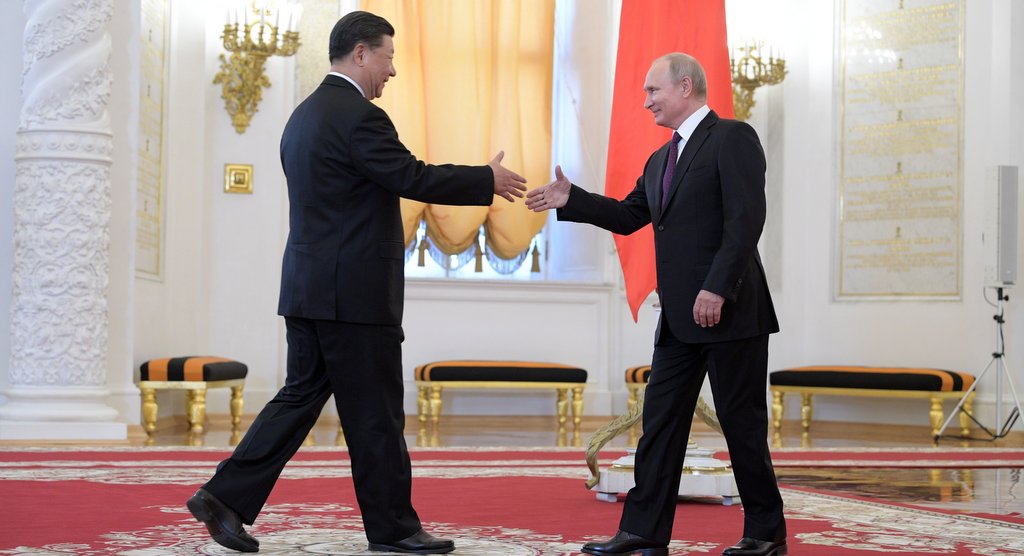
China and Russia have learned lessons from history: great powers lead or abstain, they don’t jump on the bandwagons of others, and in bilateral relations, great powers seek to maintain equilibrium-they may come close to each other if interests or circumstances demand, but not so close as to become followers.
Source: China Daily
President Xi Jinping’s visit to Russia comes exactly 30 years after Moscow-Beijing relations were normalized after a period of discord and confrontation. This normalization has turned out to be one of the most productive foreign policy investments for both countries.
By 2018, Sino-Russian trade exceeded $100 billion. Private citizens’ cross-border visits are now measured in millions. Driven by real and compelling interests, the Sino-Russian relationship in the last five years has reached the level of an "entente": basic compatibility of worldviews supported by practical collaboration in a large number of areas.
As Beijing and Moscow look to the future, they understand not only the potential of their cooperation, but also its safe limits. Both countries insist on full sovereignty and freedom of maneuver. They see each other as a key and close partner. All this provides each party with a combination of reassurance and flexibility.
The essence of the Sino-Russian relationship can be summarized thus: Russia and China will never be against each other, but they will not necessarily always be with each other.
In fact, Moscow and Beijing have designed a new model of “major country relationship”. While China and Russia are very different in many measurements of power, they have managed to preserve an essential equality in their relationship. It is this equilibrium that is crucial for the continuation of the Sino-Russian partnership.
Recently, China and Russia have stepped up policy coordination on a broad number of issues. In the United Nations Security Council, Chinese and Russian representatives cooperate closely. On some issues such as the Democratic People’s Republic of Korea nuclear issue, Beijing takes the lead, while on others such as Syria, Moscow does.
The strong bond between President Xi Jinping and his Russian counterpart Vladimir Putin acts both as the driver and-if need be-the shock absorber in the relationship. Many in the West have been waiting for decades for a Sino-Russian clash in Central Asia. Their wait will never end.
The strong Russia-China link is an important factor in the evolution of the world order. The 2014 Ukraine crisis provoked the US-Russian confrontation, and the entry of Donald Trump into the White House in 2017 exacerbated the US-China competition. By pushing back against Moscow and Beijing simultaneously, the White House has broken with a longstanding strategic maxim of preventing Russia and China from forming a close relationship. This has probably resulted from many Americans’ disdain for “declining” Russia, their belief that this disdain is secretly shared by the Chinese, and their wishful thinking about a coming Sino-Russian split.
Washington’s current pressure on both Beijing and Moscow may not be the prime cause of the growing rapprochement between Russia and China, but it has certainly contributed to both its speed and depth.
Economic dynamism remains positive. Russia has been selling increasing volumes of oil to China. Soon, it will sell China large volumes of natural gas, too. It has allowed Chinese State-owned enterprises access to its rich energy reserves. It now provides more sophisticated military technology to China and invites People’s Liberation Army units to participate in major Russian military exercises. And the Russian Central Bank has tripled (to 15 percent) the share of its yuan holdings.
Besides, Russia has vowed to “harmonize” the China-proposed Belt and Road Initiative with its own economic integration project, the Eurasian Economic Union, and has offered its own vision of a "Grand Eurasian Partnership". More is to follow in the fields of energy, agricultural trade, military and defense industry cooperation, and transit of Chinese goods to Europe. Of course, a lot needs to be done to realize the true potential of Sino-Russian economic relations, but the dynamic remains positive.
In the wake of the Ukraine crisis, Barack Obama, then US president, imposed severe economic sanctions on Russia, which were massively expanded by Trump. Later, Trump launched a trade war against China, pressuring the US’ allies to support him so he can gain the upper hand against China.
Some observers say these are signs of a new US-China bipolarity emerging. Which is probably wrong. Globalization as “one world” dominated and led by the US and the West is already behind us. And instead of a new technological and financial divide reminiscent of the 20th century “Iron Curtain”, there is likely to be a much more diversified environment of several independent players, both competing and collaborating.
This year marks the 70th anniversary of the founding of the People’s Republic of China, as well as of the establishment of diplomatic relations between China and the Soviet Union. And China and Russia have learned lessons from history: great powers lead or abstain, they don’t jump on the bandwagons of others, and in bilateral relations, great powers seek to maintain equilibrium-they may come close to each other if interests or circumstances demand, but not so close as to become followers.
Former Director, Carnegie Moscow Center
Trenin was director of the Carnegie Moscow Center from 2008 to early 2022.
Recent Work
Dmitri Trenin
Dmitri Trenin
Carnegie does not take institutional positions on public policy issues; the views represented herein are those of the author(s) and do not necessarily reflect the views of Carnegie, its staff, or its trustees.
While Russia is not ready to sue for peace on Europe’s terms, it could still either seek a ceasefire in Ukraine or try escalation. Brussels needs to prepare for both and prioritize that preparation over normative discussions.

Kadri Liik

Autonomous AI agents are increasingly prevalent in cyberspace. The EU needs a real-time monitoring strategy, to invest in AI defenses, and to reduce its strategic dependence on U.S. frontier models.


Raluca Csernatoni, Patryk Pawlak
For ninety years, Turkey has been positioned as the principal gatekeeper of Black Sea security. As a result, European and NATO efforts to support Ukraine will require closer engagement with Ankara.

Thomas de Waal

Western Europe’s dual-use infrastructure melted down during its latest heat wave. If a predicted hot weather event can take the continent by surprise, what chance does it have to withstand unexpected geopolitical crises?

Rym Momtaz
There is an elephant in the room when it comes to the EU’s upcoming security strategy: Donald Trump. Unless European leaders acknowledge the depth of the transatlantic crisis, true autonomy will remain out of reach.

Stefan Lehne