

Article
Erik Brattberg, David Whineray
{
  "authors": [
    "David Whineray"
  ],
  "type": "legacyinthemedia",
  "centerAffiliationAll": "",
  "centers": [
    "Carnegie Endowment for International Peace",
    "Carnegie Europe"
  ],
  "collections": [
    "Transatlantic Cooperation"
  ],
  "englishNewsletterAll": "",
  "nonEnglishNewsletterAll": "",
  "primaryCenter": "Carnegie Endowment for International Peace",
  "programAffiliation": "",
  "programs": [],
  "projects": [],
  "regions": [
    "North America",
    "United States",
    "Western Europe",
    "Europe"
  ],
  "topics": [
    "Foreign Policy"
  ]
}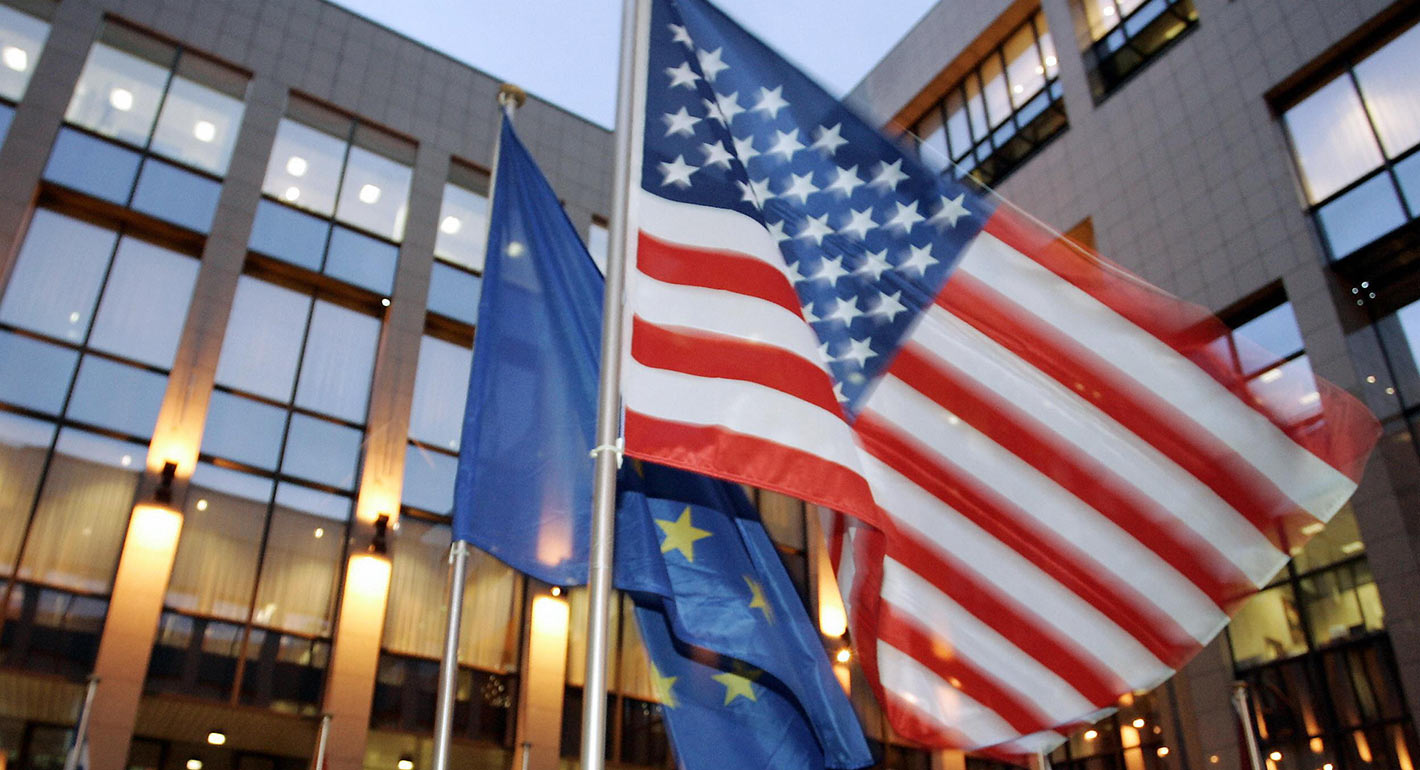
Source: Getty
Without corrective action, the United States and Europe will drift further apart over the 2020s, regardless of who sits in the Oval Office.
Source: Hill
The United States’s strike on an Iranian commander opened another rift with its European allies. Transatlantic relations are at a low. From Iran to trade with China to climate change, the two sides of the Atlantic disagree: the West is split.
Many in Europe blame President Trump for the situation — and, indeed, the Trump administration clearly bears some responsibility. But transatlantic tensions run much deeper than America's 45th president. Without corrective action, the U.S. and Europe will drift further apart over the 2020s, regardless of who sits in the Oval Office.
U.S. tensions with Europe are not new. The Iraq War famously divided the Atlantic partners. But previous fallouts have been over policy. Today, the very concept and value of the transatlantic alliance is questioned. Donald Trump is the first modern U.S. president to undermine, rather than encourage, European integration; to view the European Union as a threat instead of an ally; to inject conditionality and uncertainty into NATO.
Many Europeans think their disagreements with Washington will disappear once Mr. Trump leaves office. It is certainly true that a new president could ease tensions. He or she are likely to recommit the U.S. to NATO, share European concerns on climate change or Russia, and — when there were disagreements — handle those privately instead of over Twitter. Yet, after an initial honeymoon period, Europeans are likely to be disappointed as they discover that many of their disagreements with the U.S. are still there and reflect a longer-term divergence of U.S. and European interests.
Five issues in particular risk driving apart the U.S. and the EU over the 2020s, regardless of the person sitting in the Oval Office.
First, tensions over defense spending. Nestled under the U.S. security blanket, Europeans are likely to continue to spend less than Washington wants. U.S. frustrations with low European defense spending didn’t start with the Trump administration, and will outlast him too. Indeed, tensions could increase if a future president were to decide to cut U.S. defense spending and demand that Europeans fill the gap. Similarly, trade tensions will not necessarily decrease under a new administration, either.
Second are tensions with China. While Republican and Democratic attitudes to Beijing have hardened, Europeans — mindful of their growing economic equities — will remain reluctant to choose between their security relations with the U.S. and growing trade and investment relations with China, aggravating Washington.
Third, U.S. interest in Europe — a product of the dominance of the Cold War in U.S. foreign policy — will continue to decline this decade. As others have argued, the new Cold War is with China. The focus of U.S. foreign policy of any future administration will be the Pacific, not the Atlantic.
Fourth, as other powers rise, the United States’s ability to police the world will ebb, and will be constrained by a weary America public. As French President Emmanuel Macron has started to do, Europeans will reach out to others — including Russia and China — in response.
Finally, whether on Iran or climate change, Europeans have gotten accustomed to disagreeing with the U.S. over the last few years in a way that would have been unthinkable under previous administrations. This genie won’t just go back in the bottle. Even if the next president recommits to the EU, Europeans now know a future U.S. president could always revert back again to a Trumpian approach; they will hedge accordingly.
A strong transatlantic relationship is in the interests of both the U.S. and Europe. As we enter a new decade, one likely to be defined by a fading of the rules-based international order and the rise of a new era of great-power rivalry, a unified West is essential in confronting a rising China and a revanchist Russia. The good news is that a downward trajectory is not inevitable. Yet, to change it, the EU and the U.S. will need to renew their vows.
What could they do? Economically, a new EU-U.S. trade deal would help the United States to pull Europe away from China and better enable both to set new global standards and new international "rules of the road." Politically, the U.S. and the EU could commit to joint approaches to Iran, Russia, China, Syria and other challenges. Militarily, the U.S. and Europeans could each re-commit to NATO and re-shape NATO as a political, not just a military, forum.
Unfortunately, few of these steps currently look likely. Until that changes, Europeans should stop deluding themselves that transatlantic tensions will just magically disappear after Trump. Without action, the Atlantic may get wider, not smaller, over the next decade — whatever the electoral outcome in November.
Former Nonresident Fellow, Europe Program
David Whineray was a nonresident fellow in the Europe Program at the Carnegie Endowment for International Peace in Washington, DC.
Recent Work

Erik Brattberg, David Whineray
David Whineray
Carnegie does not take institutional positions on public policy issues; the views represented herein are those of the author(s) and do not necessarily reflect the views of Carnegie, its staff, or its trustees.

As we close out another season of Strategic Europe, it is worth taking stock of the deep shifts underway.

Rym Momtaz

The hybrid warfare landscape is evolving rapidly, leaving policymakers without clear strategies. To better inform their work in addressing emerging challenges, governments must dig deeper into the underlying dynamics at play.


Raluca Csernatoni, Alicia Wanless
The EU had to compromise to adopt a twenty-first sanctions package against Russia, exposing growing cracks in the union’s resolve. Is this latest, weaker round worth it to keep pressure on Moscow?
Rym Momtaz, ed.

Trump is distracted and Ukraine wants Europe to step up. The continent’s leaders must find their voice and assert it in talks with Russia.

Alissa de Carbonnel

Mounting economic strain and battlefield losses will not necessarily make the Kremlin less dangerous. They could instead push Moscow toward a more aggressive hybrid campaign designed to test NATO’s Eastern flank, exploit allied hesitation, and fracture European resolve.

Maksym Beznosiuk