

Commentary
Cornelius Adebahr
{
  "authors": [
    "Cornelius Adebahr"
  ],
  "type": "commentary",
  "centerAffiliationAll": "dc",
  "centers": [
    "Carnegie Endowment for International Peace",
    "Carnegie Europe"
  ],
  "collections": [
    "Iranian Proliferation"
  ],
  "englishNewsletterAll": "ctw",
  "nonEnglishNewsletterAll": "",
  "primaryCenter": "Carnegie Europe",
  "programAffiliation": "EP",
  "programs": [
    "Europe"
  ],
  "projects": [],
  "regions": [
    "North America",
    "United States",
    "Middle East",
    "Iran",
    "Western Europe"
  ],
  "topics": [
    "Nuclear Policy"
  ]
}
Source: Getty
Despite a slow start, the EU is working hard to hammer out a renewed nuclear deal between the United States and Iran. But it won’t be easy.
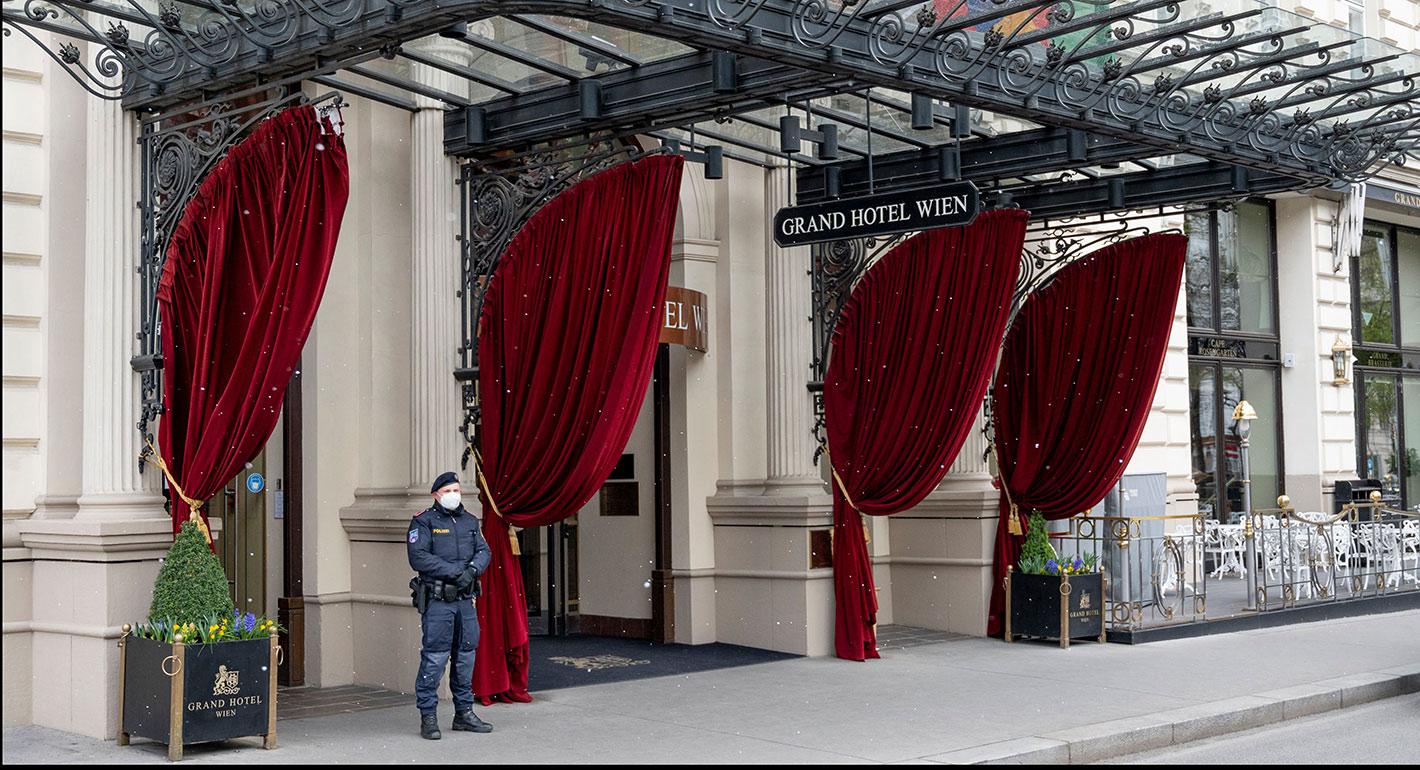
Vienna, here we come—again. Six years after world powers concluded their negotiations on Iran’s nuclear program in the Austrian capital, diplomats are talking again in the stucco-clad ballrooms of otherwise mostly deserted five-star hotels. Yet despite the genteel setting, the talks will be no waltz in the park.
The EU is trying to broker an agreement between the United States and Iran on each side’s return to the deal. Yet just like in July 2015, success is far from guaranteed. In fact, the Europeans look much weaker today than then, and that’s not just because of their dismal record in the ongoing coronavirus pandemic. If anything, the past three years since the United States left the Joint Comprehensive Plan of Action, or JCPOA, have shown Europe’s inability to keep the deal alive beyond its vital functions.
It’s true that France, Germany, and the UK—the three European co-signatories of the deal (the E3)—have fought hard to prevent the agreement from unravelling, including by torpedoing America’s unilateral efforts to reinstate all United Nations sanctions on Iran in September 2020. However, they could not maintain the economic opening that Tehran was promised in return for strict supervision of its nuclear program. Even after the pandemic had hit the Islamic Republic especially hard, European governments failed to find a way to increase humanitarian trade, or indeed grant multilateral aid to Iran, in the face of continuing U.S. sanctions.
The Europeans are learning the hard way that it is one thing to rally countries around the world against a bully in the White House but quite another to devise a plan for two sworn enemies with toxic domestic politics to find common ground again. In addition, they too have grown wary of an Iranian government that has methodically dismantled its compliance with the nuclear agreement, while enlarging its foothold in the wider region and violently cracking down on popular dissent at home.
In a similar way, U.S. President Joe Biden is realizing that although he promised to return to the deal on the campaign trail, it is hard to enact a compliance-for-compliance approach once in office. The previous administration had painstakingly built a “sanctions wall” against Iran to prevent a successor’s possible return to the JCPOA. Specifically, it went beyond just reinstating all nuclear-related sanctions by late 2018 and deliberately repackaged some of them as measures against Iran’s missile program and regional activities, in order to make the sanctions’ undoing prohibitively costly in political terms.
All this was clear when Biden won the U.S. vote in November 2020. Yet the Europeans missed the chance to prepare the ground for talks, when time was of essence. Since then, Iran has made significant advances on developing more capable centrifuges and enriching uranium to 20 percent—far above the level needed for a civilian nuclear energy program. The time it would take Iran to amass enough fissile material for one atomic bomb is now estimated to have shrunk from over a year to a couple of months.
Iran’s political calendar is also constraining the chances for compromise. Its presidential election is a mere ten weeks away, and it’s not clear how the coming campaign will influence the diplomatic dynamics. For sure, the incumbent, President Hassan Rouhani, would like to see his signature success—the lifting of international sanctions following the 2015 deal—vindicated by a renewed agreement. However, the country’s Supreme Leader, Ayatollah Ali Khamenei, has raised the bar for any bargain by asking for assurances that, this time, Washington will live up to its word. In addition, a hardliner-dominated parliament has issued guidance to drastically reduce international inspections, a move that has only been put on hold for a three-month window ending in late May, after the International Atomic Energy Agency scrambled to reach a temporary agreement.
For Europe, the negotiations that have begun in Vienna this week are the last chance to save a deal that is essential to its security, as leaders have repeatedly claimed. Together with the Austrian government hosting the talks and the E3 representatives shuttling between the Americans and Iranians in their separate hotels, the EU—as chair of the JCPOA’s joint commission—is working on two to-do lists. The first is to spell out what Tehran needs to do to come back into compliance on the nuclear front. The second—likely much longer one—will set out precisely how Washington needs to cut back its sanctions architecture. Once this short-term return to the deal is secured, the parties can engage in the hard slog of curtailing Iran’s reach by setting up a regional security architecture.
Without Europe’s mediation efforts, any agreement in such a distrustful atmosphere will be elusive. Yet it took the Europeans far too long to step up their game and engage in this eleventh-hour diplomatic dance—in the very city of their lone foreign policy success of late.
Former Nonresident Fellow, Carnegie Europe
Cornelius Adebahr was a nonresident fellow at Carnegie Europe. His research focuses on foreign and security policy, in particular regarding Iran and the Persian Gulf, on European and transatlantic affairs, and on citizens’ engagement.
Recent Work
Cornelius Adebahr

Cornelius Adebahr, Barbara Mittelhammer
Carnegie does not take institutional positions on public policy issues; the views represented herein are those of the author(s) and do not necessarily reflect the views of Carnegie, its staff, or its trustees.

Are Germany’s economic, industrial, and political struggles becoming a liability for the EU’s ability to rise to the geopolitical moment?

Rym Momtaz, ed.

European Commission President Ursula von der Leyen is about to give her annual address on the state of the EU. Here’s what she won’t—but should—say.
Rym Momtaz

Radical-right parties are expected to do well in upcoming elections in four of the EU's biggest member states. If successful, they could prevent the union from addressing key challenges ahead.

Stefan Lehne

Canadian Prime Minister Mark Carney has twice inspired praise for standing up to U.S. President Donald Trump: at the 2026 World Economic Forum in Davos and on Canada-U.S. trade negotiations. Is Carney showing a third way better than the EU has in dealing with the Trump administration?
Rym Momtaz, ed.

European states control several Overseas Countries and Territories around the world that carry strategic, economic, and environmental weight. As great powers challenge the rules-based order, defending them is a geopolitical imperative for Europe.

Marc Pierini