

Other
Stephen Wertheim
{
  "authors": [
    "Stephen Wertheim"
  ],
  "type": "commentary",
  "centerAffiliationAll": "dc",
  "centers": [
    "Carnegie Endowment for International Peace"
  ],
  "collections": [
    "Ukraine’s Long Shadow"
  ],
  "englishNewsletterAll": "americanStatecraft",
  "nonEnglishNewsletterAll": "",
  "primaryCenter": "Carnegie Endowment for International Peace",
  "programAffiliation": "ASP",
  "programs": [
    "American Statecraft"
  ],
  "projects": [],
  "regions": [
    "North America",
    "United States",
    "Russia",
    "Eastern Europe",
    "Ukraine"
  ],
  "topics": [
    "Security",
    "Foreign Policy"
  ]
}
Source: Getty
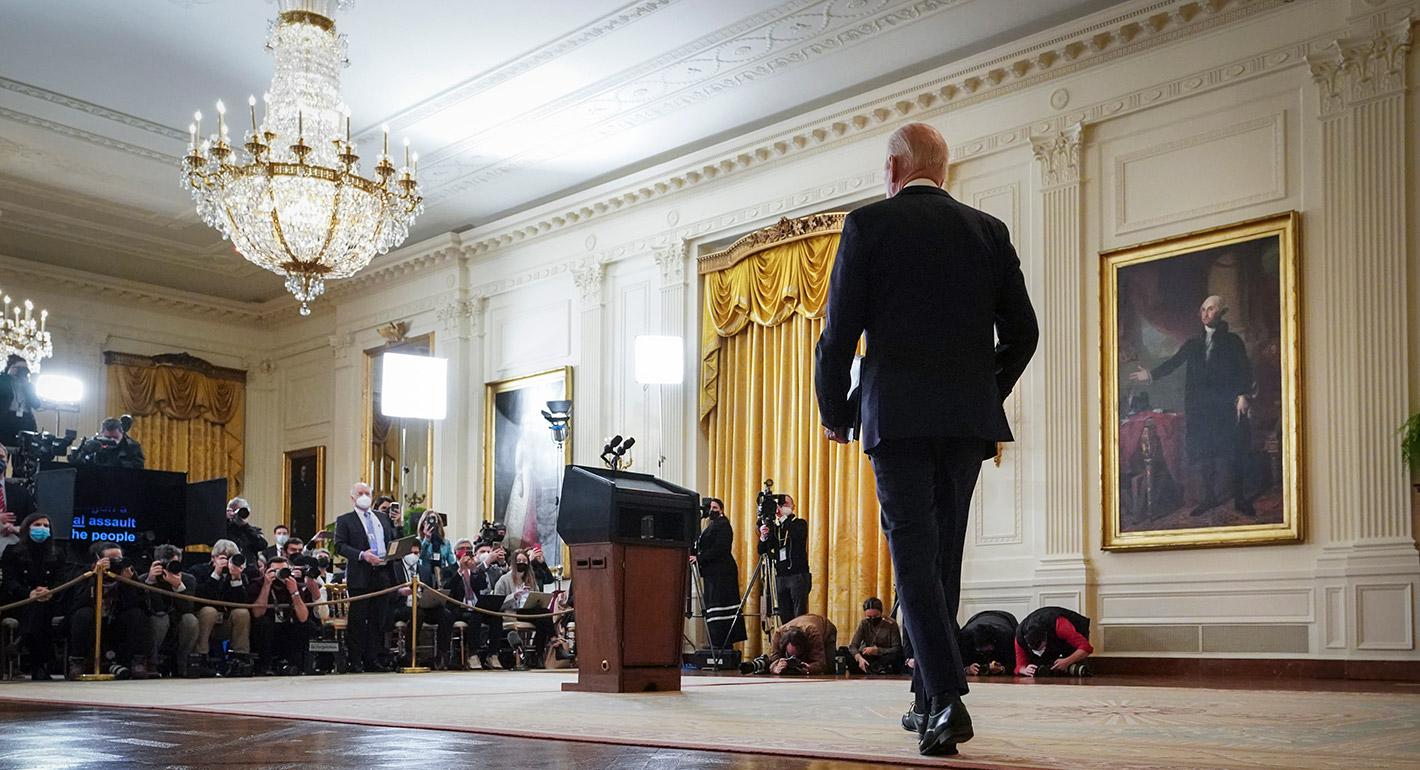
In the face of Russia’s deplorable attack on Ukraine, hard-earned lessons may be difficult to recall, but they’re only more important now.
At the direction of President Vladimir Putin, Russia has committed staggering acts of aggression against Ukraine. Its invasion is brazen in substance and style. Russia is threatening to overthrow the government in Kyiv. It seems to flaunt the flimsiness of its pretexts. Though always thuggish, Putin once seemed averse to risk. Now he has taken a world-shaking gamble whose ultimate implications neither he nor anyone else can foresee.
For Americans, this is a dangerous moment, and a disorienting one. The United States has spent much of the past three decades dealing with powers much weaker than itself. Even so, it has learned painful lessons about the limits of its power and its capacity to do harm as well as good. These lessons may be difficult to recall in the face of Russia’s deplorable and ongoing attack. But they have become only more important now, as the United States confronts a great power and nuclear peer capable of inflicting damage well beyond Ukraine.
Months ago, U.S. President Joe Biden took the use of force in Ukraine off the table. Still, a nonmilitary confrontation between the United States and Russia likely poses greater risks to the safety and well-being of the American public than did even the recent wars in Afghanistan, Iraq, and Libya, in which the United States was a direct military participant. Yesterday and today, the United States and its European allies announced severe sanctions against the Russian government, banks, and individuals, with more punishments to come. These measures, stronger than many expected, amount to warfare by economic means, and they will effectively be permanent.
In recent decades, the United States has imposed crippling sanctions on relatively small states like Cuba, Iran, and North Korea, incurring little cost to the U.S. economy. Russia, by contrast, is a great power and may retaliate in kind, sending oil, gas, and food prices higher. It could mount cyber attacks that spur cycles of retaliation. In the worst case, conflict could escalate into a hot war. What is particularly challenging is that no number of sanctions would likely stop Russian aggression in Ukraine, and there is no obvious threshold by which American and European leaders can feel satisfied that they have done enough. The demand to “do more” will persist no matter how much policymakers in fact do. So, the desire to punish Russia, however justified, will need to be tempered by two considerations: What are the costs and risks of retaliation? And how likely are additional sanctions to change Russian behavior for the better, given the alternative possibilities that they may strengthen Putin’s grip on the Russian economy, make him more desperate and reckless, or drive Russia and China closer together?
An exclusively punitive outlook could also inhibit America’s handling of the conflict in Ukraine itself. Even before Russia launched its attack, influential figures proposed that the United States should arm a prospective Ukrainian insurgency, imagining that Ukraine could become “Russia’s Afghanistan.” Military aid should be considered, but not before it becomes clearer what kind of operation Russia is mounting, who would receive U.S. support, and what battlefield objective could be pursued. In Syria, the United States trained and equipped rebel forces, only to lengthen the war without dislodging dictator and President Bashar al-Assad from power. America’s experience in Afghanistan makes for a curious model to emulate. In the 1980s, the United States aided the forces from which al-Qaeda would emerge. For the past two decades, it created a client state dependent on U.S. support and continual violence. If Putin has launched a reckless, poorly calculated military adventure, the United States should hardly follow suit.
For too long, the United States has ranked the impulse to stop evil above the imperative to help those in need. Let this time be different. The United States, despite having limited military options at its disposal, has every ability to assist Ukrainians who flee for their lives. The Biden administration should welcome those who seek to resettle in the United States. It should press European allies to do the same and mobilize U.S. agencies to help them. “We must have courage and self-confidence to cling to our own methods and conceptions of human society,” diplomat George Kennan cabled from Moscow in 1946. Kennan was writing at the start of the Cold War. It is advice to heed at what may be the start of another.

Senior Fellow, American Statecraft Program
Stephen Wertheim is a senior fellow in the American Statecraft Program at the Carnegie Endowment for International Peace.
Recent Work
Stephen Wertheim



Sophia Besch, Alper Coşkun, Nate Reynolds, …
Carnegie does not take institutional positions on public policy issues; the views represented herein are those of the author(s) and do not necessarily reflect the views of Carnegie, its staff, or its trustees.

The domestic impacts of how long it is taking to end the war in Ukraine have pushed the French electorate to the political extremes and compromised the country’s diplomatic capacity.

Rym Momtaz

Before the next wave of EU enlargement takes place, the union needs to grapple with thorny questions of how power is distributed among its members.


Emil Sondaj Hansen, Ditte Brasso Sørensen

The new U.S.–Denmark–Greenland agreement will help Washington exert political, economic, and financial dominance under the guise of security. Yet, it acknowledged Copenhagen’s and Nuuk’s sovereignty on the island.

Marc Pierini

A summer of escalation in the Black Sea has hurt Ukraine economically and is exacerbating world food security. A truce is needed—as is a broader reframing of Europe’s Ukraine strategy.

Thomas de Waal

Are Germany’s economic, industrial, and political struggles becoming a liability for the EU’s ability to rise to the geopolitical moment?
Rym Momtaz, ed.