

Commentary
Oliver Stuenkel, Adrian Feinberg
{
  "authors": [
    "Oliver Stuenkel"
  ],
  "type": "commentary",
  "centerAffiliationAll": "dc",
  "centers": [
    "Carnegie Endowment for International Peace"
  ],
  "collections": [],
  "englishNewsletterAll": "democracy",
  "nonEnglishNewsletterAll": "",
  "primaryCenter": "Carnegie Endowment for International Peace",
  "programAffiliation": "DCG",
  "programs": [
    "Democracy, Conflict, and Governance"
  ],
  "projects": [],
  "regions": [
    "North America",
    "South America"
  ],
  "topics": [
    "Democracy",
    "Economy"
  ]
}
Source: Getty
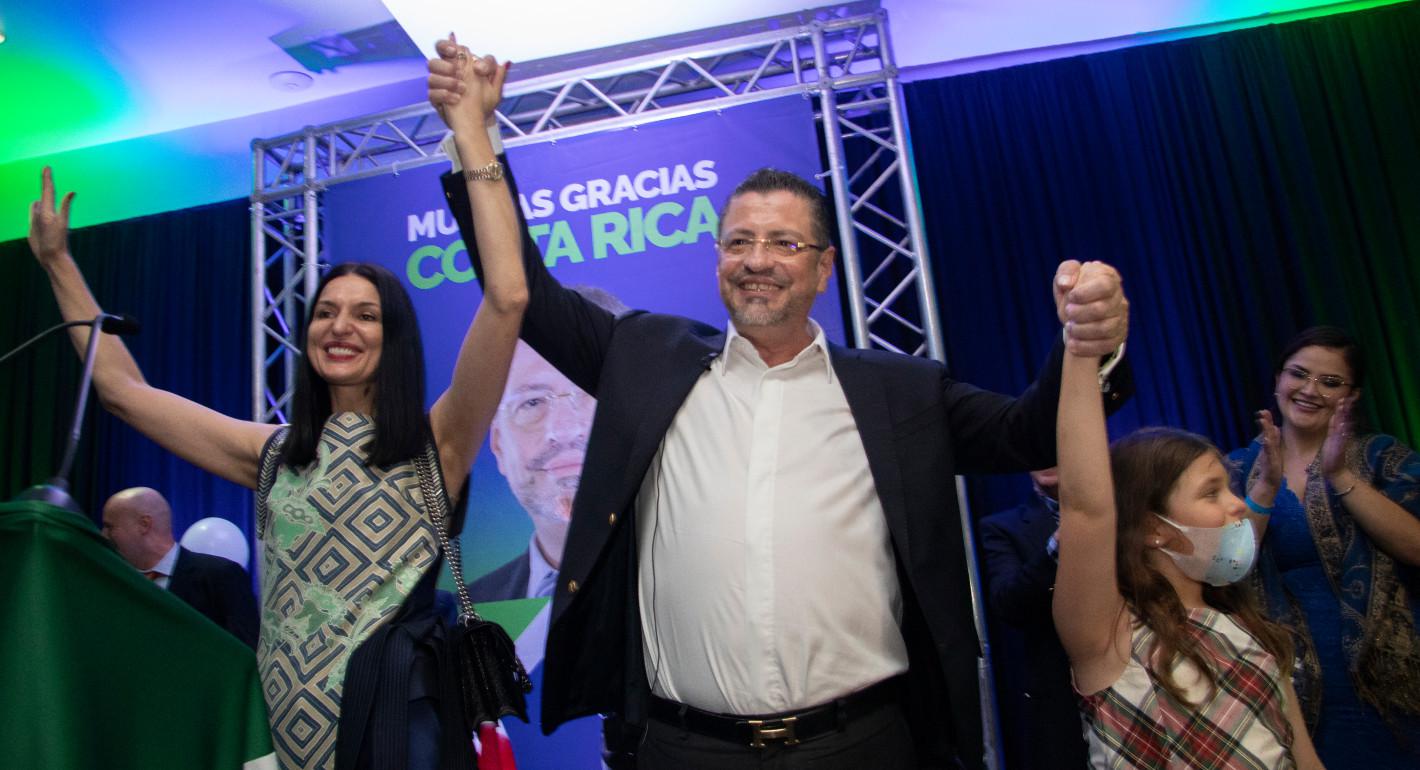
Rodrigo Chaves’s election reveals that antiestablishment sentiment remains strong across Latin America.
When Rodrigo Chaves is sworn in as Costa Rica’s new president on May 8, his honeymoon period is likely to be unusually brief. After a rancorous election, Chaves must show that he is not just a skilled campaigner but also able to govern by establishing a successful dialogue with opponents at home and with other heads of state in an increasingly troubled neighborhood.
The conservative Chaves, a former finance minister and World Bank economist, defeated former president José María Figueres with 53 percent of the vote in the April 3 runoff. The highly polarized contest was shaped by mutual accusation and a historically low turnout, as well as profound public disillusion with traditional parties. But it was also another example of the strength of Costa Rica’s democracy, which frequently receives top grades in global rankings. Figueres conceded less than one hour after the results began coming in, and there were no street protests or cries of fraud.
Many Costa Ricans regarded the runoff as a choice between two highly imperfect candidates. Chaves, who projected himself as an anti-politics maverick and whose second-place finish in the first round had been largely unexpected, was demoted at the World Bank due to sexual harassment of junior staffers and then faced a campaign financing scandal. Figueres was unable to shake off accusations of large-scale corruption during his first presidency from 1994 to 1998.
In addition, the country faces numerous structural challenges, many aggravated by the coronavirus pandemic, which battered the country’s crucial tourism industry. Corruption scandals, inequality, rising unemployment—currently standing at almost 14 percent—and slow economic growth have made the country more vulnerable to a populist outsider campaigning on an anti-elite platform. Large majorities of Costa Ricans do not identify with any party, and only a quarter say they are satisfied with democracy. Outgoing president Carlos Alvarado will leave with one of the lowest approval ratings in the Americas, after a lackluster four years in office marked by corruption scandals for his party and by public debt that stands at 70 percent of GDP. And Costa Rica’s northern border with Nicaragua is increasingly seen as a source of instability, while gang-related violence has been on the rise in the coastal province of Limón.
The election of Chaves, who has never held elected office before and whose governing style is unknown, reveals that widespread antiestablishment sentiment remains strong across Latin America. In June, Peruvians elected the political neophyte Pedro Castillo as president, a choice that also reflected a broad rejection of political elites. Just like in Costa Rica, Peruvians faced two unappealing options in the runoff, and many ended up choosing what they considered to be the lesser evil. While Castillo is widely seen as too weak to represent a threat to democracy, the situation is far more serious in El Salvador, where voters elected antiestablishment candidate Nayib Bukele as president in 2019. Bukele has since severely undermined the country’s democratic institutions. A year earlier, Brazilians, disillusioned with the political class as a whole, opted for the far-right maverick, President Jair Bolsonaro, who faces reelection later this year.
Despite his campaign promises to break with the past, Chaves likely won’t pose a threat to Costa Rica’s democracy: the country’s courts are highly independent, and the president has limited powers over the legislature. Yet Chaves’s denunciation of the political establishment and the media—which he called “vehicles of defamation” during the campaign—is still worrisome and could be used as a justification to concentrate political power. During his campaign, Chaves suggested that he would rule by executive proposals and referendums rather than with legislative support, likely because his party controls only ten seats out of fifty-one in Costa Rica’s Legislative Assembly. Leaders who attempted to bypass political parties or the legislature have rarely strengthened democracy.
Unless Chaves, who is set to govern until 2026, proves to be extraordinarily skillful at working with the political elites he systematically denounced during the campaign, he is unlikely to be able to implement the big reforms he promises, such as reducing the size of Costa Rica’s government. His somewhat turbulent stint as finance minister did not suggest he was particularly skillful at seeking compromise—he left after clashing with the president. His disgraceful exit from the World Bank will make it extremely hard for him to obtain support from progressive elements of Costa Rican society, even though he issued a public apology after the campaign and promised to strengthen women’s rights as president. The defeated Figueres had campaigned on protecting the environment, women’s rights, and promises to improve public education. But he was ultimately unable to mobilize voters in what was, above all, a referendum on the status quo, with Figueres unable to disassociate himself from the political class.
The fate of Costa Rican democracy matters beyond its borders. Despite its small size, the Central American country has long played an outsized role in global climate diplomacy. In addition to its ambitious climate policies, it is also a frequent case study of successful public health policy, a major challenge in the Americas. Given the stability of its institutions, Costa Rica may provide lessons to others about how to assure that the election of a populist after a deeply rancorous campaign does not affect the quality of democracy.
Senior Fellow, Democracy, Conflict, and Governance Program
Oliver Stuenkel is an associate professor at the School of International Relations at Fundação Getulio Vargas (FGV) in São Paulo, Brazil. He is also a senior fellow affiliated with the Democracy, Conflict, and Governance Program at the Carnegie Endowment for International Peace.
Recent Work
Oliver Stuenkel, Adrian Feinberg
Oliver Stuenkel, Adrian Feinberg
Carnegie does not take institutional positions on public policy issues; the views represented herein are those of the author(s) and do not necessarily reflect the views of Carnegie, its staff, or its trustees.

A notable degree of participative democracy has firmly arrived in Europe. But to have more far-reaching impact, democratic deliberation needs to move into a radically new phase.

Richard Youngs

The European Commissioner for Trade is headed to China. But after President Xi’s bridge-building visit to Washington, can a more isolated EU overcome Beijing’s stranglehold on critical raw materials? Who will blink first?

Rym Momtaz, ed.

The domestic impacts of how long it is taking to end the war in Ukraine have pushed the French electorate to the political extremes and compromised the country’s diplomatic capacity.
Rym Momtaz

Before the next wave of EU enlargement takes place, the union needs to grapple with thorny questions of how power is distributed among its members.


Emil Sondaj Hansen, Ditte Brasso Sørensen

A summer of escalation in the Black Sea has hurt Ukraine economically and is exacerbating world food security. A truce is needed—as is a broader reframing of Europe’s Ukraine strategy.

Thomas de Waal