

Commentary
Oliver Stuenkel, Adrian Feinberg
{
  "authors": [
    "Oliver Stuenkel"
  ],
  "type": "commentary",
  "centerAffiliationAll": "dc",
  "centers": [
    "Carnegie Endowment for International Peace"
  ],
  "collections": [],
  "englishNewsletterAll": "democracy",
  "nonEnglishNewsletterAll": "",
  "primaryCenter": "Carnegie Endowment for International Peace",
  "programAffiliation": "DCG",
  "programs": [
    "Democracy, Conflict, and Governance"
  ],
  "projects": [],
  "regions": [
    "North America",
    "South America"
  ],
  "topics": [
    "Democracy",
    "Economy"
  ]
}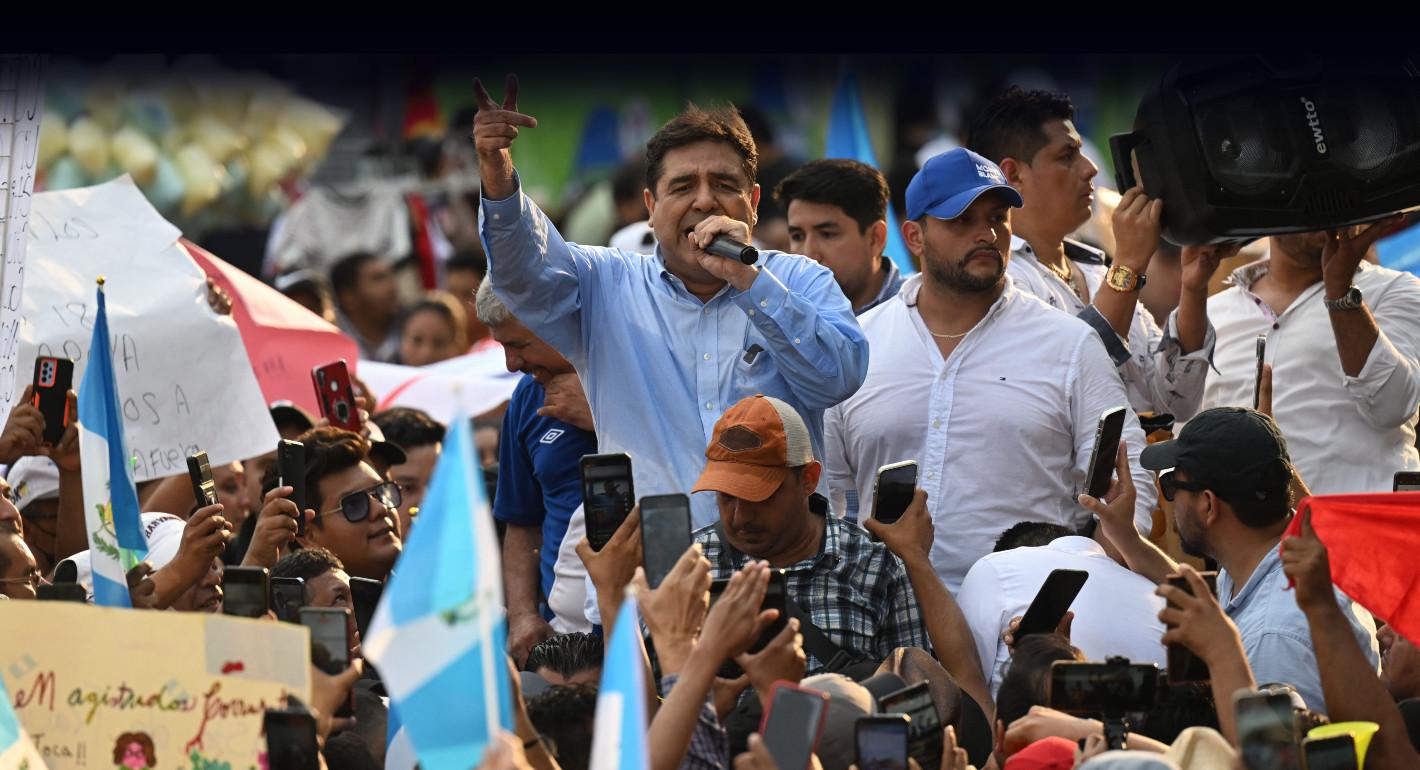
Source: Getty
The vast majority of Guatemalans think the country is on the wrong track, but elections are unlikely to lead to improvements.
Reviewing the strategies of populists with authoritarian tendencies, political philosopher Jan-Werner Müller recently pointed out that “one lesson is [to] capture the judiciary first — after that, media pluralism and elections can be undermined at will.”
This is precisely what has been happening in Guatemala, which will hold presidential and parliamentary elections on June 25. But in the runup to the vote, the electoral justice system has disqualified numerous presidential candidates—including the one leading in the polls—largely on spurious grounds. Countless critics have left the country. Only 16 percent of Guatemalans trust the electoral tribunal in charge of running elections. The vote will thus not be fair, raising the question of whether political observers should refrain from using the term “election” at all. As a result, the world’s focus should be less attuned to the political contest itself and more on the event as another milestone in Central America’s democratic backsliding.
But this round of backsliding looks different than previous eras. Those in power “don’t use death squads anymore, simply because they have the justice system at their disposal to annihilate any opposition,” says Francisco Sandoval, who led Guatemala’s Special Prosecutor’s Office Against Impunity and chose to go into exile in 2021 after receiving threats. In the same way, José Ruben Zamora, a leading journalist, said that the country has become “a veiled, multiparty, tyrannical dictatorship,” shortly before he was sentenced to six years in prison for what the vast majority of outside observers and government critics say amount to trumped-up charges. Four of Zamora’s lawyers are also in prison, and countless journalists working for the newspaper El Periódico, which he founded, have fled the country. Guatemalan Attorney General Consuelo Porras and anti-corruption prosecutor Rafael Curruchiche, who prosecuted Zamora, appear on a U.S. list of “corrupt and undemocratic actors.”
Guatemala’s current situation is the consequence of incomplete democratization. The CIA-sponsored overthrow of the democratic government of president Jacobo Árbenz in 1954 led to the rise of military dictatorship, under which the country slid, a few years later, into a thirty-six-year-long bloody civil war that ended in 1996. The resulting peace agreement strengthened the process of democratization, but powerful groups—including the military, paramilitary groups, and business elites—retained control and often illegal privileges they had secured during the war.
The UN-backed International Commission Against Impunity in Guatemala (CICIG), which operated in cooperation with the country’s prosecutors from 2007 to 2019 and helped dismantle countless criminal structures, raised hopes that these anti-democratic forces could be decisively weakened. Some observers even spoke of a “Guatemalan Spring.” But the CICIG helped uncover so many cases of deeply entrenched corruption involving numerous business, military, and political leaders that elites decided to push back.
The 2019 expulsion of the CICIG and the persecution of those involved in fighting corruption suggested that powerful members of Guatemalan society were closing ranks against efforts to see democracy taking root. Last November, a judge overseeing a case against military and police officers regarding the disappearance of nearly 200 people during the dictatorship fled into exile. Thirty Guatemalan judicial officials have left for the United States over the past few years.
Elsewhere in Latin America, processes of democratic erosion are usually led by a specific individual or family—such as Hugo Chávez and Nicolás Maduro in Venezuela, Daniel Ortega and his wife in Nicaragua, or Nayib Bukele in El Salvador. But in Guatemala, threats to the country’s democracy are more systemic and cannot be easily attributed to one group or individual. Although President Alejandro Giammattei—who cannot run again, as Guatemala does not allow presidents to seek reelection—controls both the judiciary and parliament, the country’s democratic malaise seems to continue due to a broad network involving the armed forces, Congress, and business elites—which at times fight among one another but all have an interest in limited transparency and accountability. This phenomenon is sometimes called Pact of the Corrupt by Guatemalan civil society.
Given how systematically major candidacies have been disqualified by the judiciary—including Carlos Pineda and Roberto Arzú, both conservative businessmen, and leftist indigenous leader Thelma Cabrera—whoever wins almost certainly will protect elite interests and continue to weaken the judiciary’s capacity to investigate corruption, irrespective of the target’s political connections.
Of the remaining candidates, the three leading contenders are Sandra Torres of the center-left UNE party, Edmond Mulet of the center-right Cabal Party, and right-wing Zury Ríos of the Valor-Unionista coalition. Ríos is the daughter of General Efraín Ríos Montt, a former Guatemalan leader who was convicted of genocide. None of them represents a real threat to those governing right now—including the president, who has faced numerous corruption allegations and accusations of undue interference in the judiciary and ties to organized crime. Manuel Conde, the candidate for Giammattei’s Vamos party, polls in the single digits—a reflection of Latin America’s entrenched anti-incumbency dynamic.
The situation all but ensures that this election will probably not produce fundamental political change in Guatemala, and that most of its deep-seated problems are likely to remain unresolved. Despite economic growth that is well above the regional average, the poverty rate remains above 50 percent, and large-scale emigration, including to the United States, is likely to continue. Guatemala has long been one of the deadliest countries for environmental activists, yet due to climate change, conflicts between the poor rural population and the owners of large estates are likely to increase. The country remains an extremely unequal society, and elite prejudice against the indigenous population, representing roughly half of the country, remains widespread. Torres and Ríos both endorse Bukele-style hardline strategies against crime that involve systematic human rights violations.
Given the numerous domestic challenges facing Latin American governments, Guatemala’s democratic decay has largely remained under the radar. In the same way, Guatemala’s elites have been unafraid to arrest even internationally visible figures such as Zamora. But the systemic, elite-driven democratic backsliding of Central America’s most populous country’s deserves attention, particularly given the dangers that it may provide a blueprint for anti-democratic forces elsewhere.
Senior Fellow, Democracy, Conflict, and Governance Program
Oliver Stuenkel is an associate professor at the School of International Relations at Fundação Getulio Vargas (FGV) in São Paulo, Brazil. He is also a senior fellow affiliated with the Democracy, Conflict, and Governance Program at the Carnegie Endowment for International Peace.
Recent Work
Oliver Stuenkel, Adrian Feinberg
Oliver Stuenkel, Adrian Feinberg
Carnegie does not take institutional positions on public policy issues; the views represented herein are those of the author(s) and do not necessarily reflect the views of Carnegie, its staff, or its trustees.

A notable degree of participative democracy has firmly arrived in Europe. But to have more far-reaching impact, democratic deliberation needs to move into a radically new phase.

Richard Youngs

The European Commissioner for Trade is headed to China. But after President Xi’s bridge-building visit to Washington, can a more isolated EU overcome Beijing’s stranglehold on critical raw materials? Who will blink first?

Rym Momtaz, ed.

The domestic impacts of how long it is taking to end the war in Ukraine have pushed the French electorate to the political extremes and compromised the country’s diplomatic capacity.
Rym Momtaz

Before the next wave of EU enlargement takes place, the union needs to grapple with thorny questions of how power is distributed among its members.


Emil Sondaj Hansen, Ditte Brasso Sørensen

A summer of escalation in the Black Sea has hurt Ukraine economically and is exacerbating world food security. A truce is needed—as is a broader reframing of Europe’s Ukraine strategy.

Thomas de Waal