

In The Media
Lilia Shevtsova
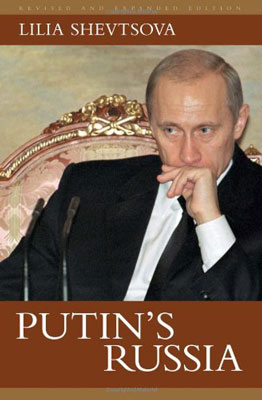
This revised edition explores the true nature of Putin’s leadership and how far he is willing to go and capable of going with further transformation. The book includes an examination of the recent presidential and parliamentary elections and their effects on Putin’s leadership and Russia.
Source: Washington

Lilia Shevtsova, one of the most respected political analysts in Russia and the West, examines President Putin’s achievements as well as his failures. She explores the true nature of Putin’s leadership and how far he is willing to go and capable of going with further transformation.
This revised edition includes an examination of the recent presidential and parliamentary elections and their effects on Putin’s leadership and Russia.
About the Author
Lilia Shevtsova is one of Russia’s top political analysts, an award-winning journalist, and a regular commentator for major world television and radio networks. She is senior associate in the Russian and Eurasian Program at the Carnegie Endowment.
Praise For The First Edition
"Out of [Shevstova's] blunt, often acerbic, account comes shrewd insights into Putin’s transformation from an implausible, contrived successor into a dominator unchallenged by oligarchs, legislators, or regional bosses, let alone a democratic opposition."
—Foreign Affairs
"Shevtsova is one of the most astute and independent-minded observers of the Russian political scene."
—Times Literary Supplement
"Offers many insights into Kremlin court politics, as well as Mr. Putin and his foes."
—The Economist
"An insightful account of how the Russian president is swaying on a pendulum between reform and stability."
—Survival
"Provides an insightful analysis of the political maneuvering inside the Moscow beltway."
—CHOICE
"This well-informed Russian observer offers a straightforward situation report. Shevtsova’s scorecard will interest serious Russia watchers."
—Booklist
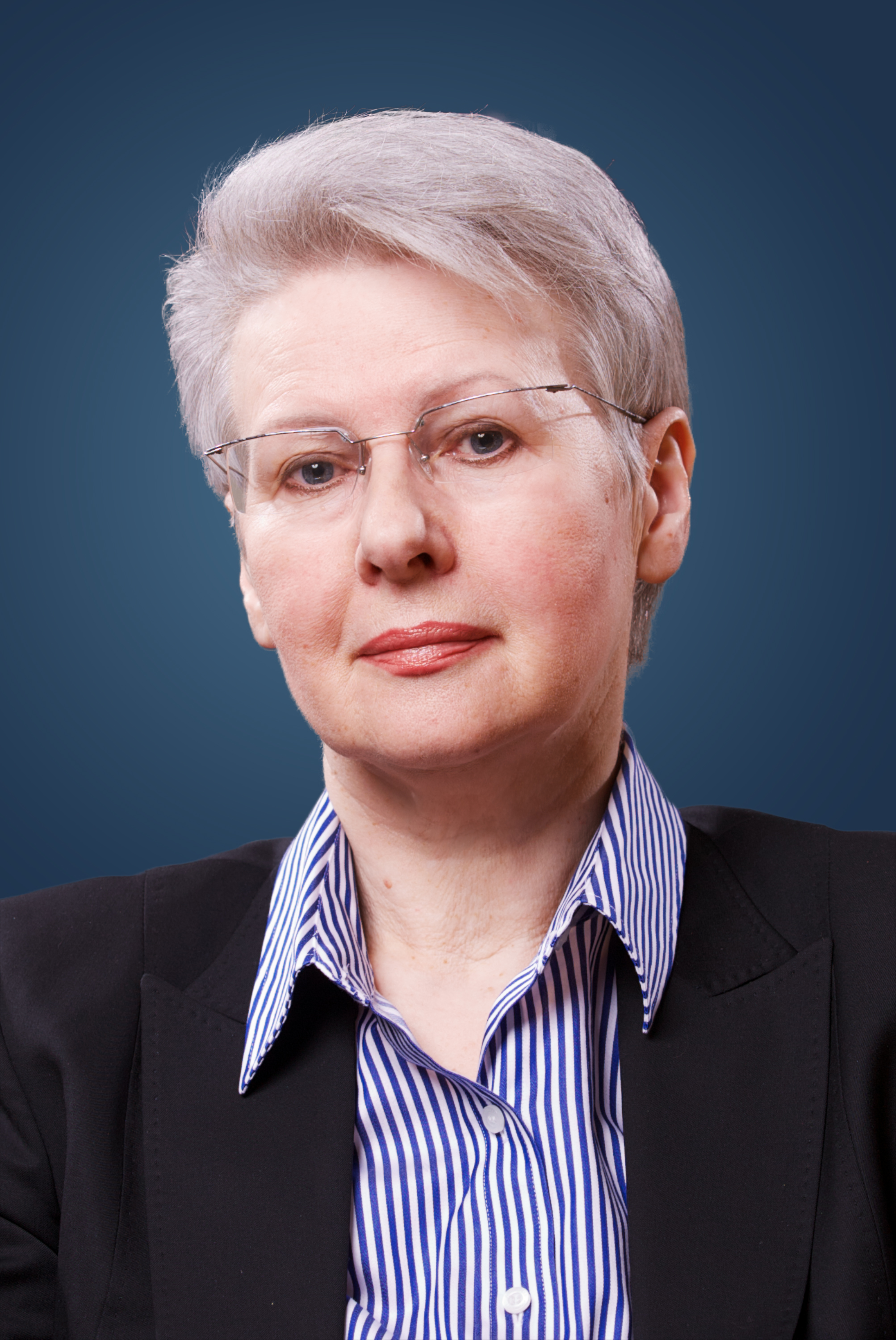
Former Senior Associate, Russian Domestic Politics and Political Institutions Program, Moscow Center
Shevtsova chaired the Russian Domestic Politics and Political Institutions Program at the Carnegie Moscow Center, dividing her time between Carnegie’s offices in Washington, DC, and Moscow. She had been with Carnegie since 1995.
Recent Work
Lilia Shevtsova
Lilia Shevtsova
Carnegie does not take institutional positions on public policy issues; the views represented herein are those of the author(s) and do not necessarily reflect the views of Carnegie, its staff, or its trustees.

Funding Ukraine remains a priority for European leaders. As Russia’s war of aggression heads into another winter, two feasible options to mobilize support for Kyiv should be fast-tracked.


Vladyslav Rashkovan, Gregory P. Wilson

While the EU and European governments are embracing the much-lauded middle-power moment, this entails three difficult conundrums.

Richard Youngs

Europe is facing rising populism internally as well as external pressures from Russia, China, Turkey, and the United States.

Dimitar Bechev

A notable degree of participative democracy has firmly arrived in Europe. But to have more far-reaching impact, democratic deliberation needs to move into a radically new phase.
Richard Youngs

Much has been said of the changes Brussels is trying to make to the EU enlargement process. Here’s why gradual integration might—or might not—be the answer.
Dimitar Bechev