

Paper
Adam Baczko, Gilles Dorronsoro, Arthur Quesnay
Source: Getty
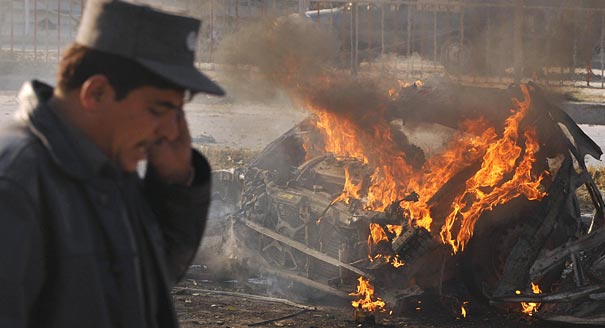
The absence of security, law enforcement or effective central government has created a vacuum in Afghanistan. The Taliban are conducting a campaign to eliminate government contact with the population and compel the people to accept Taliban rule.
The United States chose President Hamid Karzai to succeed the Taliban in Afghanistan in 2001 mainly because of his closeness to the Bush administration. Karzai is believed to have won another term in a disputed election last week, but the results are still unclear, and he may face a run-off in October. When he became head of the government, he had no appreciable political base in the country, and he sought to eliminate local powers who could threaten his control of the periphery.
Karzai relied on a narrow coterie to fill important positions in his administration, and nominated political allies as governors. His strategy backfired, in large part because he made poor choices—based more on personal relations than competence—and weakening or eliminating local leaders produced further political fragmentation. As a result, few local leaders can control any significant part of Afghanistan today.
The main problem is the absence of security and law enforcement structures, notably police and judges. Too little money has been directed toward institution-building and the justice and police programs have been a total failure. In practice, there are no state judges. The few police officers are poorly paid, prone to corruption, and poorly trained and armed. In Kunduz Province, for example, a population of one million is policed (in theory) by 1,000 men, though the actual figure is said to be closer to 500. In most cases, people seek to resolve disputes by going to local jirga (when effective) or ulema for Sharia justice.
Too little money has been directed toward institution-building and the justice and police programs have been a total failure.
The Afghan National Army (ANA) is unable to deploy large units, despite better training and, according to some anecdotal evidence, a better fighting spirit. Command and control is weak and the ANA still cannot operate without International Coalition leadership. Observers in direct contact with the ANA report that operations involving more than 100 troops cannot be effectively conducted autonomously.
Given the vacuum left by the absence of the state, local leaders are (re)arming quickly. In 2003 and 2004, the International Coalition pursued a disarmament program that paid people for surrendering weapons to the authorities. Its main effect, unfortunately, was to enable local commanders to upgrade their arsenals, buying new weapons with the money they got for the old. Since 2006, when the momentum of the insurgency became apparent, Afghans have been convinced that the government and the International Coalition are not going to prevail. To provide their own security, local groups have been buying significant quantities of weapons. The demand has driven up the prices of weapons considerably, especially in the south. Even in Kabul, buying weapons is extremely easy, in quantities as large as dozens of Kalashnikov rifles.
The Taliban are systematically destroying the local administrations at the district level, with the objective of eliminating the government’s contact with the population.
In this void, the Taliban are discrediting the Afghan central government and destroying its presence, isolating the International Coalition, building an alternative administration, and extending their influence into areas where they initially had no support.
The Taliban are systematically destroying the local administrations at the district level, with the objective of eliminating the government’s contact with the population. As they succeed, they show Afghans that the state is unable to protect them or provide services, compelling them to accept the order and justice the Taliban provide. This situation forces the United States to take charge of local security and governance, which in turn enables the Taliban to call attention to the foreign occupation and recruit resistance to it.
The Taliban are now the dominant political force in numerous regions of Afghanistan, including Pashtun-majority provinces in the east and the south. In these provinces, the situation of the International Coalition is comparable to that of the Soviet Union in the 1980s, in that the International Coalition, largely isolated at its outposts, is operating with neither the support nor the acceptance of the Afghan population.
The insurgents control the countryside, and have a strong presence even inside cities like Kandahar and Ghazni. Outside the major cities, Afghan administration is nonexistent. As President Obama must realize, whether Afghanistan is led by Hamid Karzai or anyone else, the problem for the International Coalition is not one of insufficient force; it is insufficient government.
Former Nonresident Scholar, South Asia Program
Dorronsoro’s research focuses on security and political development in Afghanistan. He was a professor of political science at the Sorbonne in Paris and the Institute of Political Studies of Rennes.
Recent Work
Adam Baczko, Gilles Dorronsoro, Arthur Quesnay
Gilles Dorronsoro
Carnegie does not take institutional positions on public policy issues; the views represented herein are those of the author(s) and do not necessarily reflect the views of Carnegie, its staff, or its trustees.

Funding Ukraine remains a priority for European leaders. As Russia’s war of aggression heads into another winter, two feasible options to mobilize support for Kyiv should be fast-tracked.


Vladyslav Rashkovan, Gregory P. Wilson

While the EU and European governments are embracing the much-lauded middle-power moment, this entails three difficult conundrums.

Richard Youngs

Europe is facing rising populism internally as well as external pressures from Russia, China, Turkey, and the United States.

Dimitar Bechev

Much has been said of the changes Brussels is trying to make to the EU enlargement process. Here’s why gradual integration might—or might not—be the answer.
Dimitar Bechev

The European Commissioner for Trade is headed to China. But after President Xi’s bridge-building visit to Washington, can a more isolated EU overcome Beijing’s stranglehold on critical raw materials? Who will blink first?

Rym Momtaz, ed.