

Commentary
The aftermath of the Ceuta crisis shows Europe has drawn the wrong lessons. Rather than doubling down on failed migration policies, the EU needs to address the underlying roots of such episodes.
Richard Youngs
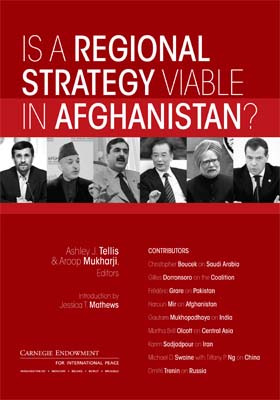
President Obama has placed a greater emphasis on the need for a regional approach to Afghanistan. Leading experts analyze what a regional strategy would mean in practice through the eyes of key states, including Russia, Iran, Pakistan, and India, and what it could mean for U.S. policy.
President Obama made decisive changes to U.S. policy in Afghanistan—increasing forces on the ground, modifying the original goals, and placing a greater emphasis on the need for a regional approach. Leading experts analyze the interests of Afghanistan’s neighbors, what they mean in practice, and what it could mean for U.S. policy.
“All the relevant states will continue to act in and around Afghanistan, pursuing their national interests as they see them,” writes Carnegie President Jessica Mathews. “Whatever succession of strategies the United States and its partners adopt in the years ahead in pursuit of a peaceful and stable Afghanistan, a deep and nuanced understanding of the interests and policies of the neighboring states—not as the United States would like them to be, but as these states actually perceive them—will be essential to a successful outcome.”
In its final chapter, Ashley J. Tellis concludes that “the regional approach to Afghanistan—understood as an effort to incorporate all of Kabul’s major neighbors into a cooperative enterprise led by the United States, and aimed at stabilizing Afghanistan through successful counterterrorism, reconstruction, and state-building—is unlikely to succeed, first and foremost, because the key regional stakeholders have diverging objectives within Afghanistan.”
Former Senior Fellow
Ashley J. Tellis was a senior fellow at the Carnegie Endowment for International Peace.
Aroop Mukharji
Former Junior Fellow, South Asia Program, US Role in the World Program
Distinguished Fellow
Mathews is a distinguished fellow at the Carnegie Endowment for International Peace. She served as Carnegie’s president for 18 years.
Former Associate, Middle East Program
Boucek was an associate in the Carnegie Middle East Program where his research focused on security challenges in the Arabian Peninsula and Northern Africa.
Former Nonresident Scholar, South Asia Program
Dorronsoro’s research focuses on security and political development in Afghanistan. He was a professor of political science at the Sorbonne in Paris and the Institute of Political Studies of Rennes.
Former Nonresident Senior Fellow, South Asia Program
Frédéric Grare was a nonresident senior fellow at the Carnegie Endowment for International Peace, where his research focuses on Indo-Pacific dynamics, the search for a security architecture, and South Asia Security issues.
Haroun Mir
Former Visiting Scholar, South Asia Program
A serving Indian Foreign Service officer of Ambassadorial rank, Mukhopadhaya's research is focused on India’s Afghanistan policy and its relationship with U.S. Af-Pak strategy.
Former Senior Associate, Russia and Eurasia Program and, Co-director, al-Farabi Carnegie Program on Central Asia
Olcott is professor emerita at Colgate University, having taught political science there from 1974 to 2002. Prior to her work at the endowment, Olcott served as a special consultant to former secretary of state Lawrence Eagleburger.

Senior Fellow, Middle East Program
Karim Sadjadpour is a senior fellow at the Carnegie Endowment for International Peace, where he focuses on Iran and U.S. foreign policy toward the Middle East.

Former Senior Fellow, Asia Program
Swaine was a senior fellow at the Carnegie Endowment for International Peace and one of the most prominent American analysts in Chinese security studies.
Tiffany P. Ng
Former Director, Carnegie Moscow Center
Trenin was director of the Carnegie Moscow Center from 2008 to early 2022.
Carnegie does not take institutional positions on public policy issues; the views represented herein are those of the author(s) and do not necessarily reflect the views of Carnegie, its staff, or its trustees.

The aftermath of the Ceuta crisis shows Europe has drawn the wrong lessons. Rather than doubling down on failed migration policies, the EU needs to address the underlying roots of such episodes.

Richard Youngs

An overwhelming victory by a far-right-wing party in a small state in eastern Germany will have major repercussions for Chancellor Friedrich Merz’s coalition.

Judy Dempsey

Canadian Prime Minister Mark Carney has twice inspired praise for standing up to U.S. President Donald Trump: at the 2026 World Economic Forum in Davos and on Canada-U.S. trade negotiations. Is Carney showing a third way better than the EU has in dealing with the Trump administration?

Rym Momtaz, ed.

The EU’s responses to two recent incidents expose the gulf between European perceptions and capabilities. Unless the union can bridge that gap, it will never become a real geostrategic power.
Rym Momtaz

European states control several Overseas Countries and Territories around the world that carry strategic, economic, and environmental weight. As great powers challenge the rules-based order, defending them is a geopolitical imperative for Europe.

Marc Pierini