

Commentary
Cornelius Adebahr
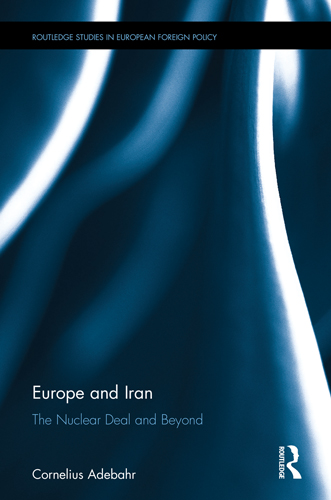
The EU’s approach to Iran is one of the few success stories of European foreign policy but is underappreciated by policymakers in Europe, the United States, and beyond.
Source: Routledge
This book aims to explain the specifics of the EU’s approach to Iran, taking into account both the complexity of European foreign policy, in particular within transatlantic relations, and Iran’s (aspired) place in the international order. It informs the reader about the special negotiation format that included a number of world powers as well as multilateral bodies such as the International Atomic Energy Agency (IAEA) and the UN Security Council. Furthermore, the book provides an outlook on European strategies after the 2015 nuclear deal and offers conclusions on the effectiveness of Europe’s multilateral approach to foreign policy. By looking at the EU’s diplomatic activities toward Iran over more than a decade, the book focuses on Europe’s role in international politics.
“The EU played an indispensable role in achieving a diplomatic resolution to the Iran nuclear challenge. Adebahr usefully identifies the factors that allowed EU foreign policy to deliver and what policy and institutional investments are required to build on the EU’s success at a moment of extraordinary political and geopolitical headwinds.”
—Ambassador William J. Burns, president of the Carnegie Endowment for International Peace and former U.S. deputy secretary of state
“In this much awaited book, Cornelius Adebahr provides a comprehensive and compelling account of the EU's greatest foreign policy success to date: The E3 + 3 nuclear deal with Iran. Adebahr convincingly highlights not only the significance of the deal but above all how and why the process of achieving it quintessentially reflected the "European way": the resolution of global problems through patient, at times stubborn, multilateral cooperation. A must read for anyone wishing to understand the EU's role in the world.”
—Nathalie Tocci, director of the Italian Institute for International Affairs
“Cornelius Adebahr has provided an invaluable contribution to the saga of the Iran nuclear deal by detailing Europe’s pivotal role in starting and maintaining dialogue with the Islamic Republic. This ‘coming of age’ for Europe as an international actor bodes well for safeguarding the nuclear agreement at a time of new tension between the US and Iran.”
—Barbara Slavin, acting director of the Future of Iran Initiative at the Atlantic Council
“Cornelius Adebahr is among the few people in the world who combines an intimate understanding of the politics of Brussels, Tehran, and Washington. Europe and Iran: The Nuclear Deal and Beyond provides a uniquely informed, dispassionate, and lucid perspective.”
—Karim Sadjadpour, senior fellow at the Carnegie Endowment for International Peace
“The Iran nuclear deal was hugely important for regional security, multilateral diplomacy and the global non-proliferation regime. Cornelius Adebahr masterfully explores the role of the EU in creating the accord and the role it must continue to play in sustaining, enforcing and expanding upon it.”
—Mark Fitzpatrick, International Institute for Strategic Studies
“The Iran nuclear deal, one of the most important diplomatic breakthroughs of the 21st century, proves that multilateralism is the best instrument to prevent nuclear proliferation and improve global stability. At a time when the international order is under strain, it is vital to bring the spotlight to the European Union’s approach to world affairs and preserve its achievements. With remarkable analytical skill, Cornelius Adebahr reflects on the links between the nuclear deal and the European Union’s role as a global actor, thus making an outstanding contribution to the study of security and international relations.”
—Javier Solana, president of ESADEgeo and former high representative for common foreign and security policy of the European Union
Book Review—Europe and Iran: The Nuclear Deal and Beyond
—Anoush Ehteshami, Global Policy Journal

Former Nonresident Fellow, Carnegie Europe
Cornelius Adebahr was a nonresident fellow at Carnegie Europe. His research focuses on foreign and security policy, in particular regarding Iran and the Persian Gulf, on European and transatlantic affairs, and on citizens’ engagement.
Recent Work
Cornelius Adebahr

Cornelius Adebahr, Barbara Mittelhammer
Carnegie does not take institutional positions on public policy issues; the views represented herein are those of the author(s) and do not necessarily reflect the views of Carnegie, its staff, or its trustees.

Are Germany’s economic, industrial, and political struggles becoming a liability for the EU’s ability to rise to the geopolitical moment?

Rym Momtaz, ed.

European Commission President Ursula von der Leyen is about to give her annual address on the state of the EU. Here’s what she won’t—but should—say.
Rym Momtaz

The aftermath of the Ceuta crisis shows Europe has drawn the wrong lessons. Rather than doubling down on failed migration policies, the EU needs to address the underlying roots of such episodes.

Richard Youngs

Canadian Prime Minister Mark Carney has twice inspired praise for standing up to U.S. President Donald Trump: at the 2026 World Economic Forum in Davos and on Canada-U.S. trade negotiations. Is Carney showing a third way better than the EU has in dealing with the Trump administration?
Rym Momtaz, ed.

The EU’s responses to two recent incidents expose the gulf between European perceptions and capabilities. Unless the union can bridge that gap, it will never become a real geostrategic power.
Rym Momtaz