

Commentary
Judy Dempsey
{
  "authors": [
    "Judy Dempsey"
  ],
  "type": "commentary",
  "blog": "Strategic Europe",
  "centerAffiliationAll": "",
  "centers": [
    "Carnegie Endowment for International Peace",
    "Carnegie Europe"
  ],
  "collections": [],
  "englishNewsletterAll": "",
  "nonEnglishNewsletterAll": "",
  "primaryCenter": "Carnegie Europe",
  "programAffiliation": "",
  "programs": [],
  "projects": [],
  "regions": [
    "Europe"
  ],
  "topics": [
    "EU",
    "Security"
  ]
}
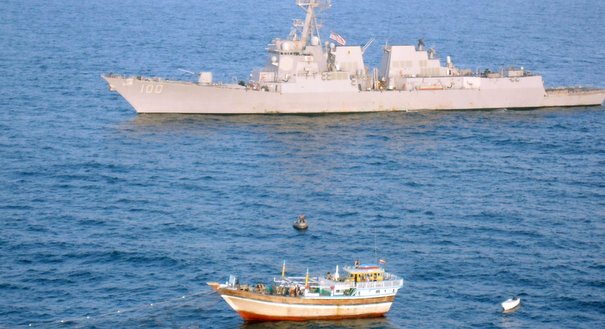
Source: Getty
Europe's decision to pursue pirates on land is no substitute for a long term strategy for the Horn of Africa.
Just before the Easter break, European military officials and diplomats approved an operation that goes way beyond the EU’s current mandate for NAVFOR Atalanta that was launched in 2008. Then, the aim was for European naval vessels to protect ships belonging to the World Food Program. NATO in the meantime has been trying to protect commercial vessels as costs for security and re-routing soar.
One Earth Future Foundation, a non-governmental organization specializing in global governance, reckons that during 2011 pirate attacks cost the shipping industry between $5.3 billion and $5.5 billion while the average ransom increased from $4 million in 2010 to around $5 million in 2011. And the number of hostages taken also increased, from 1,090 in 2010 to 1,118 last year.
But now, under a mandate agreed by the United Nations and the Somali Transitional Federal Government, the EU intends to chase after the pirates along the shores of Somalia’s Indian Ocean coastline and along some of the country’s inland waters.
This is a curious decision.
Military experts wonder how effective the pursuit will be, given that the EU wants to avoid civilian casualties under all circumstances. Political experts wonder how chasing pirates ties in to the overall political strategy and if even there is one. These doubts explain why the mission has not been met with overwhelming enthusiasm. Spain, Ireland and especially Germany had serious reservations.
German lawmakers will need to approve the extension of Atalanta when Chancellor Angela Merkel presents it to the Bundestag, or German parliament next month. (The German cabinet meets on April 18 to discuss it). Lawmakers are already asking many questions.
How deep into the shore will the helicopters go in pursuit of pirates?
“We can’t tell you the exact details but it will not be too far inland,” a spokesperson for NAVFOR Atalanta replied.
EU diplomats say the distance will be about two kilometers, ”That’s very far in,” one European Parliament lawmaker commented.
And how will the EU be able to distinguish between boats and equipment belonging to the pirates as opposed to those belonging to local fishermen?
“We have information about the pirates’ camps. We will be targeting logistic dumps close to the shoreline. That includes boats, fuel and ladders that are close to the shoreline,” NAVFOR added.
But what happens if the pirates use civilians as human shields against the EU helicopters?
“We are aiming specifically at the logistics of the pirates,” NAVFOR continued.
The EU will put no troops on the ground. It will drop no bombs or rockets. But it will use machine guns.
Germany’s opposition parties are not impressed with such details. The Social Democrats and Greens are expected to vote against the new mandate, as will the Left Party. It is even hard to see Mrs. Merkel’s center-right coalition agreeing unanimously. The defense ministry has some reservations.
Gernot Erler, the Social Democrats’ leading foreign policy expert and deputy parliamentary leader says the operation could turn into a Mission Creep.
Reinhard Bütikofer, the leader of the German Greens in the European Parliament, is more critical. “Attacking pirates' infrastructure on land, including from helicopters, doesn't make a lot of sense militarily once pirates start using human shields or moving further inland,” he told Carnegie Europe.
Mr Bütikofer was concerned too that the mission could lead to a high intensity conflict between EU forces and armed groups that have nothing to do with piracy.
As an alternative to the new EU missions, he proposes strengthening the legal dimension of counter-piracy actions by bringing pirates before strong and competent courts and doing away with the current catch-and-release practice.
At best, however, this would be a short term measure. Somalia is a failed state plagued with famine, instability, a weak government and powerless institutions. It is also a haven for Al Qaeda supporters.
The country needs a long-term policy to bring stability and jobs and end sectarianism. Catching pirates is not enough. Europe needs to do some hard thinking about its strategy towards the Horn of Africa.

Nonresident Senior Fellow, Carnegie Europe
Judy Dempsey is a nonresident senior fellow at Carnegie Europe
Recent Work
Judy Dempsey
Judy Dempsey

Before the next wave of EU enlargement takes place, the union needs to grapple with thorny questions of how power is distributed among its members.


Emil Sondaj Hansen, Ditte Brasso Sørensen

A summer of escalation in the Black Sea has hurt Ukraine economically and is exacerbating world food security. A truce is needed—as is a broader reframing of Europe’s Ukraine strategy.

Thomas de Waal

Are Germany’s economic, industrial, and political struggles becoming a liability for the EU’s ability to rise to the geopolitical moment?

Rym Momtaz, ed.

European Commission President Ursula von der Leyen is about to give her annual address on the state of the EU. Here’s what she won’t—but should—say.
Rym Momtaz

The aftermath of the Ceuta crisis shows Europe has drawn the wrong lessons. Rather than doubling down on failed migration policies, the EU needs to address the underlying roots of such episodes.

Richard Youngs