

Commentary
Judy Dempsey
{
  "authors": [
    "Judy Dempsey"
  ],
  "type": "commentary",
  "blog": "Strategic Europe",
  "centerAffiliationAll": "",
  "centers": [
    "Carnegie Endowment for International Peace",
    "Carnegie Europe"
  ],
  "collections": [],
  "englishNewsletterAll": "",
  "nonEnglishNewsletterAll": "",
  "primaryCenter": "Carnegie Europe",
  "programAffiliation": "",
  "programs": [],
  "projects": [],
  "regions": [
    "Europe",
    "Asia"
  ],
  "topics": [
    "EU"
  ]
}
Source: Getty
With its functioning multi-party democracy and significant mineral deposits Mongolia has become strategically important, but the country's president knows he has to improve the country's poor reputation when it comes to corruption.
There’s nothing like being sandwiched between two powerful countries to concentrate the mind of any leader, as Tsakhiagiin Elbegdorj, the President of Mongolia, well knows.
Mongolia, a country almost twice the size of Germany, is locked in by Russia to the north and China to the south.
Russia supplies it with oil, China with all sorts of other goods as Mr. Elbegdorj reminded a handful of journalists he met over breakfast during a hectic two-day state visit to Germany that began last Thursday.
Yet big and powerful neighbors aside, this sparsely populated country of 2.7 million that started breaking away from Soviet influence in 1989 has two big things going for it.
Despite its location it is a functioning multi-party democracy. That’s rare in this part of the world.
The second thing is that it is endowed with mineral deposits. They include copper, gold, silver and iron, coal and phosphates, but also nickel, zinc and wolfram, molybdenum, tin, tungsten, and other rare earth metals that are much sought after.
Indeed, with German industry seeking to weaken its dependence on China for rare earth metals, Mongolia has become strategically important.
The big question is whether the profits from these metals will be used for upgrading health, environment and transport services or be hived into private accounts held by officials.
I asked President Elbegdorj, 49, if he was worried that such newly found wealth might put a break on reforms and transparency and instead be used by those in power to acquire wealth and privilege.
After all, Mongolia has a miserable reputation when it comes to corruption.
The latest Transparency International Index on Corruption places Mongolia 120th out of 183 countries. On a scale from 0 (the worst) and 10 (the best) Mongolia measures 2.7.
“Look, we thought that once we had democracy we would have no corruption,” Mr. Elbegdorj said. “We were wrong.”
He seems to take the issue very seriously. He said that when he was elected, for a second time, prime minister in 2004, he sounded out the public for their views about corruption and which institutions were the most corrupt.
“The customs was the common answer,” President Elbegdorj recalled. He began cleaning up the customs, sacking top officials.
“But then I was sacked,” he said.
It was a very turbulent time. In 2008, after fresh parliamentary elections, former communist and democratic parties clashed. A curfew was imposed, public gatherings were banned and a news blackout was enforced, except for the state broadcaster.
Far from being demoralized, Mr Elbegdorj decided to run as president.
During the 2009 election campaign, he made the fight against corruption his main campaign issue.
He won.
It was by all account a fair and free election. Mongolia pulled itself back from internal strife that would only have played into the hands of its neighbors.
In power since 2009, Mr. Elbegdorj says he knows that he has to deliver.
He has signed Mongolia up to several international conventions, from combating corruption to complying with the Extractive Industries Transparency Initiative (EITI), the global standard for improved transparency in the oil, gas, and mining sectors.
Mongolia also has its own Anti-Corruption Agency. It is led by Bats Khurts, chief of Mongolia’s National Security Council.
Until last October, Mr Khurts was languishing in a German prison, after being extradited there from Britain for his alleged involvement in a murky kidnapping back in 2003 in Le Havre, France, of a Mongolian, Damiran Enkhbat.
Weeks before Angela Merkel was due to visit Mongolia, the first such visit by a German Chancellor, Mr. Khurts was released and now has a top job back in Ulaan Baator.
“I didn’t choose him,” President Elbegdorj replied quickly when questioned about the wisdom of having such a controversial figure in charge of such a high-profile post. “It was the parliament.”
That aside, President Elbegdorj certainly gave the impression that he cannot afford any backsliding on corruption. Indeed, he is banking on western companies and governments to help him.
Ever since the collapse of the Soviet Union, Mongolia adopted a “third neighbor” policy aimed at mitigating the influence of Russia and China.
In practice, it meant developing the closest possible relations with the United States and Europe.
Mongolia sent troops to Iraq, Afghanistan and elsewhere. It was duly rewarded. Former U.S. President, George W. Bush, visited Mongolia in 2005, becoming the first U.S. president to do so.
President Elbegdorj sees close ties, especially investments, as a kind of insurance policy, a guardian of the country’s democracy.
It’s as if he knows Mongolia’s democracy is not yet rooted deeply enough to withstand major shocks.
“It is all very well having so many political foundations coming in to tell you how to do reforms during the transition from a one-party state to a multi-functioning democracy. But its afterwards that matters. Democracy has to be tended to,” he said.
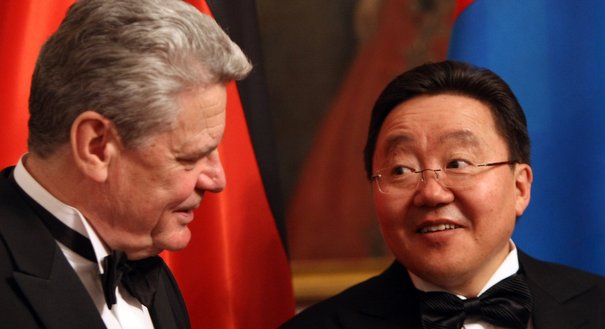
Which is why, when he met Joachim Gauck, the newly-inaugurated president of Germany last week in Berlin, President Elbegjorj said he asked him one thing. “Please invest in democracy.”

Nonresident Senior Fellow, Carnegie Europe
Judy Dempsey is a nonresident senior fellow at Carnegie Europe
Recent Work
Judy Dempsey
Judy Dempsey

Are Germany’s economic, industrial, and political struggles becoming a liability for the EU’s ability to rise to the geopolitical moment?

Rym Momtaz, ed.

European Commission President Ursula von der Leyen is about to give her annual address on the state of the EU. Here’s what she won’t—but should—say.
Rym Momtaz

The aftermath of the Ceuta crisis shows Europe has drawn the wrong lessons. Rather than doubling down on failed migration policies, the EU needs to address the underlying roots of such episodes.

Richard Youngs

An overwhelming victory by a far-right-wing party in a small state in eastern Germany will have major repercussions for Chancellor Friedrich Merz’s coalition.
Judy Dempsey

Canadian Prime Minister Mark Carney has twice inspired praise for standing up to U.S. President Donald Trump: at the 2026 World Economic Forum in Davos and on Canada-U.S. trade negotiations. Is Carney showing a third way better than the EU has in dealing with the Trump administration?
Rym Momtaz, ed.