

Commentary
Judy Dempsey
{
  "authors": [
    "Judy Dempsey"
  ],
  "type": "commentary",
  "blog": "Strategic Europe",
  "centerAffiliationAll": "",
  "centers": [
    "Carnegie Endowment for International Peace",
    "Carnegie Europe"
  ],
  "collections": [],
  "englishNewsletterAll": "",
  "nonEnglishNewsletterAll": "",
  "primaryCenter": "Carnegie Europe",
  "programAffiliation": "",
  "programs": [],
  "projects": [],
  "regions": [
    "Europe"
  ],
  "topics": [
    "Climate Change",
    "EU"
  ]
}
Source: Getty
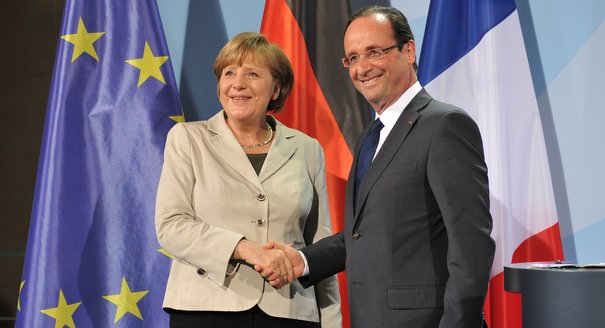
Merkel and Hollande know why they have to work together, and they will have to do so quickly if Europe is to emerge from the euro crisis.
Don’t believe for one minute that the two most powerful leaders in Europe will not be able to work together.
Of course, Angela Merkel knows she made a big mistake by putting all her eggs in Nicolas Sarkozy’s basket during the French presidential election campaign. I wonder what her advisors were thinking at the time?
Merkel’s decision was also out of character. Throwing caution to the wind is normally not like her.
So when it became clear that Francois Hollande was going to defeat Sarkozy, the Chancellery moved into top gear.
Merkel’s European policy advisor, Nikolaus Meyer-Landrut, a Francophone and staunch supporter of European integration, had little difficulty in reaching out to Hollande’s advisors.
Hollande himself, as early as last February, had dispatched teams to Berlin to obtain some sense of Merkel’s thinking but also to talk to federal lawmakers and foreign ministry officials.
In short, the ground was well prepared for last Tuesday’s meeting. When Hollande arrived in Berlin on Tuesday evening, Merkel was all bonhomie.
No one should underestimate her smiles, her gestures, and her ability to make her guests feel genuinely welcome.
When Hollande, flanked by Merkel, inspected the guard of honor, during a brief respite from the rain which had already drenched him back in Paris during his post-inauguration parade, Merkel chaperoned him very nicely. She guided him, with the slightest of pushes, to turn the corner of the red carpet and continue with the inspection. Then, a few seconds later, she gestured to him that they should bow together. After that, it was marching orders, with some guidance, to end the ceremony.
Then it was down to dinner, and business, in the Chancellery.
Both leaders know exactly how deep their differences over the euro crisis run: Berlin still believes in austerity measures to balance the books. Paris believes a dose of Keynesianism to be a necessary palliative.
But at the short press conference after their dinner both agreed they were looking forward to working with each other anyway.
Actually, the history of Franco-German relations shows that leaders from the opposite political parties get on far better that those of similar ideological inclination.
Helmut Kohl, a conservative, managed to establish a close relationship with Francois Mitterrand, a socialist. It was even closer between Gerhard Schroder, a Social Democrat and Jacques Chirac.
In contrast, Merkel failed to have any empathy with Chirac. And it took her a long time – and all the pressure of the euro crisis – to develop any kind of a relationship with Sarkozy.
But they never seemed to share that sense of historical necessity to use the special Franco-German relationship for European ends.
Hollande, a sober, calm, persistent man whose character suits Merkel far better than his predecessor did, might just produce that spark that is needed to modernize the Franco-German relationship in a way that will strengthen Europe.
The fact that he has chosen Jean-Marc Ayrault, a former German professor and Germanophile as his prime minister seems very promising.
Let’s hope that they will not forget the wider issues of foreign policy.
Of course, both leaders know they have to tackle the euro crisis. Both leaders also have their electorates to satisfy. Don’t forget that Merkel faces re-election in 2013 so she might be a bit preoccupied.
Nevertheless, Hollande and Merkel will have to also find some time to work out the kind of relationship Europe wants with Russia, Ukraine, and Belarus, not to mention Turkey, the Middle East, and China.
These relationships are too important to be kept to the bilateral and national interest level. Europe has to think strategically about them. The future of the continent depends on that.
This means that once Hollande settles into the Elysee, his foreign policy advisors must be given rein to engage Germany and the rest of Europe in drawing up a new Security Strategy. The euro crisis is important, but France and Germany cannot continue to hide behind. It is time to develop a new foreign and security policy.

Nonresident Senior Fellow, Carnegie Europe
Judy Dempsey is a nonresident senior fellow at Carnegie Europe
Recent Work
Judy Dempsey
Judy Dempsey
Carnegie does not take institutional positions on public policy issues; the views represented herein are those of the author(s) and do not necessarily reflect the views of Carnegie, its staff, or its trustees.

The EU can impose sanctions but struggles to enforce them without the United States. With Washington increasingly disinterested in backing European interests, the bloc must now fend for itself.


Nicu Popescu, Tiago Antunes

Russia is testing the waters of NATO’s mutual defense clause. What do strikes in Romanian territorial waters mean for the alliance’s posture toward Moscow?

Dimitar Bechev

With its public finances in shambles, the far right polling at 35 percent ahead of the 2027 presidential election, and a growing protest movement, is France’s crisis a threat to the EU’s geopolitical awakening?

Rym Momtaz, ed.

Ahead of a tough winter for Ukraine, Donald Trump’s swing back toward Russia bodes ill. But instead of panicking, Kyiv’s European allies are focusing on action.
Rym Momtaz

While the EU and European governments are embracing the much-lauded middle-power moment, this entails three difficult conundrums.

Richard Youngs